Backcountry Skiing Boot Dimensions
Our boot dimensions are taken from a combination of interior casting and interior shell measurements. Due to curves and other factors, consider our dimensions to be plus/minus several millimeters in accuracy. You may find it surprising how similar most boot shell dimensions are, meaning the lasting (shape) of the liner can have a lot to do with fit. To us, this simply means the services of a boot fitter are essential if you don’t drop immediately into a good fit. Thus, we feel that going through the trouble of measuring liners would be a waste of time and energy.
When using our data consider your foot shape and match as best you can to our shell dimensions. Examples: Large volume foot? Look at our overall impressions and dimensions and start shopping with a large volume boot. Existing boot cause blisters in a certain location and all your fitting has had little success in prevention? Pick a boot with different dimensions in your problem spot. Wide at ball of foot? Pick a boot with wider “metatarsal width.” Heel seems like it lifts up too easily in most boots? Pick a boot with a more pronounced heel cup and perhaps narrower heel cup width.
Above all, please use these dimensions as only a general guideline. Feet vary in infinite ways, and fit is a combination of hundreds of dimensions and factors. Custom boot fitting is most often the key. Evaluate with dimensions, pick a best-bet, try, and if necessary work with a professional boot fitter.
Again, we do NOT provide liner dimensions, as we feel liners are so easily customized and so flexible, their dimensions are nearly meaningless in terms of fitting a given boot to a given foot. This is especially true of all the heat mold liners out there. That said, in terms of how stiff you want a boot to feel it’s important to note any additional beef a given liner provides. Conversely, a stiffened liner can interfere with what appears to be a good wide-range walk mode in our charts. Also, if you’re prone to heel blisters it’s a good idea to note any “L-pad” type pressure points the liner may have. These can be skived out or compressed by a boot fitter.
Caveats:
1. To normalize things, we attempted to obtain boot shells that fit Lou’s feet, no matter what the stated mondo size range of the shell. This resulted in Lou downsizing boots such as the Tecnica Agent and Dynafit ZZero to one shell size below that used for the 28 liner. Lesson from this is it’s extremely important to size your foot to the shell, liner be darned. After that, work on the liner.
2. Heel pocket is tough to measure due to all the curves involved. We feel our measurements offer good comparison, but they’re not the type of dimensions you’d want to design a boot last with.
3. Our impression of overall volume is IMPORTANT. While it’s just a visual impression from our casts combined with comparison of a few measurements, it should be very helpful for people who’s feet fall at either end of the volume spectrum. Additionally, we’d recommend most skiers with unusually fat or skinny feet use custom thermo liners no matter what shell they pick. (Though they might make a stab at using the stock liners.)
4. Due to the advent of swapable soles, sole thickness for/aft, and chosen bindings, we are not keen charting ramp angle (delta). We have no idea how to standardize this other than measuring on a level table, as we do, even though variations in sole thickness and the type of binding you use can make big differences in delta. Luckily delta is easily customized if the boot has a removable boot board such as Scarpa’s. Delta is usually around 6 to 8 degrees, toe low, and is easily changed a few degrees by adding shim under the heel or forefoot.
5. Please know we will continue to refine this chart by repeating measurments and figuring out better ways to obtain such measurments.
Chart Key
Mond = Mondo size of shell we measured, at this time we do not have shell overlap information in terms of how all shell sizes create the full series of mondo sizes This information is usually available from the manufacturers. We will, however, attempt to note which sizes our test shell covers. To normalize, in most cases we measure the shell specified by the maker as working for a size 28.
Sole length = end to end as usually stamped on side of boot heel.
FL = Footboard length, measured from our casting of the boot interior. This is not a hyper critical measurement, it just gives you an idea of what shell might be slightly longer or shorter for our size 28 comparo.
HPW = Heel Pocket Width, measured 3 cm above footboard and 5 cm from heel cup.
PW = Pivot Width, measured between the cuff pivots (at points approximating the interior surface of liner, due to pivots being irrgular surfaces). This is done with boot unbuckled and is not a critical measurement, just intended to give an idea of how the boot is sized.
RW = Rear Width of footboard, 70 mm forward from boot rear. This is may be a critical measurement for folks who feel like boot pinch their feet in the area just forward and below the ankle joint.
MW = Metatarsal (ball of foot) Width, measured at widest point of mold in this area. Not measured at footboard, but rather widest point in boot shell.
CH = Cuff Height, measured from footboard just forward of cuff rivets, with cuff at level for/aft lean position, inside side of boot (outside of boots is frequently lower than inside, to reduce weight and add a bit of touring comfort). A higher cuff can make a boot feel quite a bit stiffer.
Arch = Height of arch built into shell or bootboard. Most boots have none or close to none.
VOL= Overall impression of volume. For now we’re on a scale of “less, average, more.” There is no magic standard for volume. Lower volume boots fit some folks better. Other people need max volume, still others are average. Again, due to the similarity of most boots in terms of interior shell size, know that a boot fitter can work wonders if you need extremes in less or more volume.
IH = Instep Height just forward of instep break, an approximate dimension as buckling boot changes this. If you have a high “bump” on top of your foot, more of this could indicate a useful fit factor, conversely it means the boot has more volume in this area. Liner thickness is of course a major compensation for volume in this area, and can easily be changed by a boot fitter.
RA= Ramp Angle, measured with boot on flat table, AT soles on boots with swap soles. Also known as “delta,” ramp angle is created by difference in height between toe and heel.
CL= Cuff Lean angle when locked, in degrees, in relation to the footboard. In the case of two settings we’ll use a slash, e.g., 6/10. It is actually quite difficult to measure this. We did so by inserting an oversized carpenter’s angle gauge in the boot, resting one arm on the bootboard, then eyballing the “blade” of the device so it appeared to match where the vertical axis of person’s leg would go. As with our other measurements, use as comparison rather than absolute. The CL will appear as a lower number than you’re used to seeing. That’s because the total forward “lean” of a boot is a combination of cuff lean and ramp angle, along with liner spoiler thickness, usually resulting in numbers in the vicinity of 17 degrees, but varying due to binding delta, lower leg shape.
CT= Cuff Travel is the amount the cuff is able to move rearward starting from what we felt was the farthest forward practical limit (this starting point ends up being fairly similar due to ergonomics and boot design). Using a cold hard measurement for this may sound great, but the interior boot shape and the size of your leg and make big differences in cuff travel, so only consider these numbers a guideline. Boots with similar CT numbers may feel more different than you’d expect, and you’ll only know that personal feel by trying them on. Please know that manufacturers measurements of this are taken from their own choice in starting point.
(All measurments in millimeters and degrees, for weights, please see our weights chart.)
| Black Diamond Factor – Shell for Mondo 27/27.5 – Shell Length 318 | ||||||||||||
| FL | HPW | PW | RW | MW | CH | Arch | Vol | IH | RA | CL | CT | |
| 280 | 71 | 88 | 73 | 102 | 240 | 0 | Average | 100 | 6 | 12 | 12 | |
| Adjustable forward lean, we used middle position. Forefoot area is high. Removable footboard. Very alpine-like, limited cuff travel for touring. | ||||||||||||
| Dynafit ZZero - Shell for Mondo 27/27.5 – Shell Length 306 mm | ||||||||||||
| FL | HPW | PW | RW | MW | CH | Arch | Vol | IH | RA | CL | CT | |
| 280 | 75 | 86 | 65 | 103 | 212 | 0 | Average | 100 | 6 | 6/10 | 23 | |
| One of the best for power/weight ratio, carbon stringers add beef without weight. Lou’s fave. Forward lean has two positions, is not adjustable. | ||||||||||||
| Dynafit ZZeus - Shell for Mondo 28/28.5 – Shell Length 322 mm | ||||||||||||
| FL | HPW | PW | RW | MW | CH | Arch | Vol | IH | RA | CL | CT | |
| 285 | 76 | 90 | 65 | 105 | 245 | 0 | Average | 116 | 7 | 8/12 | 25 | |
| Average volume, thermo liner with lots of padding and somewhat narrow factory molding might cause mistaken opinion of this boot being on the excessively narrow side. Excellent cuff travel. PU shell is super stiff. Another alpine-like boot. Forward lean has two positions, is not adjustable. | ||||||||||||
| Scarpa Skookum - Shell for Mondo 27.5/28 – Shell Length 313 | ||||||||||||
| FL | HPW | PW | RW | MW | CH | Arch | Vol | IH | RA | CL | CT | |
| 287 | 78 | 86 | 66 | 107 | 225 | 4 | More | 103 | 9 | 9/13 | 25 | |
| Larger volume, removable and customizable footboard makes Scarpa much easier to fit than in previous years. All fasteners on boot are user removable, nice. Cant rivets on both sides, combined with footboard that makes this one of the most customizable boots out there. Nice system for adjusting forward lean. | ||||||||||||
| Tecnica Agent AT - Shell for Mondo 27.5 – Shell Length 318 mm | ||||||||||||
| FL | HPW | PW | RW | MW | CH | Arch | Vol | IH | RA | CL | CT | |
| 290 | 74 | 85 | 70 | 103 | 245 | 0 | More | 112 | 6 | 7 | 25 | |
| Larger volume, extra length due to pronounced big toe cup and deep heel pocket. Less delta and less FL (forward lean) equals easily perceived less forward lean during field testing, i.e., very upright, and is not adjustable. Somewhat stiff overlap boot. Well liked by some skiers, others find the fiddly lean lock and upright stance to be downsides. We downsized shell to match our standard length/fit. Shell plastic is somewhat soft. | ||||||||||||
![]() |
|
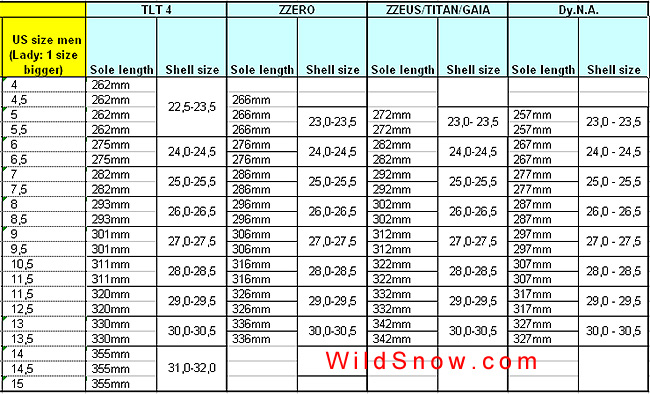
Dynafit sizing chart – 2009
|
![]() |