Tire Chains — Thule Easy-fit CU-9 — Review

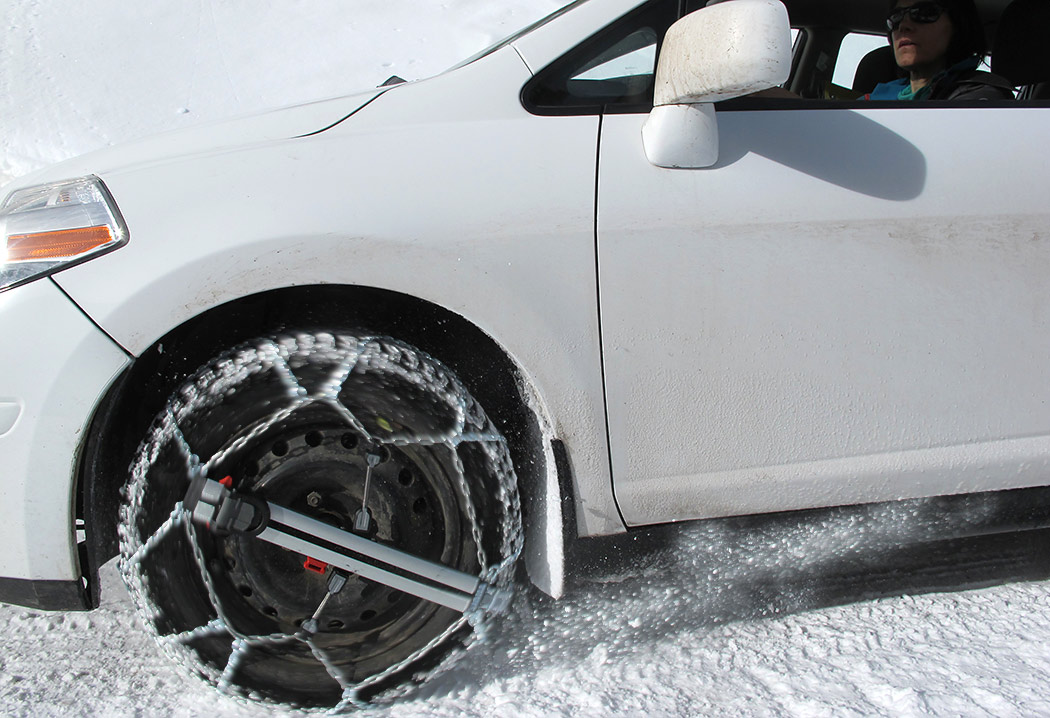
Thule Easy-fit tire chains on the WildSnow green-mobile. Substitute for agro snow-tired pickup with a winch? Close. (Click all images to enlarge).
Put your tire chains on in 12 seconds? That’s what Thule claims you can do with their Easy-fit version of the time honored traction device. I’m here to tell you that 12 seconds might be a little optimistic in real world conditions. Still, after a couple of practice sessions, getting these things wrapped around your meats in a minute per wheel is not an unreasonable expectation. Check ‘em out.

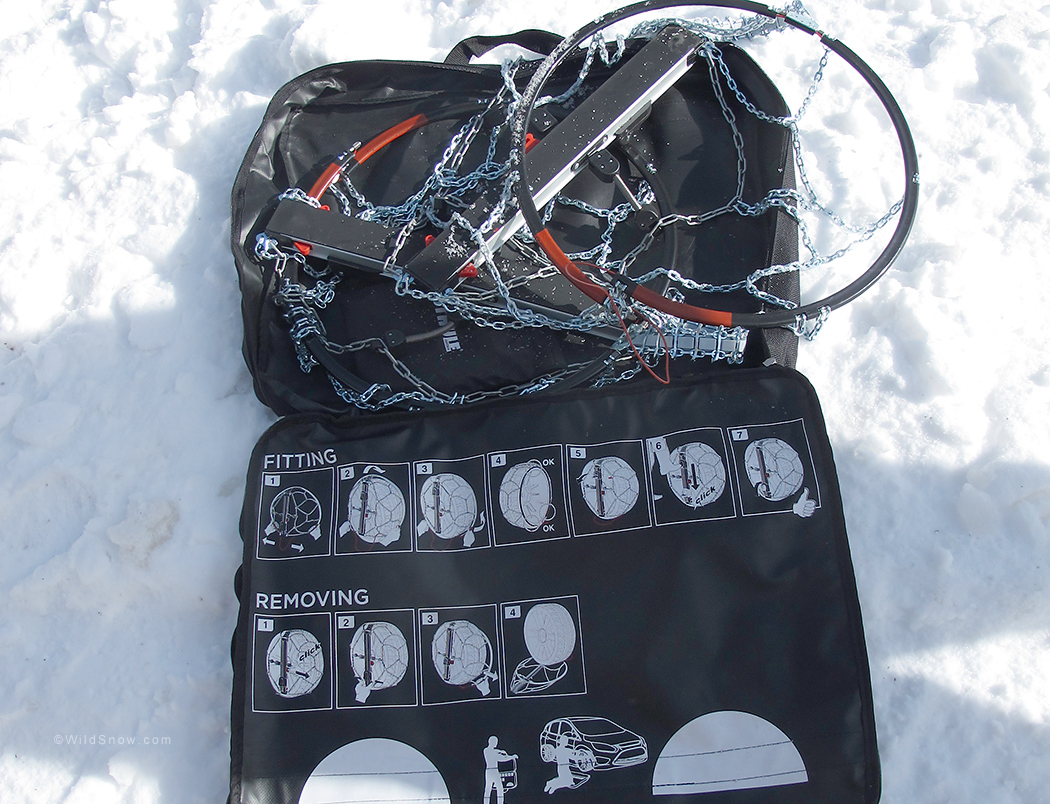
This may look nearly as scary as a conventional tire chain you pull out in a tangled pile, but these are different. Thule chains in nice case with easy to follow directions. And they don't seem to tangle.
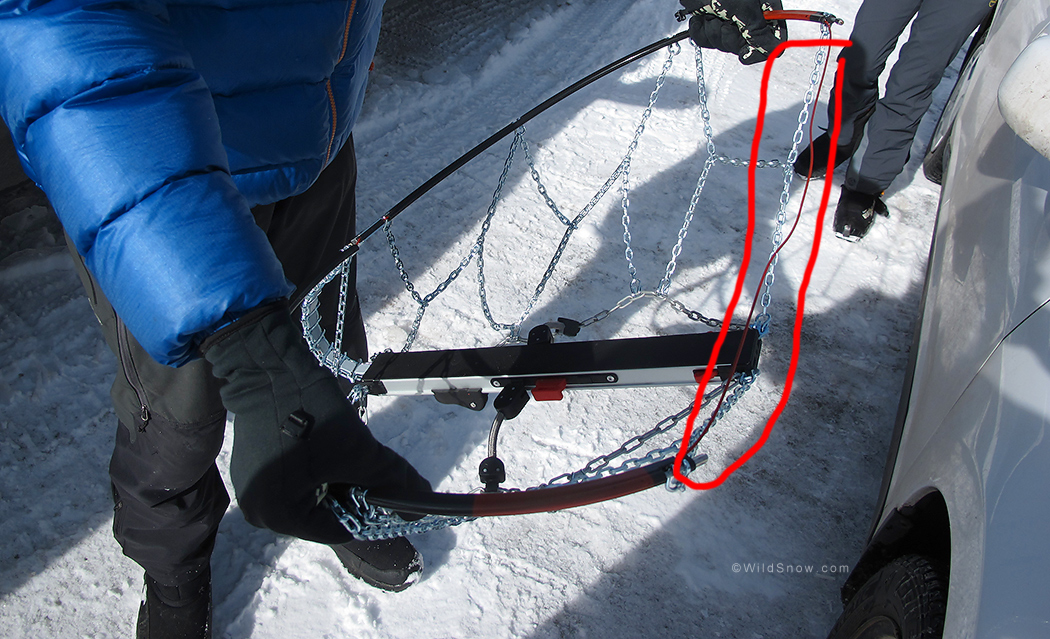
Thule ready to install on Nissan Versa for backcountry skiing access. Basically, you slip the hoop over the tire so it's around the inside, with the thin cable down at the bottom slipping under the tire as much as you can get it to. Once the cable is started under the tire, the rest is nearly automatic. Quite amazing to watch, really. Sure, some readers might have used 'hoop' chains that facilitate wrapping the tire, but these go beyond that basic step.
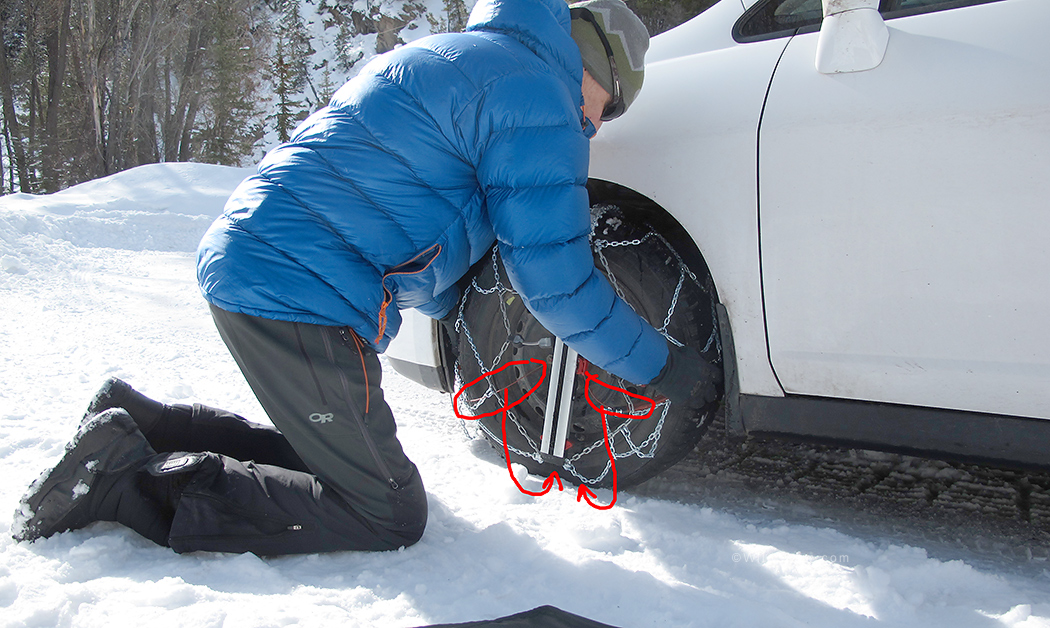
Only my second time, it took me a bit of fiddling to figure out exactly how to get the hoop applied inside, and the thin red cable worked in under the tire's contact patch. A few times later, I had it totally down.

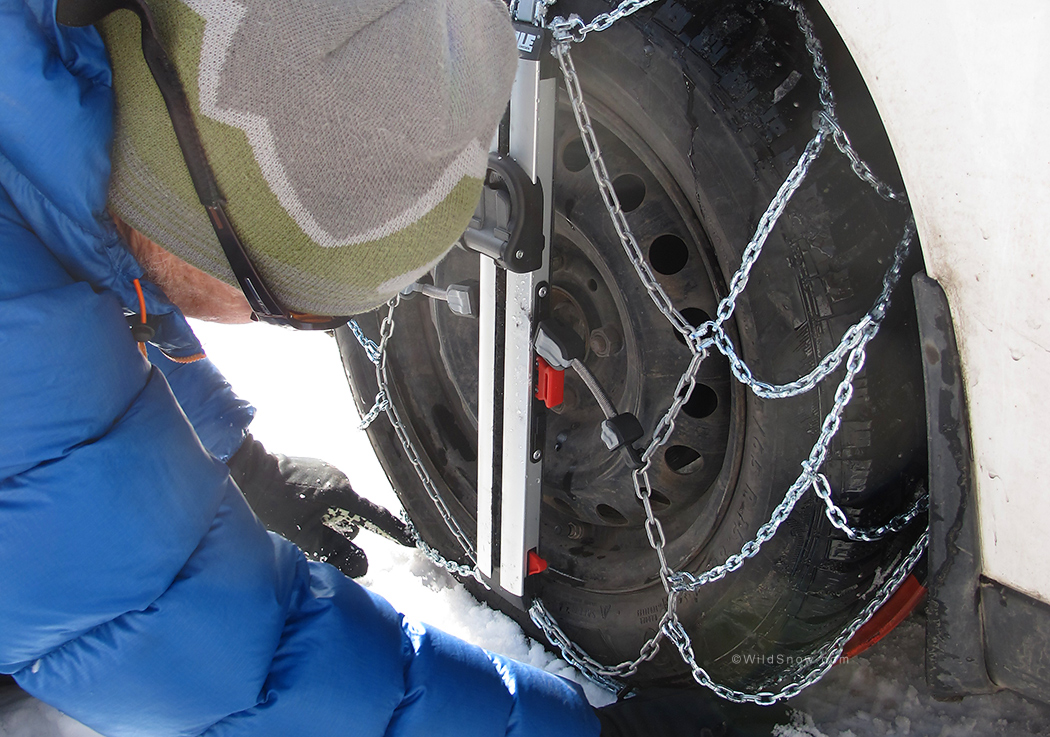
Here I've got the hoop behind the tire, and am getting the cable located underneath. This is all happening in mere seconds.
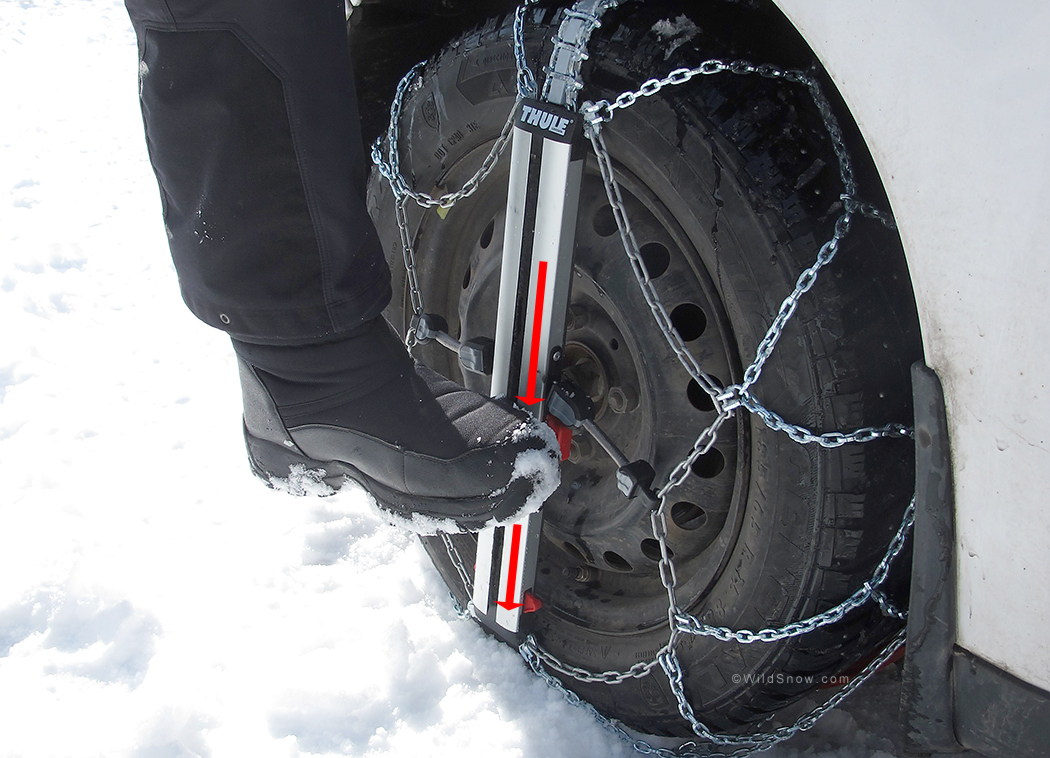
Next, you fold out a small step and stomp on it. This is where the tricky engineering is. Your stomp tensions a spring inside the metal rail. When you drive away you hear a satisfying series of clicks as the spring pulls the small red cable around behind the tire and everything tensions properly. In our view, it was necessary to drive a few hundred feet then get out and inspect the install. Chains that come of your tires do bad things to inconsequential parts such as your brake lines, so good to be careful.
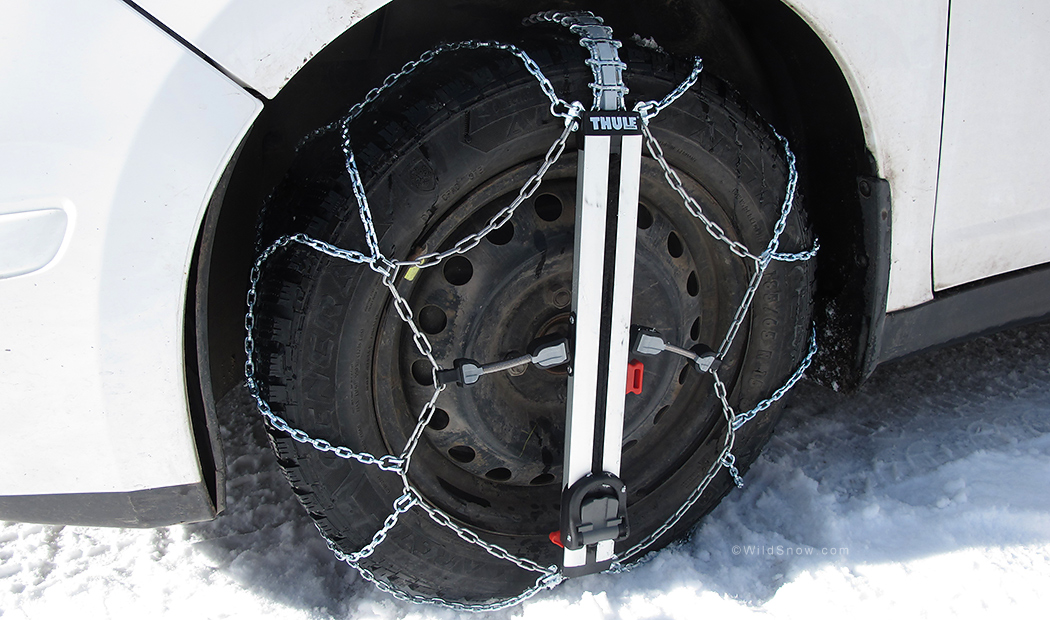
The one question, how will the tensioning system hold up in a rut or trench? Jury out on that, but if you watch where you're going you should be ok. Besides, small econo cars have so little ground clearance you don't want to be jabbing ruts anyway. These chains would work on a more beefy vehicle such as a Subaru, however, so consider how they'd behave in ruts before you max your credit card. These things are expensive, so they need to be useful. (Click all images to enlarge.)
Other features and concerns regarding Thule Easy-fit tire chains: An attempt is made at rim protection, though we suspect you’ll still create some blems if you ram your chained tires into tight ruts. Ditto for the tensioning system, which could be damaged if you encounter the type of deep icy trenches that occur on roads that don’t get a lot of snow plowing. Removing the chains is easy. You press small red tabs, tension releases. If you’re on snowpack you can sometimes drag the chain completely off without moving the vehicle, by slipping the thin cable out from under the tire as you pull the chains off (requires positioning by driver). On harder surfaces, you get everything to the outside except the cable, then have the driver move a few feet. The chain easily comes off after that. Whatever the case, with a small amount of experience removal literally does take seconds. Another downside is price, but if you challenge your Prius or other Euro scooter to reach back road trailheads, Easy-fit chains could change your life.
Comments
24 Responses to “Tire Chains — Thule Easy-fit CU-9 — Review”
Got something to say? Please do so.


Dear Wildsnow – I LOVE your automotive coverage. As much as I want to devote my life to climbing mountains on my own two skis, it turns out I frequently need a car in my life.
I’ve been considering these Thule Chains for a while, and am now convinced – I feel you could objectively offer a link for me to buy these online and earn a referral without sacrificing your journalistic objectivity – just a comment.
Since I respect your opinion on these matters, and because I think I’ve read this here and elsewhere, I was wondering if you could tackle the concept of ‘All Wheel Drive Sucks in the Snow’ or refer me somewhere to decide for myself.
More specifically, I need a new car. 99.9% of this car’s purpose is to drive around urbanized areas. It needs to hold (not yet existing) kids and a dog.
I want this car to safely transport all of us to Tahoe in the snow 4 times a year.
My first instinct was a Subaru Forester – great long term maintenance, but not so great gas mileage (because of the AWD).
I’d love to see an article that more or less tackled this.
Thanks!
Rob S.
Rob, that’s interesting. I can tell you what you already know: Any car will first benefit from the most agro studded snow tires you can wrap on the wheels. All wheel drive helps, but it makes no difference in stopping distance, nor does it help much in cornering unless you practice. Thus, tires are just so important.
Beyond that, personally I would always buy all-wheel drive but we live and drive in the snow all winter. For 4 trips to Tahoe I stick the best tires you can on there, carry chains, and don’t worry about all-wheel drive. On the other hand, if you can afford the extra gas and cost, why not? Where it’s most useful is getting in and out of parking areas, but the bad days on Donner make it worth it as well.
Pencil out exactly how much more that AWD will cost you in fuel per year. That can be an eye opener — it’ll either be less than you suspect, or perhaps more, but you might as well be realistic.
Lou
P.S., at the cost of these Thule chains, be aware that it could get expensive using them for situations where you end up on pavement with no place to remove them. In my view, they’re more for short distances in situations where you know for sure you’ll be on snow. Lou
Thanks Lou!
It looks great and very practical, my only concern is that the mechanism doesn’t look like it would last very long….Thanks for the post!
Just to belabor your “PS” to make sure I understand it correctly -
You DO NOT recommend these as ‘Highway Chains’ because their cost out-of-the-box is too high?
My motivation for these things is to spend as little time as possible screwing around on the side of the highway.
Little cars like lou’s work great with “wall-to-wall” studded snow tires in general winter driving conditions. Not sure about studies, just what I see around AK.
Have a mat with you so you don’t get your pants dirty when messing with chains. Get a bigger box to store your chains. The manufacturer’s box/bag is too small with most of these chain kits.
Finally, telemarkers typically bend to one knee when chaining tires.
Why wouldn’t they work as highway chains?
Subarus and the like tend to have better clearance, which is nearly as valuable as the AWD. I have used a 5 year old version of the Thule chains on a Passat wagon and found them easy to get on, even in a few inches of loose snow, with bare hands, and have had to circle back to help dig out friends with pseudo-4wds who did not have good tires. But, on broken pavement and dirt roads, or sometimes parking lots, the Passat has real limitations, particularly if there’s a full load of adults making the clearance even less.
SR, super super good point. That’s where our Nissan Versa is really a problem, several inches less underneath than something like a Forester.
Regarding the highway use of the chains, it’s sometimes inevitable you’ll hit pavement. When you do, the less beef you have in the part of the chain that makes contact, the shorter they’ll last. Like many other lightweight chains, the Thule are not beefy. Thus, they could wear out pretty fast. They are expensive. Thus, I’d think one would want to be careful where they were used so you didn’t end up getting forced to drive some distance on pave. For example, if you were on a limited access highway where stopping to de-chain would be dangerous.
They are quick to take off. Literally seconds once you practice a few times.
Lou
Hey Lou, completely off topic but do you still have your bumblebee Jeep?
That thing is sweet!
Sure, it’s Rumblebee… not out jeeping as much as we used to, since WildSnow.com is a full time year-around job! But we do use it during summer for a bit of 4-wheeling as well as cabin work. Lou
Nice. I just picked up a 87 toyota truck that I’m planning on restoring and turning into a “crawler”. A buddy has a few of them and I’ve got to admit, going 2 miles per hour can be a darn good time.
Lou: In 1988 I bought cheapo tire chains for a VW Jetta in Austria similar to Thule CB 12, but they had rings for the backside of the tire. I ran those for 4 winters without failure, sometimes on the autobahn. IMHO the cheapos are justified because you only pull them out a few times each year.
George, yeah, I’ve used those Euro type hoop chains a number of times. Never ran them at 140 KPH on the ‘bahns, however…
Hey Rob S, concerning Lou’s advice to buy “the most agro studded tires”;
while I agree with buying “killer snow tires” I’d might take issue with the agro part. and the studded part.
I’m totally sold on studless snow tires, especially for snow covered pavement. If you’re driving around the city most of the time with only four trips to Tahoe the studs are mostly wasted. My experience is with my wifes honda ciivic, first with studded (admittedly cheapo) tires, versus now with first rate (nokkian hakkapalita) studless tires. With the cheapo studded that damn thing would spin tires in 2″ of slush in Portland’s west hills it was a nightmare up in the mountains. I thought for some reason the newer civics just couldn’t handle the snow. But after 4 years she finally wore down the studs and finally listened to me and got good tires. Now with the hakas that thing drives almost as good as my old mountain girl, a corolla all-trac.
The tires make all the difference! The soft rubber that all good winter tires use is the secret. Blizzaks, nokkians, winter ice, all those use soft rubber with a lot of sipping (mini grooves all over the tread) to make the tire grip the snow and ice. With them I’ve slipped and fell the minute I stepped out of my car because the ice was so slick but I’d just driven safely over the same ice!
I have fond memories of my VW beetle on all-season tires getting me up to Targhee all winter long. No problem with traction, ditto the low clearance. That invincible little car just seemed to surf along, no sweat. Sure coulda used a heater though, but Canadian blood can withstand pretty low temps.
I recall I had a cheap roof rack on that VW, served me well. Some years later, Thule came up with a roof rack that was priced higher than what my VW was worth. So, trust Thule to come up with expensive chains. Reminds me of when Starbucks invented the $5 cuppa coffee, so many years ago. I don’t doubt the Thule quality, I just can’t bring myself to buy their stuff.
This decade, I’ve been driving a 2WD Previa with good all-season tires; I carry chains for the few times I need them. Helps to have ~50 years experience of driving on snow.
Roger, studs or not is of course an eternal debate. So your point is a good one. But one thing stands to reason, if you’re going to compare, you’d need to run one set of the same make/model tires with, and one without. I’ve done that over the years, and I still like studs. They do nothing on snow, but we get glare ice in dangerous places where we could skate off cliffs and stuff like that, and the studs do what I need — along with the good rubber and good design… I simply do not get as good performance on ice without studs.
Lou
lou,
I’m sure you have a lot more experience than I and if you did the tire comparison with your usual flair I’d bet on your opinion being good. My experience was comparing obviously poor studded tires to top end studless, so it’s really a “garbage in, garbage out” kinda comparison. All the serious articles I’ve read agree with you that the studs are better but in my limited experience not all studded tires are equal. My mistake was in letting my then girlfriend go buy tires on her own without giving her consumer info first. My now wife knew to ask for nokkians the second time around.
But for I’ll stand by the idea that studless are much better for city dwelling weekend warriors. I found the sound and vibration of the studs on dry pavement annoying and it seemed to know the mpg of the civic down by about 20%. You think that’s possible? It could have been the cold weather gas (nitrogenized or something?) that was forced on drivers in the NW, not sure, but the civic’s mpg sucked all winter
Roger, My wife has a Subaru and we run all seasons two thirds of the year and studded snows the other third or so. The car really seams to drive slower with the studded snows on. They are the same size tires, but there are a lot of variables, such as carcass stiffness, rubber durometer, tread pattern, and the studs. We don’t mind the road noise and slow driving in the winter time though.
On my SUV, I cannot compare the differences since I go from big mud tires to snow tires and they drive so differently
I had spike spiders on my passat for washington and they were super easy on and off, much more so than these appear to be. About the same price too.
Now living in MT and have a forester without snows, but it will have them next year likely studless. Forester is fine in the snow, but I would worry about fitting a car seat if you are tall, the seat already doesn’t go back far enough.
I’ve always appreciated your willingness to try stuff like this out, stuff that I would probably not even think about using due to price, uncertainty or whatever. But then again, I’m cheap. Heck I even kept my BFG AT’s with 60,000 miles on all winter. But, that being said, thank God for 4 hi and lo.
As far as AWD, I’m really impressed with how our newer Suby Forester does in the wintertime around here, even with just plain ‘ol all season tires. I’m willing to sacrifice a few mpg’s for that, but I think we still average around 29mpg with mellow driving. I’m guessing with chains the Suby would be pretty remarkable up something like the Quarry Road or wherever.
I used to have a Chrysler Neon that I used Nokian Hakkapalita’s on, and, it was like the thing was half snowmobile. I can remember going down roads covered in deep snow, and, it was flowing over the windshield so that I couldn’t see where I was going.
Lou; how did the retreads on the truck work out? My Blizzaks are now on my “not recommended” list.
Bar, the retreads are doing well so far. I’ve been rotating them at 3,000, and have not put many miles on them. I’m not expecting them to wear particularly well as they are indeed soft rubber as well as having the walnut shells and glass particles that cause even faster wear. They grip nearly like chains, in that respect we love them. Have not had to use the winch or tire chains once yet this winter. Lou