
Gear for backcountry skiing.

Mountain Equipment Glacier 1000 Sleeping Bag – Review

Bookmark and Share
This post by WildSnow.com blogger  

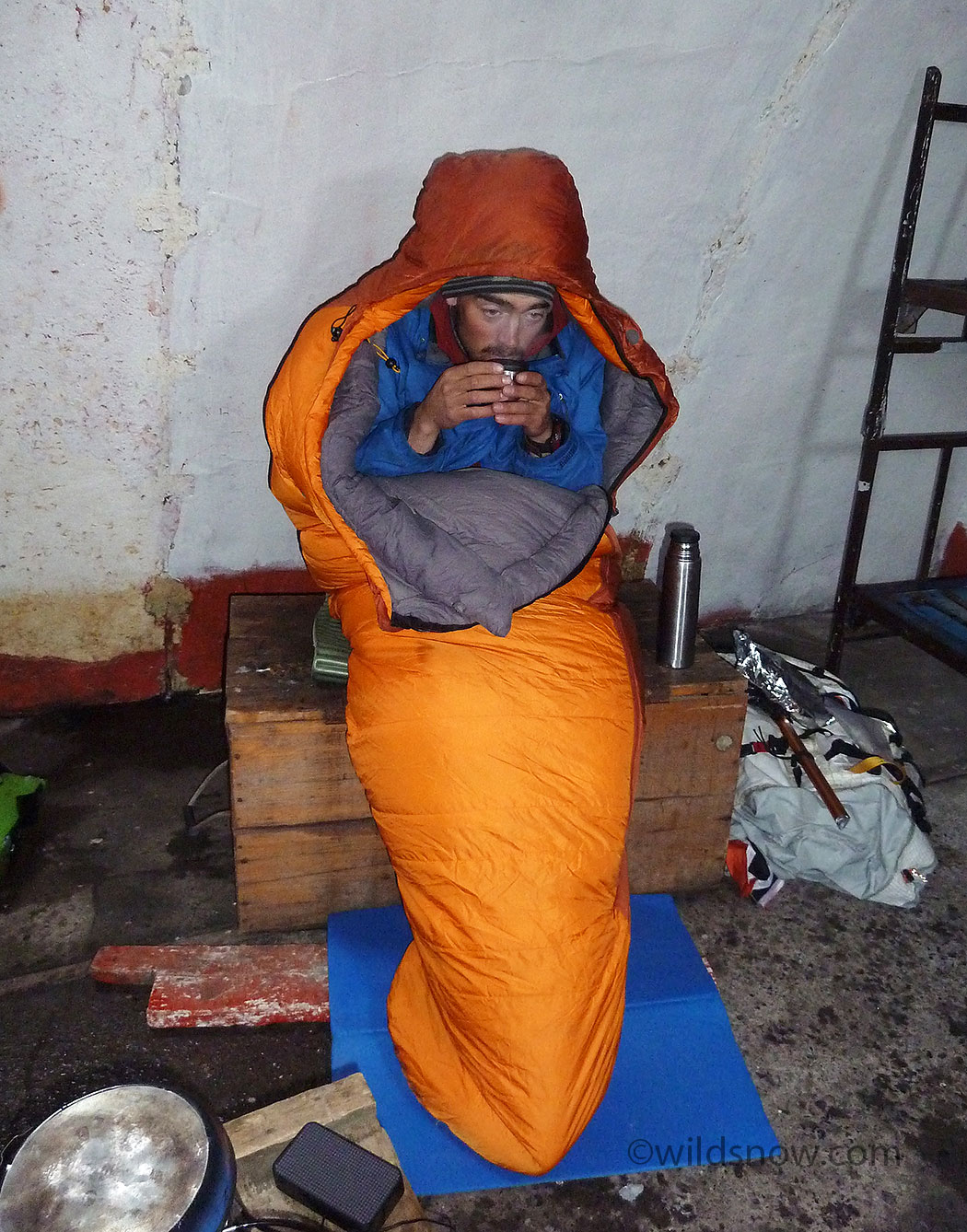
Plumage keeping me warm in the Refugio Militar on Volcan Lanin.

I haven’t owned a down sleeping bag for a few years now, being willing to carry the extra weight of a synthetic bag in order to reap the benefits. For backcountry shelter I usually use a lightweight Megamid tent, or a bivy sack, both of which don’t protect my sleeping bag from 100% of the elements. Therefore it’s nice to have water-resistant insulation.

I’ve had my latest synthetic bag for about six years. Consequently it is worn out. What once was a zero degree bag is now probably closer to a 15, although with a few extra layers I’m able to make it work. Yes, synthetic fill deteriorates — especially when forced through hundreds of tight compression cycles.

For my recent trip to South America, I didn’t know what to expect as far as sleeping arrangements, or what the temperatures were going to be. To be prepared for the worst I wanted a warm sleeping bag, but I also knew I’d need all the help I could get to stay under those 50 pound baggage limits. I decided to acquire a new down bag.

The Mountain Equipment Glacier 1000

I settled on the Mountain Equipment Glacier 1000, a -15° celcius (5° farenheit) bag. Mountain Equipment has been selling sleeping bags in the States for a little over a year, although they’ve been making nice sacks for quite a while on the other side of the Atlantic. Fun to check out a new brand.

The Glacier 1000 has 1000 grams of 675+ down (click here for more than you ever wanted to know about that). The total weight comes in at 1650 grams (3.63 lbs), on the hefty side for down bags, but still light, and I wanted a heavier-duty, durable bag for traveling. It also has water-resistant shell fabric, something I definitely wanted in a down bag. Other features include a full-length zipper, draft collar, and an anatomical footbox.

I got the new bag a day before I flew out and quickly packed it up. It wads down fairly small, especially compared to my old synthetic bag. I chose to use a lightweight dry-sack instead of the included compression sack. Unfortunately by the time the airport got done with it, the dry-sack had a big rip in the side. Oh well, so much for that plan.

A few days after arriving in South America we camped at a low elevation. It wasn’t very cold, but dew covered us every morning. The shell fabric got damp, but it kept out most of the moisture. The down would get a bit wet if I stuffed the sleeping bag before drying out the wet exterior. Although the temps at that camp were too high for a 5 degree bag, the full side zip kept me comfortable. Down bags definitely have a comfy, fluffy feeling, and the Glacier 1000 also features an extra-soft lining that enhances that.

Throughout the trip I spent thirty nights in the Glacier 1000. I slept in a variety of situations: beds, floors, warm huts, cold huts, camping in the open, and everything in between. Although we didn’t encounter super cold temps, it was nice to have the warm bag just in case. A few nights got chilly, and we also encountered some fairly windy conditions (it was southern South America after all). The water resistant shell also does an admirable job of keeping out the wind, something that can make any sleeping bag chilly. I wasn’t cold once, at least after being in the bag for a few moments to warm up. (Mountain Equipment bags are made to the EN 13537 standard which ensures they are as warm as they say.)

Another reason for down bags is durability. A synthetic bag, while cheaper, will invariably wear out after a few years. Down, however, will keep it’s loft for decades if it’s cared for correctly. The Glacier 1000 has a fairly durable fabric exterior, while the interior is a softer, more fragile fabric, although still adequately durable. The build quality of the bag is superb which is a huge factor with longevity.

There were of course a few cons with the bag as well. The major one for me was the draft collar. I don’t find myself using draft collars a whole lot, but when you are right at the temperature limit of the bag they can be useful. The draft collar in the Glacier 1000 has a weak elastic drawstring. Although this makes it more comfortable and less restricting, it also decreases the usefulness of the collar. I found I couldn’t tighten it enough to effectively block airflow, somewhat negating the purpose. Also, the Glacier 1000 is an all-around bag, a good value that you can use for lots of styles of trips. Yet consequently it is a little heavier than some down bags of equal warmth. If you’re looking for an ultralight bag, this one isn’t it but Mountain Equipment makes several series of bags, some lighter and some with more weather proof options.

My first trip using a down bag in six years didn’t leave me soaked and frozen. The Glacier 1000 lightened my pack and handled a variety of conditions in South America. I think it will hold up well to the harsh North Cascade winter as well. I’m looking forward to testing it out in those conditions.

Shop for down sleeping bags.

Comments

8 Responses to “Mountain Equipment Glacier 1000 Sleeping Bag – Review”

  1. See October 12th, 2012 7:40 pm

    I’ve wondered for a while if different fill power downs differ in ways other than weight to volume ratio. Specifically if higher fill power is always better (if cost is not considered), or if lower fill power down has any advantages, like maybe being less compressible and therefore better for use as a midlayer (maintains loft under pressure).

    Also, I’ve read that the European method for measuring fill power is different from the US method (as in boot stiffness, the numbers may be of limited usefulness).

    Also, also, I really enjoyed the South America trip reports. My hat is off to you guys; not just for the mountaineering, but also the writing and photography.

  2. Lou Dawson October 13th, 2012 6:33 am

    See, glad you enjoyed our SA content!

    As for fill powers of down, there might be some small advantage to using lower fill-power down in applications that need compression resistance, but I doubt the advantage is significant. Thing is, you start using the lower fill-power stuff and you get a lot closer to equivalence with things like Primaloft.

    Regarding the different fill power rating systems (European and “US”), the “US” standard is the one most gear makers around the world use and is the standard promulgated by the IDFL, who does most of the independent testing both in North America and in Europe.

    http://www.wildsnow.com/7994/international-down-feathers-lab-idfl-visit/

    Lou

  3. john nobil October 13th, 2012 7:46 pm

    would like to see a long term report on this new “dridown” synthetically coated water-resistant down. just ordered one myself:

    http://www.backcountry.com/sierra-designs-zissou-0-hi-600-fill-dridown-sleeping-bag-0-degree-down

  4. shem October 15th, 2012 9:06 am

    Great blog. I use a ‘Mammut’ down bag, and have slept in it, down to -10 approx, but not in the wet, always under some form of cover. Im really pleased with it, and find it pretty light as well.

  5. Bryce October 15th, 2012 1:55 pm

    As a lifelong Northwest outdoorsman, my enthusiasm for the lovely, expertly crafted range of high-end down products available to the modern mountaineer tends to be “dampened” by the memory of that stream that developed in the middle of the night through the middle of my tent in the Hoh Rainforest one night, turning my dad’s Korean war-era bag of chicken feathers into a mild case of hypothermia… I’ve subsequently learned that a wet synthetic bag is very nearly as unpleasant on a few occasions in the Army, but still better, and can be dried out easily the next day. Last summer while I was in the market for a new bag, as tempting as those lovely bags from my local Feathered Friends outlet store were, I had to go with synthetic. The problem is, most of the best materials are reserved for use in the high-end down bags. I ended up using my Seattle Mountaineer’s 40% discount on the EB Karakoram Igniter 15° for my uses and have been quite happy with it. http://www.eddiebauer.com/catalog/product.jsp?ensembleId=42700&&categoryId=28783&categoryName=SLEEPING-BAGS&pCategoryId=5&pCategoryName=BAGS–GEAR&gpCategoryId=1&gpCategoryName=EB&catPath=~~categoryId=28783~~categoryName=SLEEPING-BAGS~~pCategoryId=5~~pCategoryName=BAGS–GEAR~~gpCategoryId=1~~gpCategoryName=EB&viewAll=n&pg=1

  6. Stevie D October 15th, 2012 3:47 pm

    Louie looks like he just got out of a concentration camp in that pic!! :-)

  7. Jim October 15th, 2012 10:09 pm

    What do think pro/con on bag vs quilts. I’m shopping now, I like how light quilts are, but when it gets near 0F, any breeze in the bag is a serious situation. Not sure how well a quilt would work in real cold.

    I got an old EB-40 bag, its 40 years old, works great to below 0F, but weighs 7 lbs, uggh.

  8. Brazilian hair October 16th, 2012 4:37 am

    I’m a spammer who visits at night, skulking around like a criminal. But you might like my hair products.

Got something to say? Please do so.


Anti-Spam Quiz:


If you need an emoticon for a comment just copy/paste off the following list, or use text code you might be familiar with.
:D    :-)    :(    :lol:    :x    :P    :oops:    :cry:    :evil:    :twisted:    :roll:    :wink:    :!:    :?:    :idea:    :arrow:   
  
Due to comment spam we moderate most comments. Please do not submit your comment twice -- it will appear shortly after we approve it. Once you've had one comment published, your comments will be pre-approved and appear immediately if you're using the same computer and not blocking browser cookies. NOTE however that ALL comments with one or more links in the text will be held for moderation no matter what, again for spam prevention.
Welcome to Louis (Lou) Dawson's backcountry skiing information opinion website and e magazine. Lou's passion for the past 45 years has been alpinism, climbing, mountaineering and skiing -- along with all manner of outdoor recreation. He has authored numerous books and articles about backcountry skiing and is well known as the first person to ski down all 54 of Colorado's 14,000-foot peaks, otherwise known as the Fourteeners! Books and free back country news and information here, and tons of Randonnee rando telemark info.

All material on this website online magazine is copyrighted, the name WildSnow is trademarked.. Permission required for reproduction, electronic or otherwise. This includes publication and display on other websites by whatever means. PLEASE SEE OUR COPYRIGHT and TRADEMARK INFORMATION.

Backcountry skiing is a dangerous sport. You may be killed or severely injured if you do any form of randone, randonnee and randonnée skiing. The information and news on this website is intended only as general information. While the authors and editors of the information on this website make every effort to present useful information, due to human error the information, text and images contained within this website may be inaccurate, false, or out-of-date. By using, reading or viewing the information provided on this website, you agree to absolve the owners of Wild Snow as well as content contributors of any liability for injuries or losses incurred while using such information. Furthermore, you agree to use any of this website's information, maps, photos, or binding mounting instructions or templates at your own risk, and waive Wild Snow its owners and contributors of any liability for use of said items for backcountry skiing or any other use.