
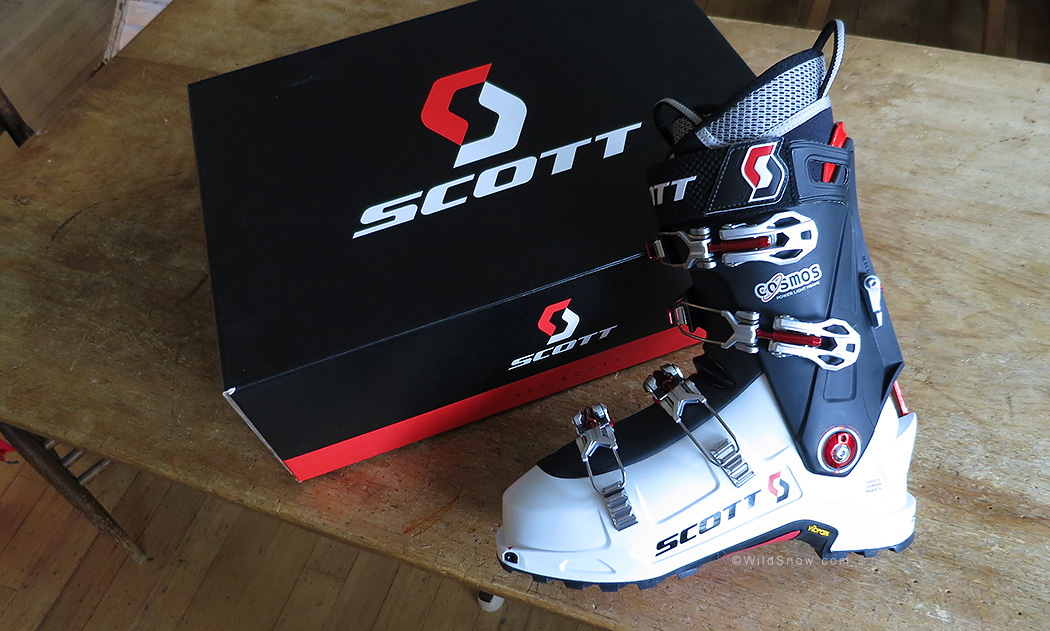
20131024 Scott Cosmos alpine touring boot is now a contender. Note we only tested one pair, but we're assured by the folks at Scott that they've gone to great lengths to be sure all their tech fittings work correctly.
Allright folks, it has been a saga. We liked the Garmont Cosmos boot when we got our review samples way back in May of 2012 (when we first published this review) only to eventually discover the tech fittings in the toe were somewhat “grabby” and possibly compromised safety release. During that time Scott bought the Garmont ski boot business. They inherited a truly nice boot design in the Cosmos, but needed to fix the problem with the fittings. All conspired to make one wonder exactly how would it all turn out?
When a box such as this graces your porch, you start searching for Italian snacks. Click all images to enlarge.
Fast forward to now. Yesterday, October 9, 2013, our porch was graced with a box direct from Italy, lovingly cuddling a pair of shiny new 27.5 Scott Cosmos, presumably the retail version. I ran out to the shop and tested the tech fittings. Pass. They release smoothly and feel similar to other properly functioning tech fittings. No play when locked. What’s more, the fittings are coated with a “black thermic treatment” that might help with preventing ice plugs and perhaps adds some smoothness to the release. Our source at Scott told me they put an immense amount of work into getting the fittings working correctly, exacerbated by the still present reality that there is no industry standard for tech fittings.
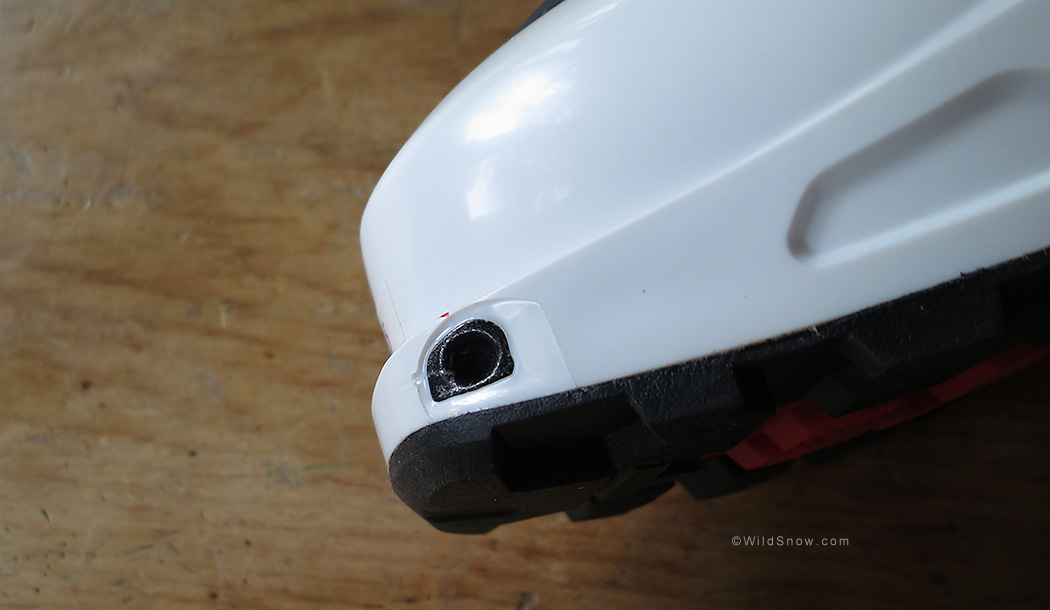
The toe fittings tested well in the shop. Smooth release, no play. Pass. The black color is a 'thermic' coating that could be anti-icing and anti-corrosion as well as helping release with a bit of lubrication.
Improvements by Scott:
– Lean-lock bar (red in photos, made of aluminum) is stronger, said to be rated at 650kg in contrast to 370kg in original Cosmos.
– Lean-lock mechanism is stronger, located in a wider pocket that required a mold modification.
– Rib reinforcements in lower cuff to prevent bulging of scaffo, especially when the cuff is levered to the rear.
– Toe fittings behave correctly, and have “thermic” coating.
The blog post below is our original review. Rather than leaving this hanging behind to confuse matters, we’ll update herein with new information and photos. We’ll also leave a few older photos that are easily identified by them being branded as “Garmont” rather than “Scott”. Here goes.
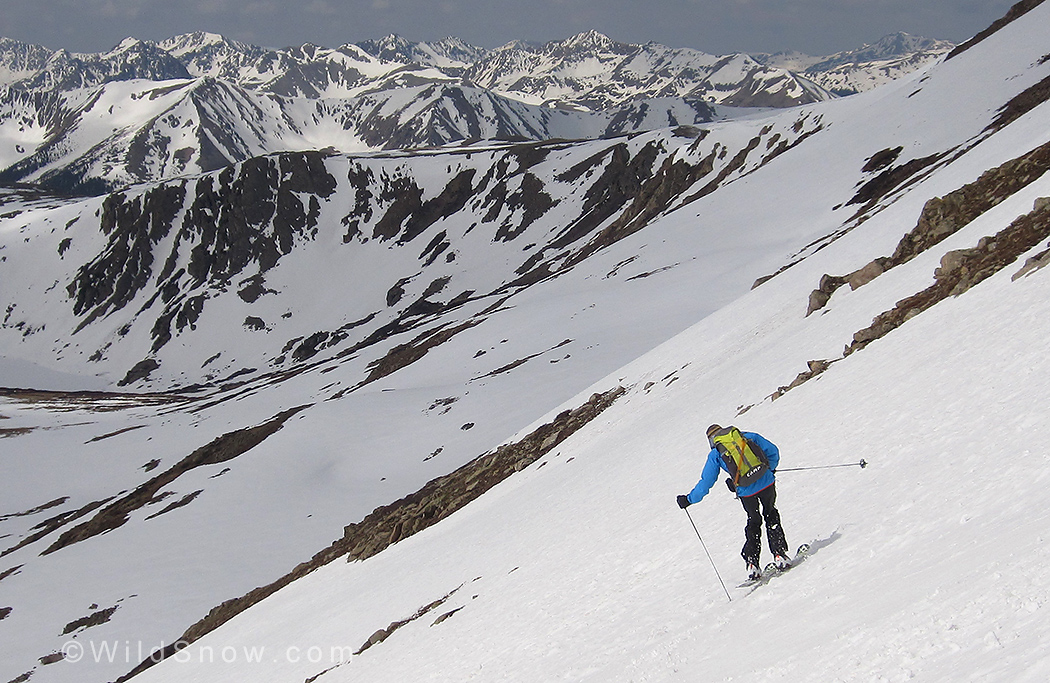
Lou testing early version of Cosmos when they were made by Garmont, May 2012, Colorado. Click most images to enlarge.
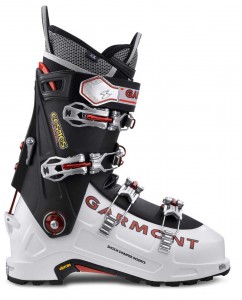
Original Garmont Cosmos backcountry skiing & ski mountaineering boot. Note the Garmont brand, now changed to Scott
With atomic bomb force, the backcountry skiing boot market has exploded with variety that even my fertile gear-fantasy brain never imagined a decade ago. Joining the chain reaction, Scott is introducing for 2013/14 their improved Powerlite series. This review focuses on the Cosmos. All Powerlite boots have similar features to Cosmos with variations in buckle number, plastic compounds, and so forth.
– Cosmos 4 buckle (men) (all Grilamid plastic, stiffness 125)
– Celeste 4 buckle (women) (all Grilamid plastic, stiffness 120)
– Orbit 3 buckle (men) (Grilamid lower shoe, stiffness 115)
– Nova 3 buckle (women) (Grilamid lower shoe, stiffness 110)
Overall, Cosmos is positioned as a fairly beefy boot that still has the cuff articulation and lack of weight for effective human powered vert.
Weight
Pick up the Scott Cosmos; you’ll think it’s lost mass through some miraculous process involving cosmogentic nuclides. Thankfully, no radioactivity is involved. Instead, Scott builds every major shell component with Grilamid, that difficult to mold but beautiful plastic that’s now the go-to material for making light yet stiff ski boots. Our pair of 2013-2014 size 27.5 (BSL 306) drift on the scale at 51.7 ounces, 1466 grams. Incidentally, that’s a few ounces heavier than original version done by Garmont, ostensibly due to Scott’s thicker plastic and beefed up lean-lock.
In terms of comparison, one of our recent 4-buckle “modern lightweight” review boots weighs in at 50.7 ounces 1,439 grams, size 27, thus indicating Cosmos definitely holds its own in terms of modern weight metrics. Enhancing that, know that that due to how Scott lasts and builds their AT boot shells (using molds bought from Garmont), the next shell size down in a Scott ski mountaineering boot may be a better fit comparison. Thus, you could end up with significant weight savings with a likely downsize.
Uphill
Okay, yeah, they’re light. But weight matters little if you can’t walk in your shoes. While not providing the cuff articulation of leading “tour optimized” backcountry skiing boots, Cosmos still delivers in the cuff comfort department.
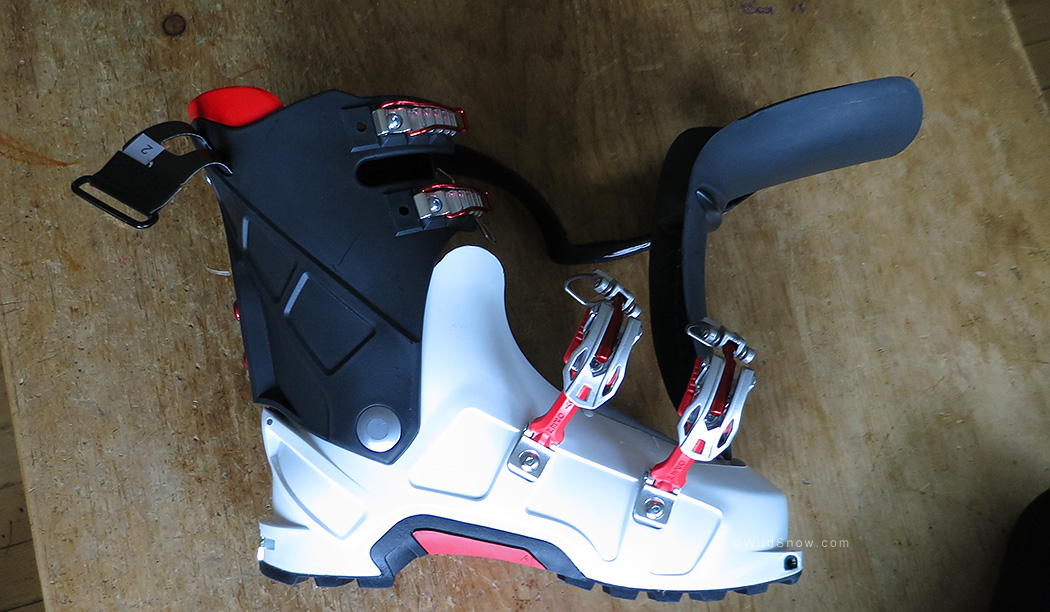
Cosmos cuff articulation is totally adequate and enhanced by the way the lean lock bar pivots at both top and bottom.
From vertical position to termination of rearward travel, Cosmos cuff rotates about 17 degrees. Translated to English, that means the cuff moves enough for a comfortable and normal touring gait. Though a bit more sluggish than I’m used to these days, rearward cuff articulation is nicely ergonomic. This due to the vertical lean-lock rod being free to pivot at both ends, both where it’s anchored lower in the boot as well as its sliding anchor point in the cuff. This is similar to other cutting edge systems you’ll find on the market, and truly does more closely match the motion of your ankle while having less resistance.
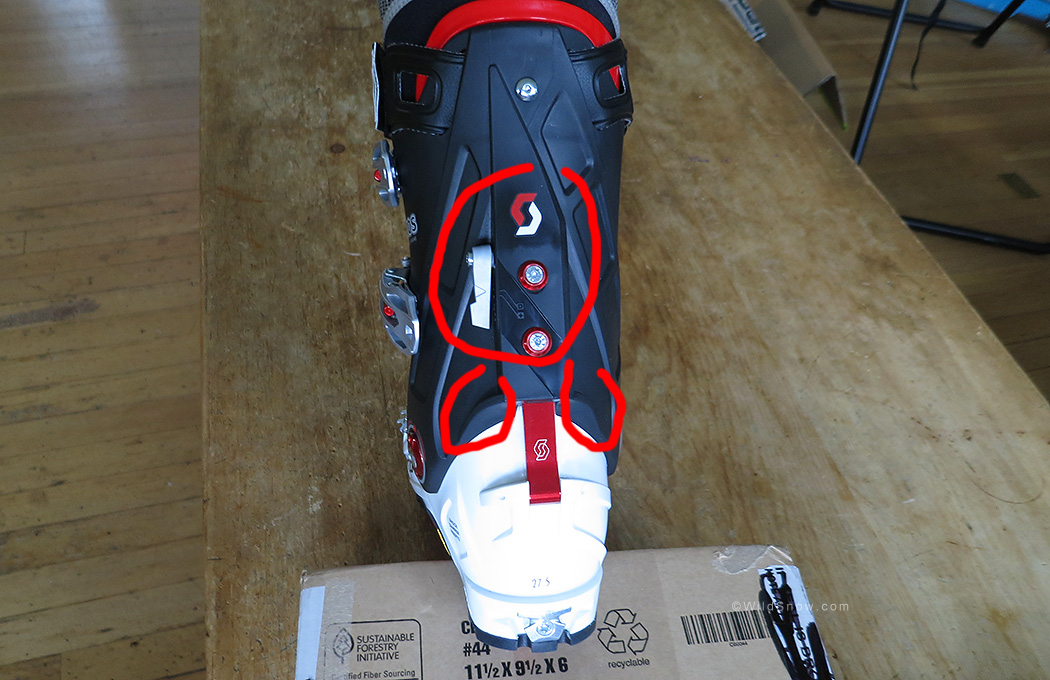
Scott Cosmos lean lock. Two plastic struts (circled in red) strengthen lower portion of lean-lock mounting area. We think these might have been beefed a bit, but they were also on the earlier design. The lean lock is beefier, accommodated by a wider molding indicated by the upper circle. The cuff moves easily on the bar in tour mode. Downhill mode anchoring appears positive with the slight bit of play customary to this type of cuff locking machinery. We do wonder how the aluminum bar will hold up in terms of motion wear -- time will tell. Most lean-lock bars are steel.
Trouble with any “tongue” type ski boot shell is you’re going to get resistance forward while walking. Keep the upper buckles loose or unbuckled helps with this, but ultimately you’ll still feel the tongue if you stride out. Cosmos is average in this department.
How the buckles stow is also important when you’re uphilling on skis or just foot packing a dirt track access trail. The two Cosmos cuff buckles are spring loaded so they stay folded in even when unbuckled. The cuff buckle ladders have spring loaded wire “frames” that rest over the attached bails, holding them in place if you prefer touring with your buckles attached but loose. Due to the nice fit I got in these boots, I toured with the cuff buckles totally undone. Your mileage will vary on that one.
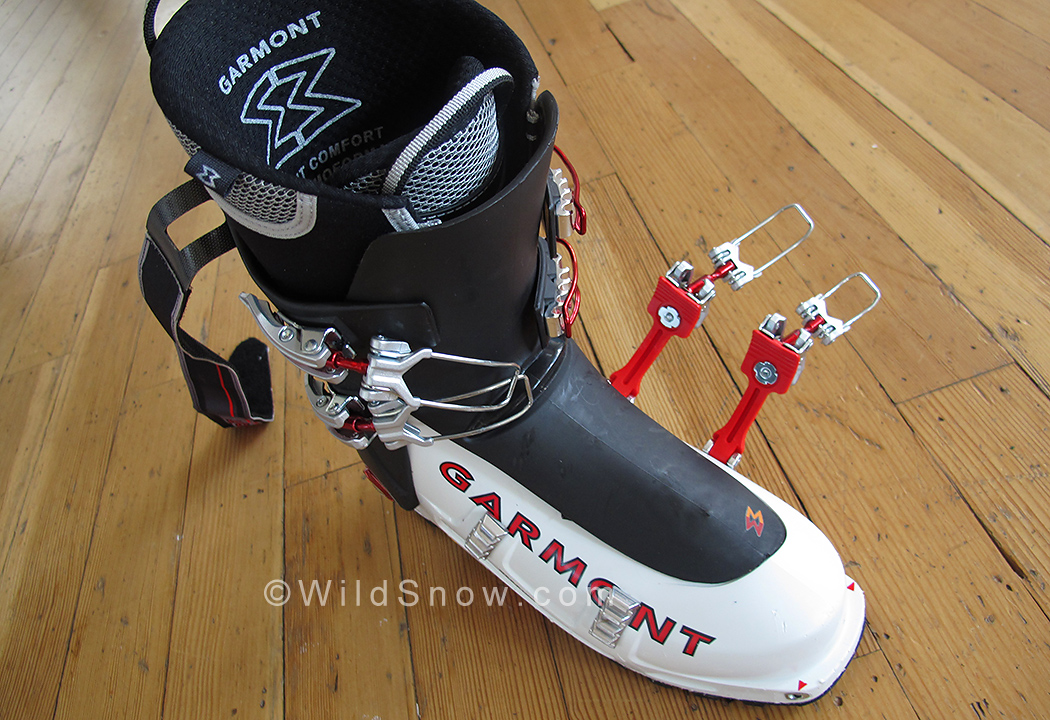
Garmont Cosmos showing buckles automatic position while unbuckled.
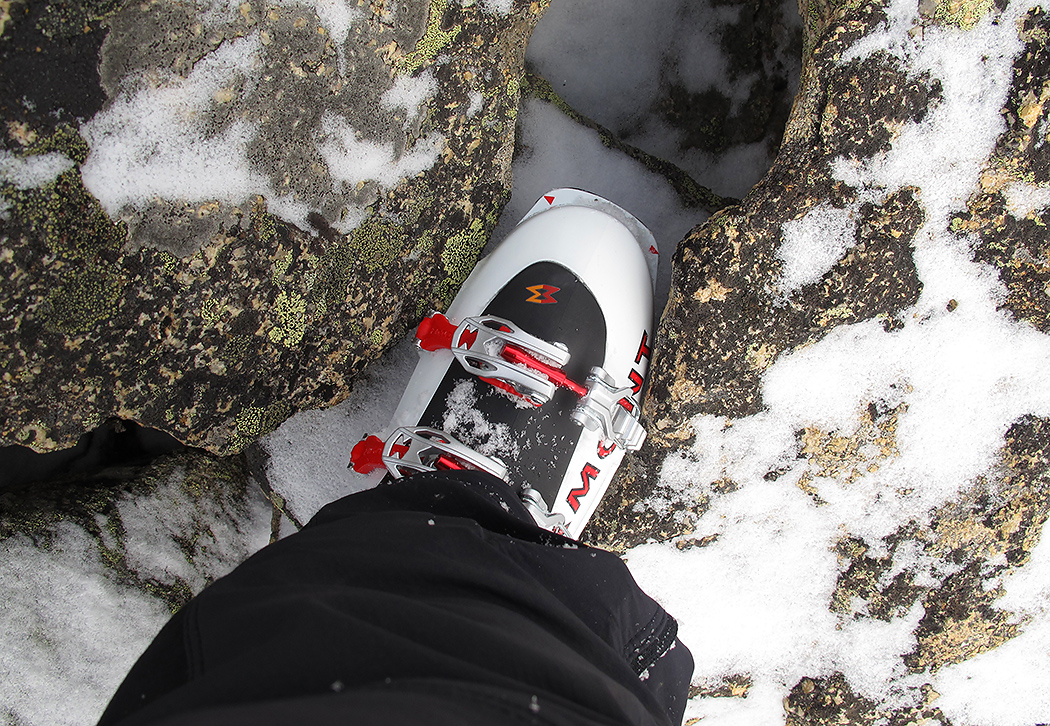
The lower two buckles are one of the best Cosmos features. Open, and they swing totally out of the way via spring loading. Snap closed, and both buckles rest ON TOP of the shell tongue, thus being totally resistant to catching or opening on crusty snow, rocks, brake pedals, snowmobile tunnels, or anything else your feet might encounter in a normal day's ski mountaineering. Yeah, the buckle ladders are still over there on the side, but that's way better then having the actual buckle in a vulnerable location.
Entering and exiting ski boots can be annoyingly fiddly or difficult. Cosmos is an exception. Due to the way Grilamid is molded, the lower shell opening extends farther towards the toe than has been common in ski boots. Along with that, the tongue folds up and away on a hidden wire hinge. Pry the cuff laps out of the way with both hands, and your foot pops in and out like donning a pair of Tevas.

Check out how open Cosmos is when it's open. The only fiddle while getting your foot in and out is having to hold the curve molded cuff laps out of the way. The cuff is made from stiff, springy plastic, so this is harder than it sounds but a minor inconvenience.
One other thing about hiking or climbing in Cosmos ski mountaineering boots. They have a Vibram brand sole with nice stiff rubber in the toe area where AT boots frequently become shredded after sometimes as little as a few hundred feet of scree scrambling. (Though we’d like to see even more rubber in this area, which seems to always be problem with high mileage AT boots used for walking or rock scrambling.) During my testing I stumbled up a bit of scree, and was delighted at how well the Cosmos sole held up. They’ll still wear, of course — and they’re ski boots so the sole has to be fairly thin in the toe area.
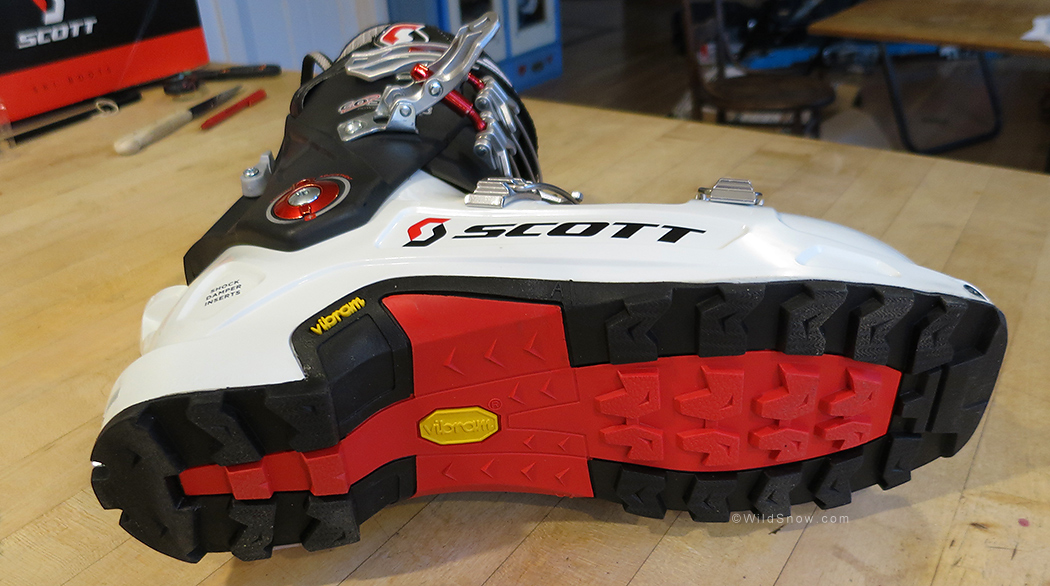
Vibram makes terrific AT boot soles,and this version has denser rubber around the outside and at toe, more grippy stuff in the middle. I did a good test of these while booting a variety of moderately steep snow without crampons. They're fine. This version of Vibram might be slightly heavier than the vapor soles found on some of the super light backcountry skiing boots available, but they actually stand up to some abuse. Also illustrated: one advantage of using old style tech binding sockets is you have quite a bit more distance between the steel socket and the boot sole, thus allowing for a thicker sole. For some backcountry skiers this is important, while others who seldom hike dirt or rocks will yawn while reading these words. To wake you up, know that by having the denser rubber on the sole, these boots will probably perform slightly better in frame bindings then they would with a softer sole. Thought I should mention that point somewhere in here, for the three of you Wildsnowers out there who don't use tech bindings.
Downhill
When examined in light of the complete AT boot market, Cosmos is indeed optimized for the down: Conventional tongue shell design, stiff Grilamid plastic for all three major shell components, four buckles, plenty of height — the list goes on. During my testing I found Cosmos to be an impressive mix of weight savings and downhill control. This is an excellent boot for the skier who cranks hard on big vertical — charging both up and down under human power.
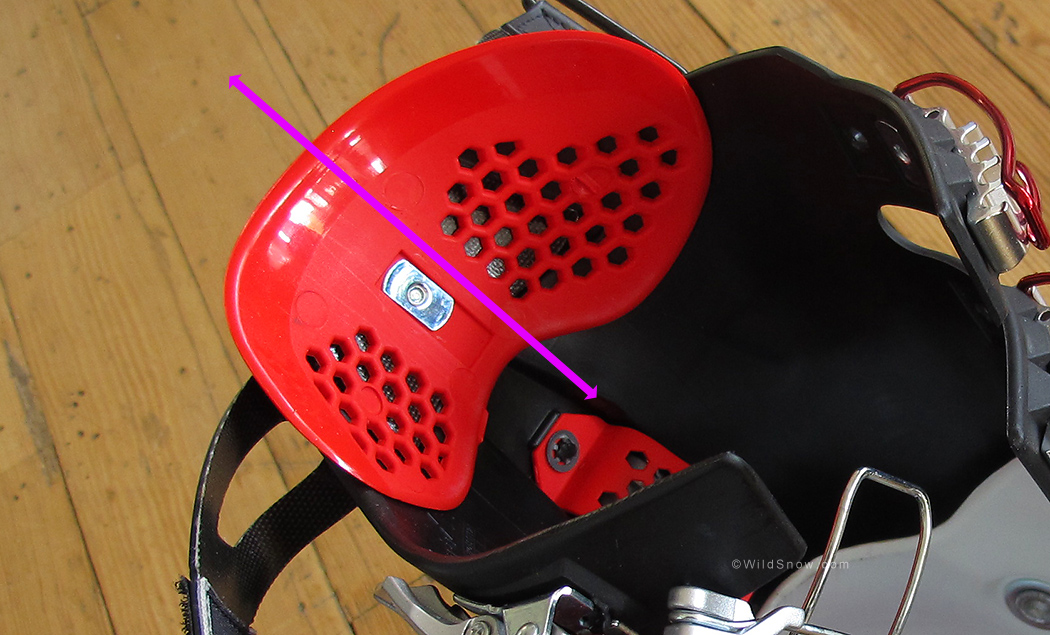
Cosmos spoiler can be raised by drilling another hole, or removed entirely. To remove power strap you take out the spoiler attachment fastener (threaded in Scott improved boot, thankfully), jerk out the strap, then replace the fastener. Note attention to weight saving detail. We love speed holes.
Scott touts their “anatomic shell design.” While simply meaning they attempt to bring in the ski boot shell dimensions to more closely match the shape of an average human foot, this is a valid feature. You can see it in the shell, with the deep heel pocket and slightly reduced volume over “bathtubs” of the past. No bull, you can feel the “anatomics” when you ski — a snug responsive nesting of your foot that even worked for me on a shell and liner that’s around a half size too big.
Oh, and last size? First, know that this danged “last size” thing that everyone seems to obsess on can be quite misleading. Kind of like BSL (see above). Some say the informal standard is to measure the widest part of a size 26 boot’s metatarsal area and that’s the “last size” for a model size run. But some makers measure other sizes than that, and where the shell breaks for your sizing also influences what such a number would really mean. I quizzed boot designer Paul Parker about this and subsequently decided the most precise we could get with communicating “last width” is to say Cosmos has a last width for a 27.5 of 103.5 mm, and that this is very similar to the last width of the Garmont Adrenalin (as well as being a common last width across the interbred spectrum of AT boot brands.) In broader terms from a backcountry skiing boot perspective, I’d call it a “medium” width last. If speaking from the alpine skiing side, I’d consider it a wide last. Beyond all that, remember that simple things such as the thickness of the liner and which shell size is ultimately picked (the last width scales up and down with size) obviate any precise accuracy in using “last width” to predict the fit of a boot.
Two technical adjustments prove Cosmos is a ski boot for the down as well as the up.
First, yes Virginia, the shell has cuff alignment. Some of you could care less about that, but those who need it know what I’m talking about, and what I’m talking about is wonderful to have.

Inclusion of cuff alignment is always appreciated.
Second, forward cuff lean angle is moderate, what I’d call around 12 degrees — but you can adjust it up to about 14 degrees. Beyond that, more angle can of course also be added by using thicker spoiler, shimming inside the boot under your heel and so forth–tuff boot fitters can do in their sleep. Scott is well aware of issues with binding ramp angle, especially that of some tech bindings having pronounced ramp. Thus by providing a relaxed cuff angle choice, requirements for modern style skiing are perhaps satisfied even while using bindings with tons of ramp (though in the end, shimming such bindings is probably a good idea).
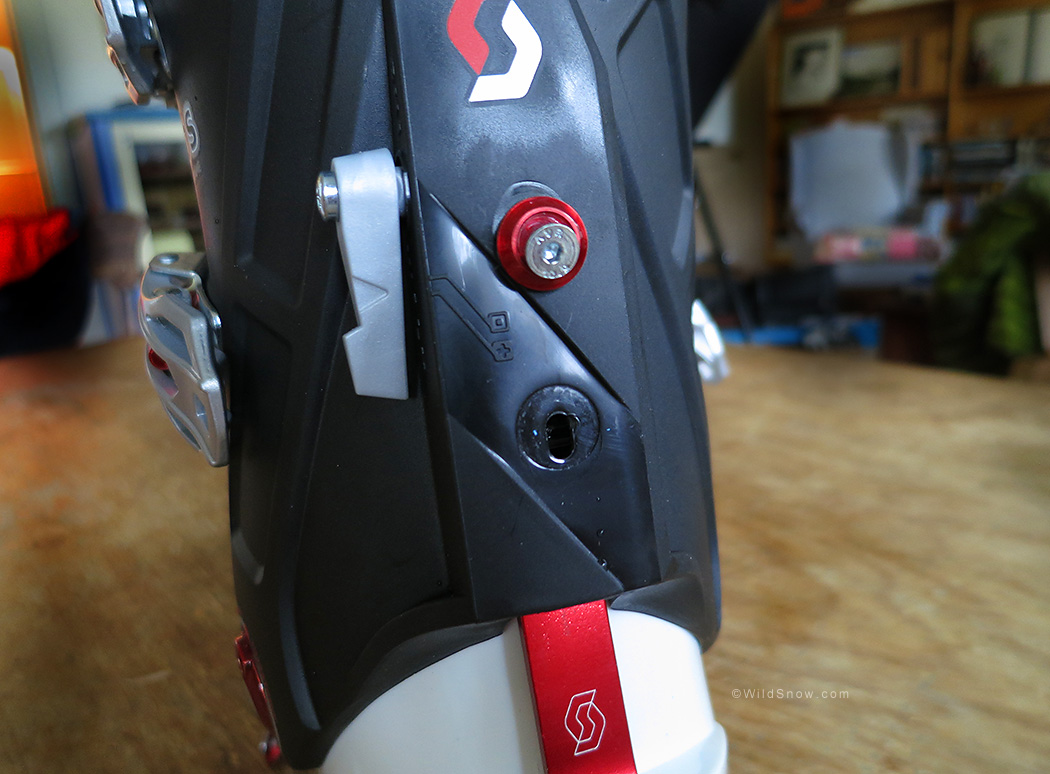
Cuff lean angle can be slightly adjusted by loosening two screws, holding cuff in desired position, then re-seating the screws.
Important: Rather than providing the two lean positions in the lock bar (perhaps the worst “feature” to ever exist in backcountry skiing boots), Scott sets this up so you can increase forward cuff lean by loosening the obvious two screws on the outside rear of the boot, jacking the cuff forward, then re-tightening the screws.
One small gripe about the lean lock; the mode switch is rather small and difficult to operate with thick gloves. Designing it this way is obviously a feature that prevents accidental switching from rocks or pant cuffs, but has a downside. This is not a deal breaker, and if you otherwise like the Cosmos I suspect you’d get used to it.
Sidebar: While we feel some tech bindings have too much ramp, providing at least some forward lean via binding ramp angle has a few hidden advantages. Mainly, you get some lean angle without compressing your ankle joint. Boots with aggressive forward lean in the cuff can cause ankle compression injury when pushed too far forward on ankles that are already flexed. Secondly and more importantly, boots used with a ramped tech binding can be built to walk nicely when used in the binding flat-on-ski mode, yet automatically have more forward angle when the binding is set to alpine mode with the boot heel lifted up higher than the toe. What seems to work best for a backcountry skiing setup is to provide moderate ramp angle for the binding in downhill mode, but not too much. Ramp angle of any binding can of course be tuned with shims under heel or toe mounting points, though doing so can be complex due to the need for longer screws and such.
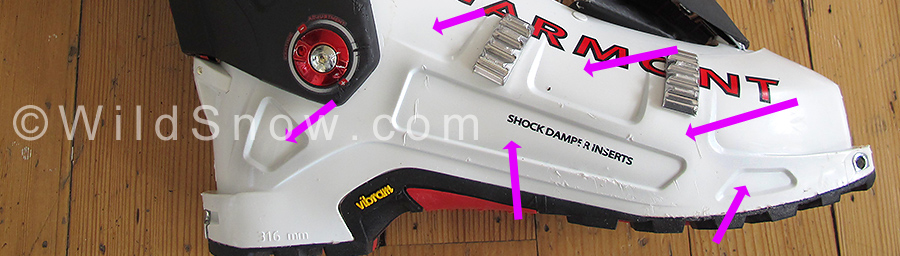
Injection molding of Grilamid plastic is a high art. Getting it thin enough to reduce weight is key, but doing so is tough because the stuff is difficult to inject into small spaces. One solution is the inclusion of thick-thin patterns in the mold. In the Cosmos backcountry skiing boot, 'webframe' reinforcing ribs yield the combo of thin and thick, thus reducing weight while keeping the beef. Nice job, only one problem: If you want to relocate a buckle for better fit, it appears doing so will require mounting the buckle in a thinner, weaker spot. Since the second buckle up from the toe buckle is mounted a bit too forward for some folks (it's in the wrong place for this reviewer, for example) this is definitely something to consider. On the other hand, most people don't do things such as buckle relocations to tune their boot fit, so in that case, non issue.
Lastly, forward flex while the cuff is locked is similar to most other tongue type boot shells. Cosmos does flex forward, and they ski fine in my opinion, but this boot doesn’t have the progressive flex of an overlap cuff. If you prefer the flex of an overlap, keep that in mind.
Liner
I quite like these liners. They’re light (9.5 ounces, 28.5) and conform well to my feet. The reinforced tongue feels good on my chicken legs. I can see swapping them into some of my other boots.
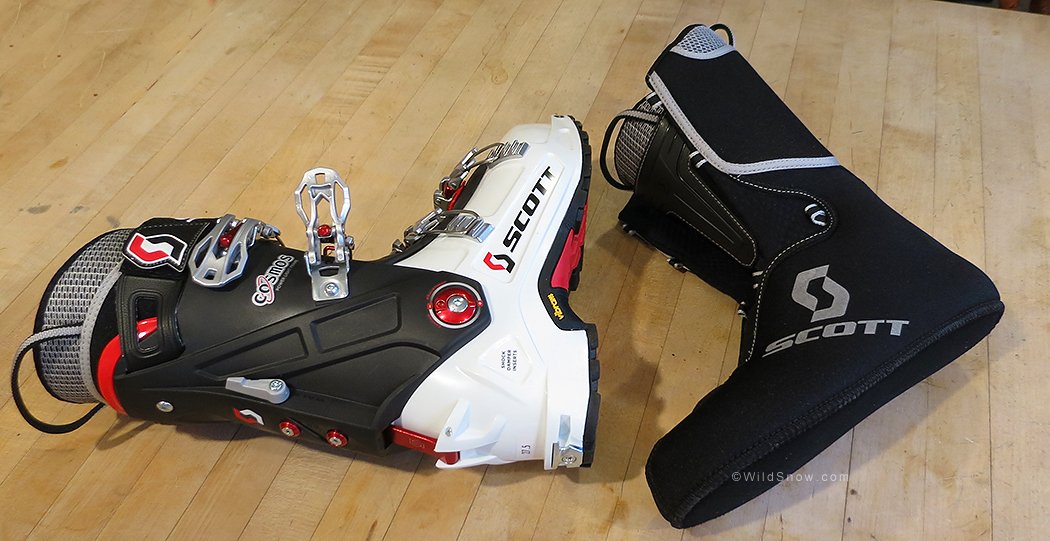
Cosmos liner is high quality, with dense foam and various stiffened areas. You liner swapping fanatics might even stick with it. I likely would.
As most of you WildSnowers know, I’m not big on writing endless verbiage about boot liners. They’re so easy to swap out, and so many people do it, that extensive coverage feels like writing chewing gum reviews. But I’ll keyboard a few things. What makes the Cosmos good is the optional laces, pull loops both front and back, density where you need it, and the nicely shaped cuff. In my view the go-to feature of the Cosmos-specific liner is the plastic stiffener in the tongue. This combined with the Cosmos shell tongue I suspect will give most of you “forward stiffness challenged” boot shoppers something to be joyful about. Indeed, perhaps you won’t have to be swapping in other boot tongues, nor re-building up your boots with epoxy and Kevlar? And yes, the liners are thermoformable and strobel constructed (sole stitched on).
Conclusion
In our first on-snow testing back in 2012, we easily gave the Cosmos backcountry skiing boot a rousing cheer and multiple thumbs up in terms of how it skied. We continue that emotion, especially since the Cosmos last provides a fit option for those of you who were happy with Garmont boots of the past.Scott has nailed a beautiful combination of light weight, walking comfort and downhill performance. Simply put, by paying cosmic attention to detail and improving almost every aspect of a fairly conventional “tongue shell” ski boot design (including their working past a problem with the tech inserts), Scott deserves kudos. Give Cosmos and the other Scott ski mountaineering boots a look if you’re shopping for AT ski touring boots.
Important note: Many _Garmont_ branded “Powerlite” series boots, including Cosmos, have unacceptable tech toe fittings. We thus recommend the Scott branded boots, but not the Garmont. While Scott kept the model names the same, they changed the category name from “Powerlite” to “Ski Mountaineering.”
Sidebar, with help from Paul Parker: When comparing boot shell weights, do so using what shell actually fits your foot rather than looking at BSL (Boot Sole Length) numbers. Although often mistaken as such, BSL is not the boot size. At the risk of stating the obvious, again, BSL is only the boot’s exterior sole length. BSL can vary greatly between different boot models of the same internal size due to how the boot shell is designed (how thick the plastic is, shape of sole, etc.).
All boot shells have a number stamped inside the lower shell (scafo in Italian) such as “28.5.” This number is the boot’s Mondo Point Size. Shell cuffs and tongues often span two lower shell sizes so they may not reflect the exact size — it is important to look inside the scafo. That number in the scafo in virtually all cases will be the length of the inside of a complete boot. This is the number you need to compare one boot shell to another in terms of what will fit your foot. For example, if you fit a 28.5 scaffo in one brand, you’ll likely find that the same Mondo fits you in another brand.
Most ski touring boots use this Mondo Point System (MPS) with the shell changing every 1 cm in size. (Note: some alpine and race boots use UK sizing, which I won’t go into other than to note that it is a different measurement scale similar to the US scale.) In the Mondo Point System, half sizes are usually taken care of with the thickness of the liner and/or footbed. Note that different brands use different 1CM shell “size breaks”, i.e. some use the same shell for a 26.5-27.0, others use the same shell for a 27.0-27.5. It is vitally important to know this shell break when fitting the boot, and certainly when comparing weights and BSL.
The BSL, or BOOT SOLE LENGTH, is printed on the outside of the boot and is often mistaken for size. Most manufacturers also put a sticker on the outside of the boot that shows actual MPS size, but a good hint to boot makers would be to print shell size on the outside as well–new concept?
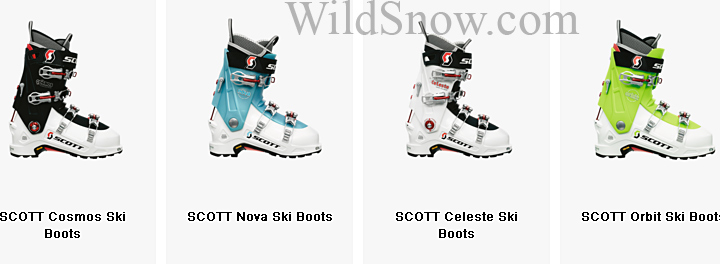
Scott 'Mountaineering' boot lineup for 2013 2014.
Along with Cosmos, the Scott “Mountaineering” boot series includes other models. For boot fitting, here are the shell breaks:
Celeste, Nova and other women’s backcountry skiing boots:
23.0-23.5, 24.0-24.5, 25.0-25.5, 26.0-26.5, 27.0-27.5Cosmos, Orbit and other men’s boots:
25.0-25.5, 26.0-26.5, 27.0-27.5. 28.0-28.5, 29.0-29.0, 30.0-30.5, 31.0-31.5

WildSnow.com publisher emeritus and founder Louis Dawson has a 50+ years career in climbing, backcountry skiing and ski mountaineering. He was the first person in history to ski down all 54 Colorado 14,000-foot peaks, has authored numerous books about about backcountry skiing, and has skied from the summit of Denali in Alaska, North America’s highest mountain. He published his memoir, Avalanche Dreams: A Memoir of Skiing, Climbing, and Life in 2024.
