Riffler Powder Riot – Zillertal Alps, Austria
The proposal: End with a gasthaus beer. Begin with a cable ride. Ski tour. Wear your harness for a bit. Ski powder. Ok, deal.
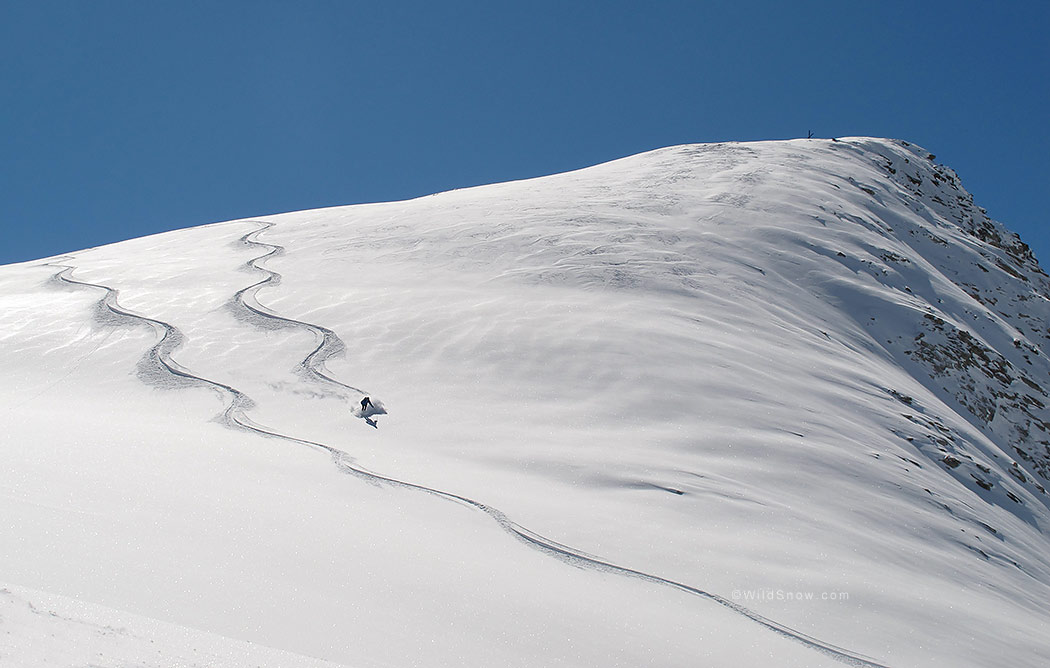
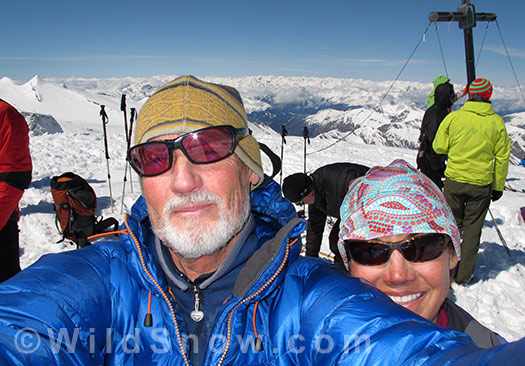
First stop, Riffler, 3,231 meters (look close to see the classic cross on top). Early locals stole first tracks. Click most images to enlarge.
Zillertal Alps of Austria provide yet another area in the western European mountains where deeply riven valleys and high peaks give stunning relief — and provide the height to hold good snow when lower reaches are too warm for perfect powder. For today’s adventure, we drove to one of the highest ski resorts in the Zillertal region just east of Innsbruck, on the Tuxer Glacier. A cable ride brought us to 3,270 meters, where we enjoyed the view and scored a bonus powder descent to the start of our muscle powered day. Follow us in photos (for location, see map at bottom of post):
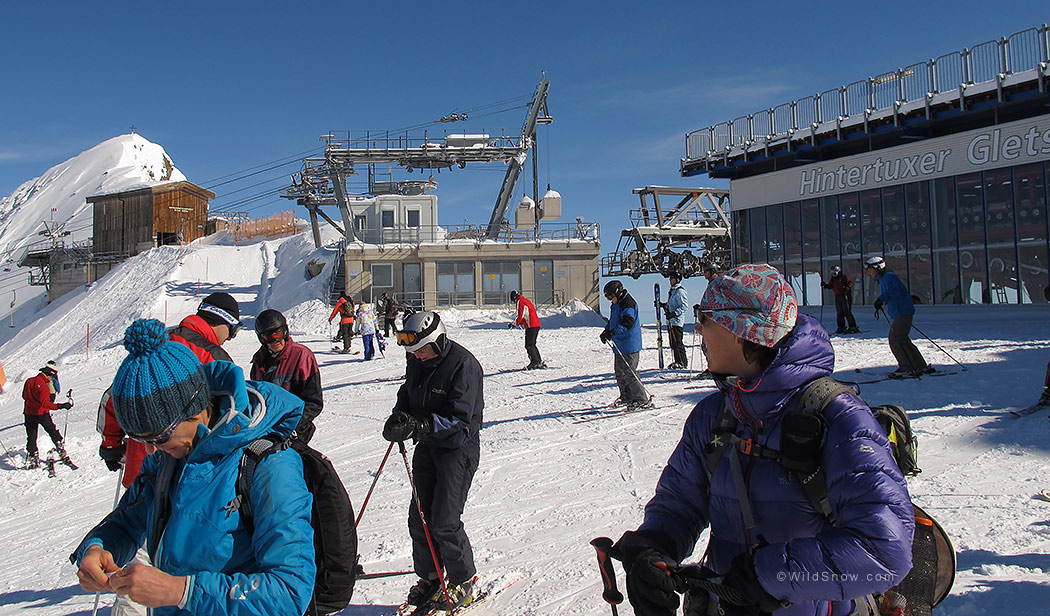
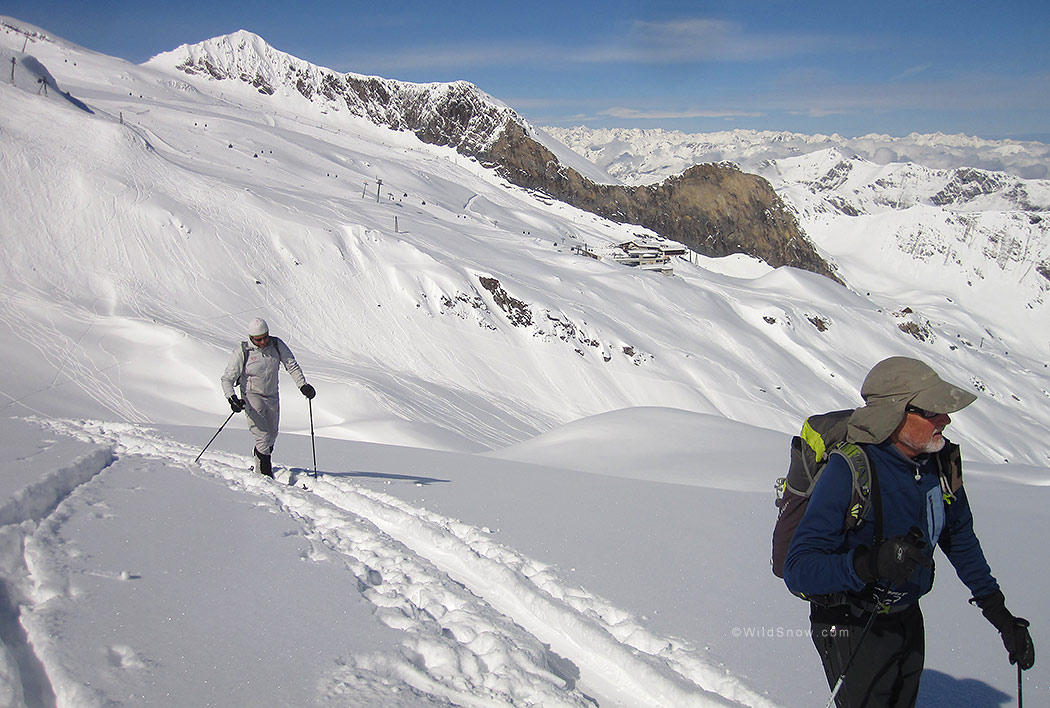
Just as spring skiing strategy is back in Colorado, here you want elevation for the best snow. Rather than driving to a high pass as we usually would back home (or hiking dirt for hours) we catch a one-ride ticket on the well known Hintertux Gletscherbus gondola system. We could have stopped part way up for a few less euros, but opt for the nearly 1,800 vertical meter cable haul to the top of the resort. When we get there the view is worth the ride, but of course a herd of lift-served Euros are scraping of the fluffy new snow like they're scarfing lunch at the gasthaus. Luckily we have different plans, though we do join the schnitzel fueled powder race for about a thousand vertical feet down to our tour start.

Main reason we opted for the full cable ride was the view. In this case, they keep the resort piste going on the Hintertux Glacierr below the famous and quite beautiful Olperer. This peak has been climbed at least once by a woman in socks (Barthel family inside joke).
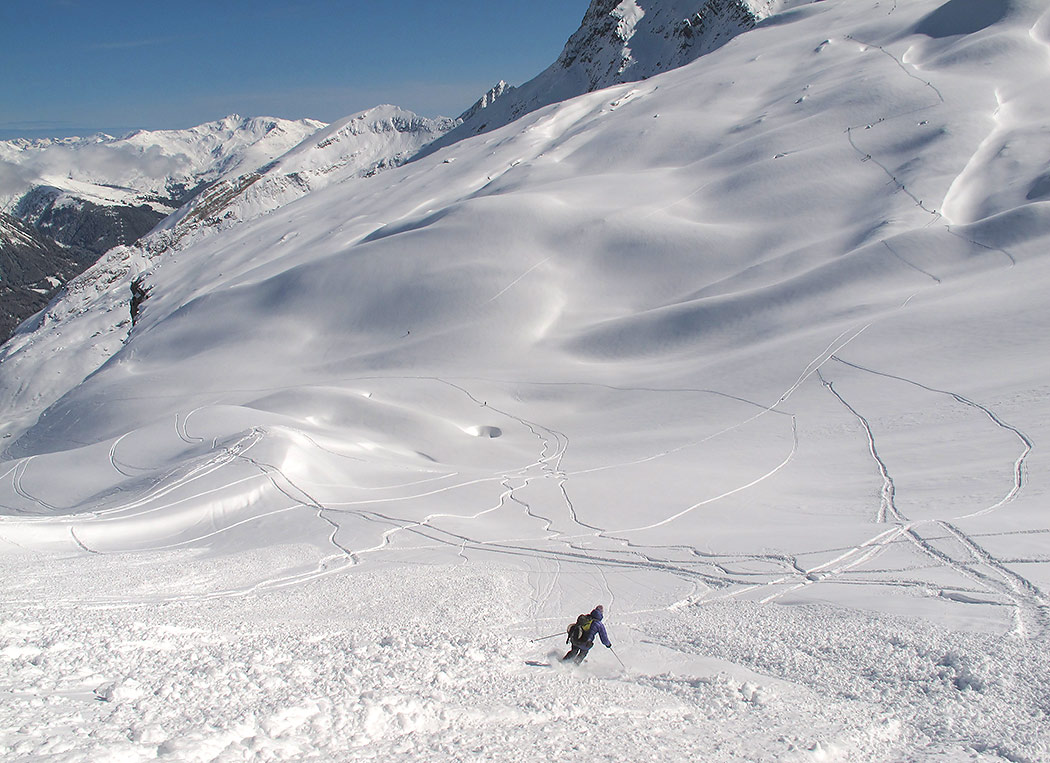
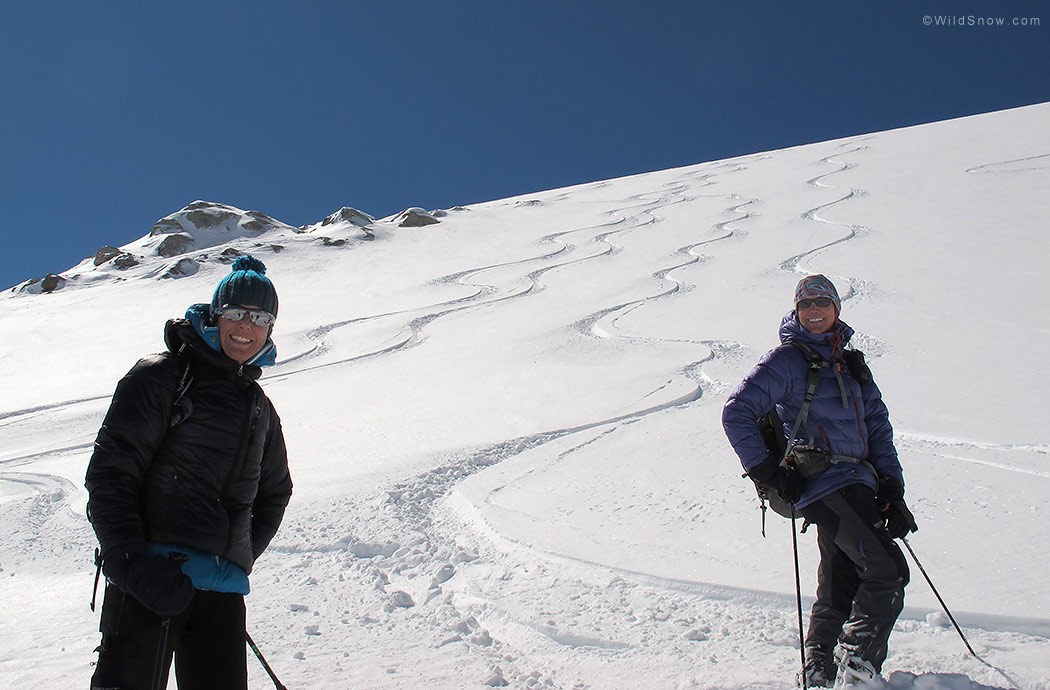
Lou does some Tirolean powder farming as we head down the Feather Bed glacier (Federbettkees) from Riffler. We ski quite a bit of vert off here, then find a dry spot on smooth glaciated rocks where we sit and dine on chocolate and other goods.

Can you spot the WildSnow girl in the photo above? She's hanging from a cord, dangling over the Alps. After our first ski of the day off Riffler, we wind our way easterly up and through a series of high alps. With the weather deteriorating, Fritz leads us to an improbable passage down from a saddle next to a peak called Realspitze. I'm not highly impressed with our navigating a snow-shelf above a 200 foot cliff, so I belay Lisa across to the start of a fixed-line the guides had installed. We rope down, which positions us for a huge (around 6,000 vertical foot) descent to the valley floor, over ground that is much less tracked than other, more easily accessed places.
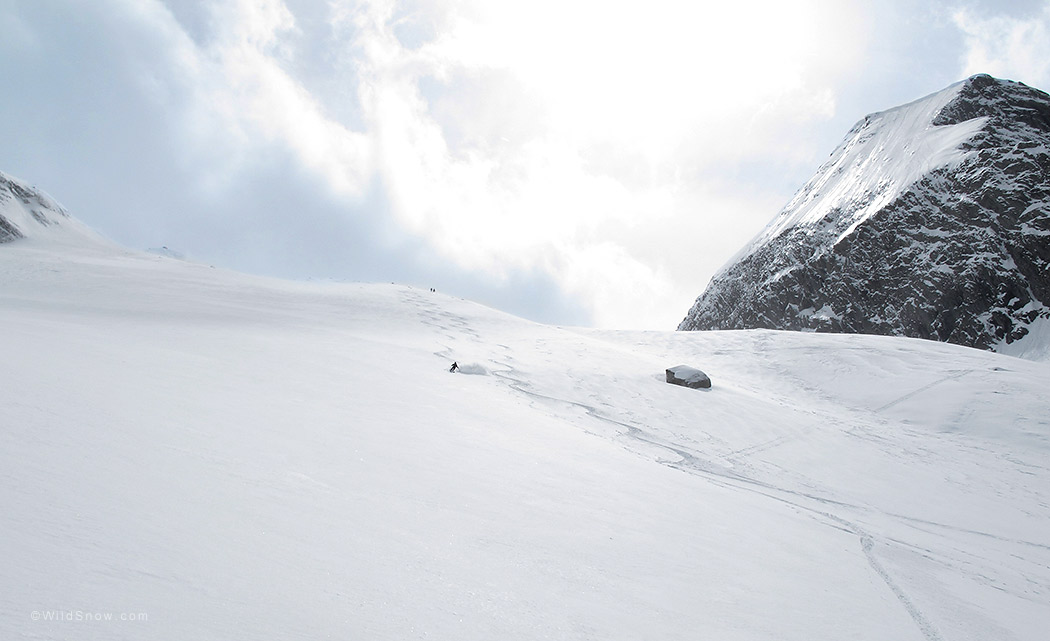
Riki during the day's finish, which goes from a few thousand vert of perfect powder and culminates with still skiable junk, a typical 'big vert' run in the Alps.
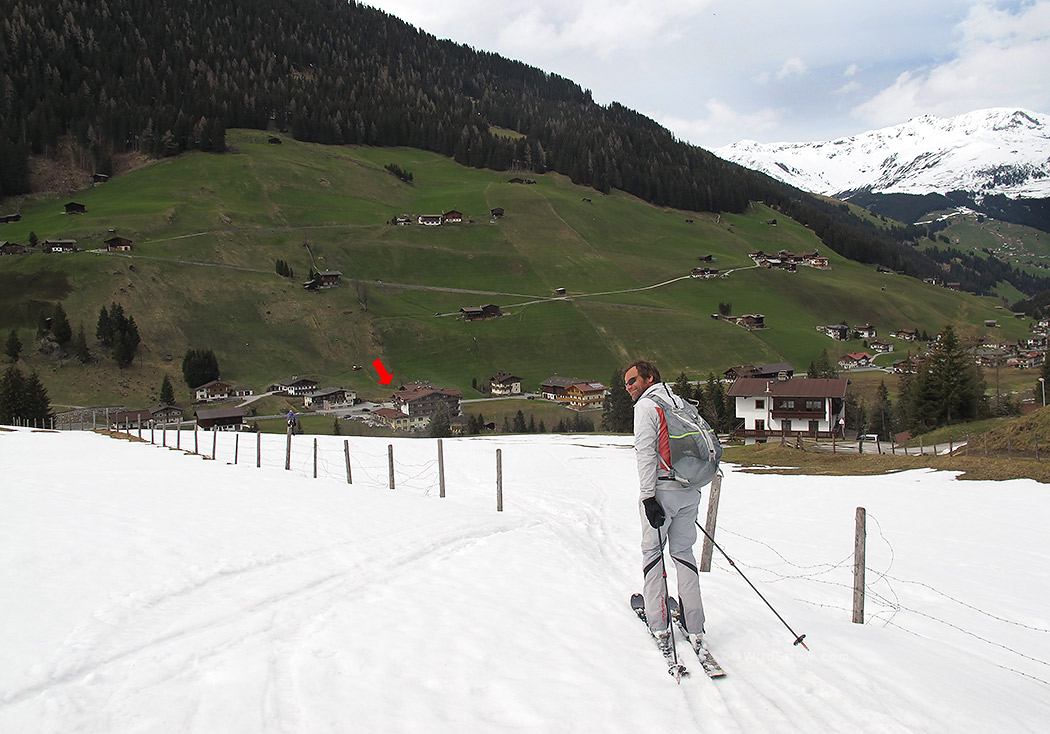
The finish is so classic I smile till the sun blisters my tongue. Snow leads over the pasture, through a fence, and down within a few feet of a bridge across the river. After that you have a desperate dirt hike of about 200 feet to the gasthaus sun porch (indicated by red arrow in photo.) The name of the gasthaus? Eden, but of course.
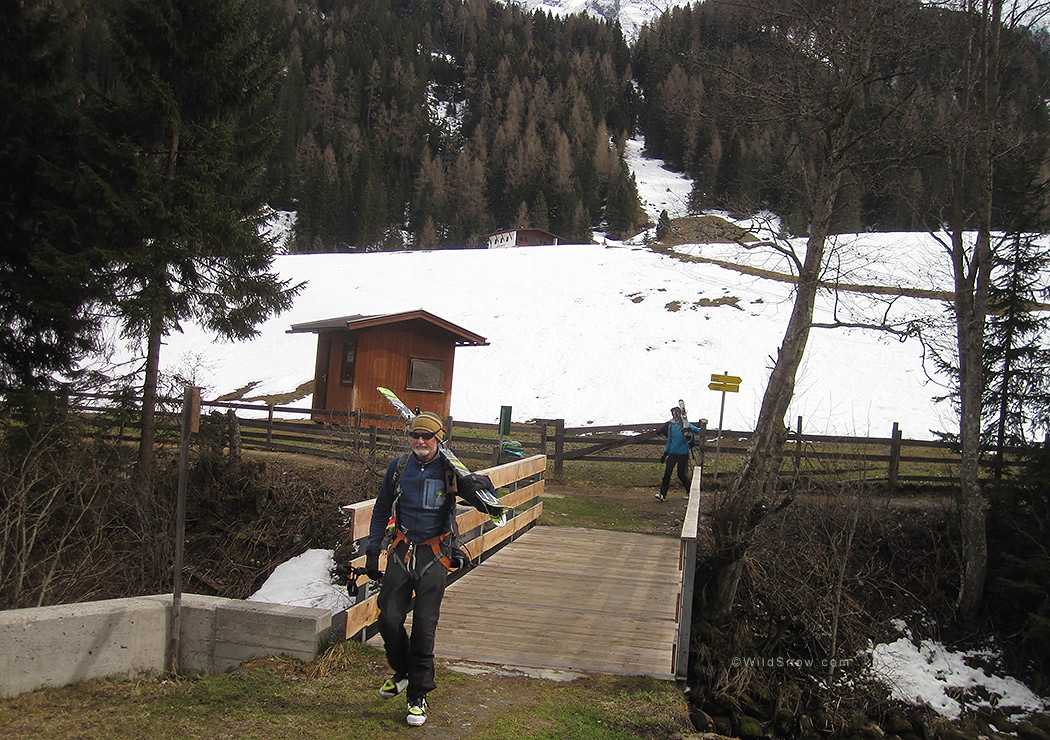
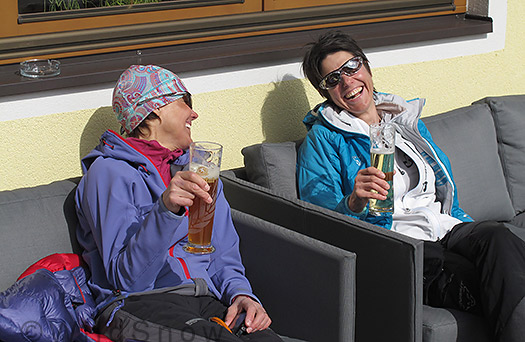
The WildSnow girls share a laugh over traditional refreshments. You literally walk about 200 feet from the bridge to the gasthaus sun porch. A week earlier you probably could have skied every inch.
We’ll, without the rope work this could have ranked up there with the most hedonistic ski tours I’ve ever done in my life. As it was, still pretty good. Only crowds were at the start. After that, it was like touring in the relatively deserted mountains of Colorado or Wyoming.
“Hoher Riffler” marked on map below was our first highpoint. We then toured and skied northeast and north from there, eventually dropping down northerly to the main drainage.
Comments
15 Responses to “Riffler Powder Riot – Zillertal Alps, Austria”
Got something to say? Please do so.


Did this same run a few years back. We had great snow but marginal visibility. This is when Euro skiing shines. Great lift infrastructure, easy touring access to summits and awesome runs down to the beer and strudel dispensing hotel sun terrace. And never cross a track. Great reports!
Fantastic! Why can’t we have this kind of expierience in the United States. OK, this is a rhetorical question as I understand how the sometimes backwards thinking of the USFS pretty much prevents this sort of thing, but I’m continually left wondering why in America we can’t recognize the value of allowing this sort of thing in some areas while protecting wilderness in other areas. Thanks for the post Lou!
Tom, there’s a few places where you can make that sort of thing happen. But usually it’s not very smooth due to things like high lift prices, high prices at the base restaurants, transportation issues that prevent easy transition when tour is over, that sort of thing. The other big factor is that many of the places where you can do this sort of thing lack moderate terrain and/or have a less reliable snowpack. The infrastructure in the Alps is the big one. But what causes infrastructure? Scads of people to support it… you do the math (grin).
Nonetheless, I do think there is enough ski touring in certain places in North America to support a trailhead restaurant that’s not in need of resort business. A visionary will be needed to make the leap of faith. When they do, I think they’ll be amply rewarded.
Legal Wilderness preventing any sort of development, or huts, is also a factor in all this. I mean that neither as criticism or praise, it’s just what is, take it or leave it.
Thinking about it, can one do this sort of thing by riding Jackson tram then skiing the canyon? or is that just a drop with no hiking? The ski touring component, in moderate to semi-moderate terrain, is what really is the key to these experiences. They’re not meant to be ‘extreme’ or ‘radical’ or particularly dangerous, just fun.
Lou
Makes me drool with envy. What a great tour!
@Tom re: why can’t we do that in Amerika?
Lou has part of it right…it takes a lot of customers to make it worthwhile as a business AND you need the right attitude from the regulatory agencies who have been strongly influenced by the green attitude of the Sierra Club which seems to think man must be banned to protect wilderness. Seems they forget that part of the original purpose of the Sierra Club was to promote wilderness through enjoyment of it.
If people experience and enjoy it, they will want to protect it, but not to the point where they are not allowed access.
I think Lou has it pretty much nailed – more people = more demand = feasibility = infrastructure. One other factor that I was really struck with while touring in the Alps is terrain and tree line. Because the tree line in the Alps is so low you have a lot more skiable terrain. In CO, with our high tree line, a lot of stuff below 11500 or so is simply too tightly forested to ski enjoyably.
Still we have our opprotunities. In my area of I-70 Colorado we can probably do some resort-to-resort stuff like Breck to Copper where we can use the bus system to get back to the start. But this dosen’t provide much “tour”. nevertheless I’m sure there are other possibilites as well, just need to get more creative
Tom, another and oft sweep-under-the-rug reason the skiing in the alps is better is because vast areas were deforested for firewood through the ages, and many acres are still kept open for agriculture (this ‘alm’ skiing is one reason the skiing in the lower alps is so good during mid winter). . The deforestation is known to have caused numerous avalanche situations over the years, and some of the big avy paths are being encouraged to re vegetate.
The timberline is a bit lower, but so are the mountains compared to Colorado plateau. In Colorado and especially up in Canada there is nearly infinite terrain above timberline, but much of that is super difficult to access and of course ski touring in Colorado above timberline in winter tends to be hit/miss.
Lots of factors in all this. But I think if a restaurant entrepreneur found one place in the country where they could buy property at a popular trailhead, they could probably open a small restaurant/hotel and make a go of it. Like I said, there has always been some of that here and there, but hardly anything that’s really dedicated to the backcountry users.
Dostie is correct in that the regulatory environment is also a factor. For example, doing commercial use on private property may have to conform to zoning, and in many places around here anti-growth zoning has been enacted that basically threw the baby out with the bathwater and makes doing things like highcountry lodges very difficult or impossible.
I should also add that roads, both improved and unimproved, as well as trails, are of a density many times greater than in most North American mountain areas. These trails and roads are equally important to how the ski touring culture has developed in Europe. For example, in Colorado you can descend innumerable peaks into roadless and trail-less dense forest where egress can take painful hours, if not benight you. Generally, in western Europe you’ll find a road or trail — if not a resturant (grin).
Yes, we love our wilderness, but so do we love the more civilized backcountry skiing. Nice to experience a mix.
I agree with most of Lou’s points particularly the historic agricultural uses and timber practices that have allowed for much of the below treeline skiing they have today. The development of infrastructure, and the associated users, have also played a major role as well as their history of ski mountaineering which is much more a part of their culture than in the US.
But, I disagree with Dosties’ stereotype and finger pointing of the Sierra Club. Have you not heard of their Outings programs that travel every part of the globe in almost every type of land designation (major cities to the most remote wildernesses), their work programs (that the participant pays to participate in) that make improvements to benefit people, fauna, and flora in every thing from wilderness areas, national recreation areas, national monuments, national, state, and city parks, and their youth outings programs that center around both recreation and work to improve our wilderness areas, and parks and at the same time give kids a chance to experience and appreciate the outdoors that they may not otherwise ever have?
Gee, who has been responsible for the largest reduction in CO2 levels produced by the US? You guessed it, not Congress, the Administrative Branch, or the good will of private industry, but The Sierra Clubs’ “beyond coal” campaign. Maybe you feel that CO2 levels still have nothing to do with our changing weather patterns, snow pack, or our ability to ski at certain elevations, but this has undeniably helped clean up our air in the areas that we like to recreate in. They also have a long history of programs to lobby, influence, and write legislation that promotes energy efficiency in almost all sectors from residential and commercial buildings to our energy, distribution, and transportation sectors. This again plays a major role in quality of the experience we can have in our wilderness areas.
Their is no question that litigation, some that I agree with and some that I don’t, has had some impact on specific developments; but I think your blame is misplaced. Almost every major environmental organization today recognizes the key role that humans play in the biological and economic health of these places. And, how our uses and impacts are part of the very fabric of these environments. I work, almost daily, with regulatory agencies; federal, state, and local. Believe me I understand that kind of frustration, but in the larger scheme of things I think you are attributing fault to the wrong organization. Generally our public agencies reflect what the public desires, especially when it is in your own backyard. If anything our agencies are too influenced by the money, power, and profits of industry.
Chris, thanks for the excellent comment. I think where I’m at with this is that yes, Sierra Club has done plenty of good, but they went too far with preservationist leanings when it comes to land use policy. This has always appeared a bit contradictory to me as well, as they were indeed founded on recreation. One classic thing that sticks in my mind is the cover of a Sierra magazine long ago, that featured a pick wielding volunteer hacking away at some alpine tundra, building a trail. I always remember that as an icon of the conflict between preservation and recreation that the Sierra Club has.
As for carbon reduction, when the glaciers quit melting I’ll celebrate. Before then, whatever.
Lou
Lou,
Thanks for your insightful comments as well. Yes, it certainly is a complicated issue. My personal experiences with the Club and the Sierra Club Foundation (the main funding arm of the Club) in particular, which dates back about 35yrs., have been much more practical than most people might think. I’ve had many first hand experiences with board members and staff where I’ve found them to be practical and level headed thinkers with broad experiences in land management issues and policies. Sadly this debate often boils down to a persons life experience and perception of an issues based on where and how they live; often rural vs urban. People often forget how much, and for how long, some of the traditional organizations like the Sierra Club have done. Just think of how our natural environment might be without them. Makes me think of the incredible negative impacts developing nations have while struggling with energy infrastructure. Imagine the Front Range or the Powder River Basin without them; isn’t it bad enough as it is?
This is one of the best TRs. Thank you!
Amazing vert on that tour. Just throw in a rappel, and voila!
Chris,
I’m with Lou. You make some good points and yes I DO stereotype the Sierra Club because I’m envious of Colorado’s 10th Mt. Hut system that the Sierra Club prevented from being developed in California’s Sierra Nevada range. I’m not asking for as many huts, or even as big, but it sure would benefit backcountry aficionados if California could develop something like that. Thus I’m not discounting many of the points you make.
And no, I don’t think CO2 is harmful, but that isn’t my main beef with that agenda and a debate on that deserves face to face discussion and open minds and ears on both sides. If I’m ever in your neighborhood (wherever that is) I’m more than happy to share a drink and talk like men. I’ll even buy the first round.
Craig,
We actually met briefly about about 10 maybe 15yrs ago on the summit of Mt. Shasta. You were lugging 15#’s of camera gear and a friend of mine was giving you grief for publishing info. on Mt. Shasta- another story. Years ago I skied with John Holleman.
I think the lack of money and infrastructure is the primary reason we don’t have many huts in the Sierra. I believe the Sierra Club is the single largest owner of huts in the Sierra, something like six in the northern region and four in the southern.
If you build (or open) a hut they will come. The tourists are there and they have the means.