New Model Silvretta Pure Freeride Has Killer Features – Improvements
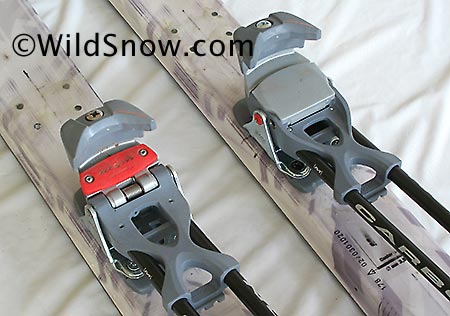
A few days ago we unboxed this coming season’s (07/08) Silvretta Pure Freeride. While substantially the same binding as last year’s offering, this model has several significant improvements that make it much more viable a choice for backcountry skiing. Check it out.
![]() |
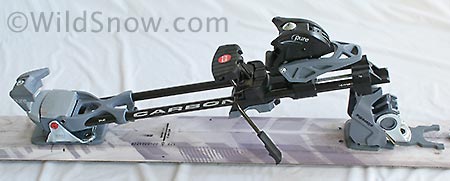
| New 07/08 Silvretta Pure Freeride is similar to last year’s model but with significant improvements. See our detailed zoom. |
![]() |
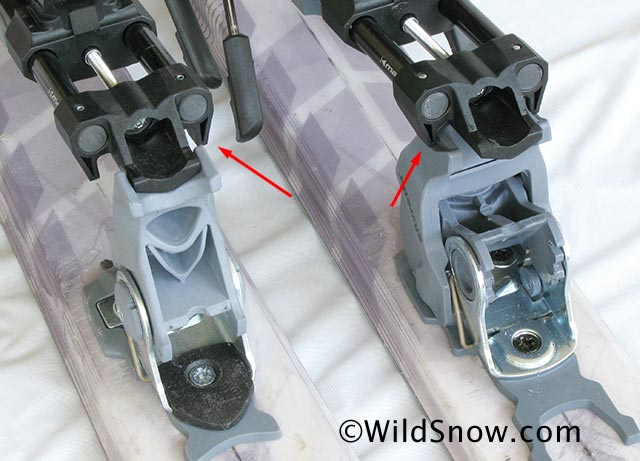
| Side by side comparo of toe units, new one on right. They look slightly different, but in function are significantly different. |
![]() |
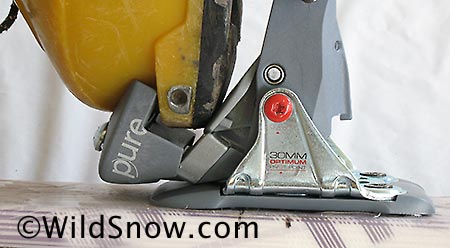
| Here is what’s different about the new toe. It has a way of hinging that allows more forward angle when the binding plate and boot are taken to max forward angle in touring mode, which occurs when you fall forward in touring mode (a “knee fall”). The idea is to prevent a knee fall from damaging the binding. On the bench, it looks like this might work as the point of binding damage is well beyond the angle where your knee hits the ski or snow surface. While this sort of damage is uncommon it did occur with earlier Pures, so curing this failure mode is in my opinion a significant improvement. Check out our video of the toe action. |
![]() |
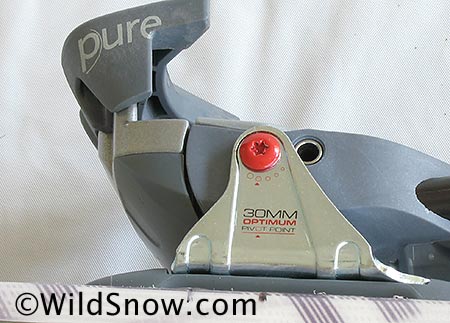
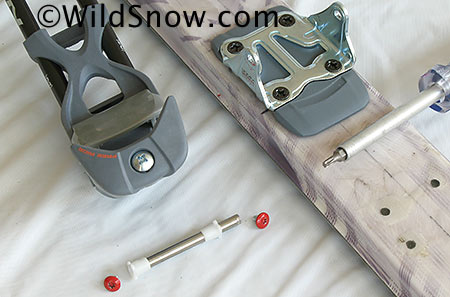
| The improvements continue, and this is the killer feature. Any backcountry skier worth their avy beacon has worn out the pivot on a plate binding. Often you’re out of luck when this happens, as many AT bindings have a pivot that’s not user serviceable. But with the new Pure you’re totally set, as the pivot axle and bushings are easy to remove and replace by backing off the red star-drive screws on the side and popping the front of the plate out of the bracket. |
![]() |
| Toe axle and bushings removed for refurb. Takes just a few minutes to R&R. Very nice. |
There you go, a significantly changed and improved Pure Freeride for this coming season. Downside is the binding has gained weight, and at 35.4 ounces (1002 gr) per binding is only .6 ounces (20 gr) less than a Fritschi Freeride Plus, and is still not quite as laterally stable (meaning resistance to boot cuff forced left/right). So why pick the Pure Freeride over a Fritschi Freeride? I’d say the main reason is tourability. Pure’s big selling point is that the touring pivot is back farther toward the ball of your foot than any other binding, thus providing a natural stride only the Naxo can match or exceed. While this is not a big factor for steep fall-line climbing, it makes a huge difference during low angled tours.
Other shopping options: Remember the Silvretta Pure X-Mountain model is intended as an “entry level” option that’ll presumably be one of the more affordable AT bindings on the market. And don’t forget the Pure Kidz model if you need a binding short enough for a child’s boots. As for something lightweight, the Silvretta Pure Performance model of the Pure line uses hollow carbon rails and more aluminum resulting in quite a bit less heft than the Pure Freeride. We don’t have a real-world weight for the Performance, but last year’s weight should be close (see Silvretta info in menu to left.)
As for the controversial Pure caveats I blogged a while ago, I’d say this binding and presumably the other 07/08 Pures (which have similar new features*) are improved and thus would require less shopper caution. That said, the crop of new Pure models has not received the ever telling North American consumer abuse testing, so I’ll reserve final judgment until next winter’s early adopters start sending me their emails. Also, I’ll go ski on the binders to keep it real and report back once that’s done.
*(As far as I know, all Pure models have the improved heel clamp and improved toe, though the X-Mountain lacks the serviceable pivot bushings.)
For more Silvretta Pure binding information please see menu to left.
Comments
32 Responses to “New Model Silvretta Pure Freeride Has Killer Features – Improvements”
Got something to say?


Lou, are you sure about that weight difference (.6 oz versus the Fritschi Freeride Plus)?
I thought the Pure’s big selling point was that they were much, much lighter than the Fristchi–almost “Dyna” light.
Sounds like some nice improvements. Too bad the weight is so close to the Freeride Plus.
Andy, Pure also makes a lightweight model (Pure Performance) that probably gained a bit of weight for this year but is still quite light. It looks pretty much the same as the Pure Freeride (aside from having white plastic rather then grey) but has lighter components and hollow rather than solid carbon rails. This post is about the Pure Freeride.
For more Pure info please use the menu to your left.
Dear Lou,
Thank you for providing gear information and updates. I purchased a pair of Silvretta Pure Freeride bindings last January. Unfortunately, I experienced so much trouble with broken toe wing parts and absolutely terrible customer support, that Silvretta can ‘reengineer’ their bindings with Supermann titanium parts, and I will never ever ski them again.
Regards
Lou, I’ve very curious about Pure Kidz model. I’ve seen it on the website but I’m aware of no dealer in the U.S. (or anywhere else) that sells it. Do you have any recommendations? Also, how small a boot would it fit, and would it fit ISO/DIN alpine boots?
Hi Eric, glad you asked, DIN from 2 to 4, but catalog has no information on size ranges nor does their website as far as I can tell. I’ll try to get the information today and post here. Need to add it to FAQ as well so I’ll do so soon.
Salewa USA told me the Kidz is the same size as any other small sized Silvretta, meaning it fits boots 22-26 Mondo.
The good news is that Silvretta Pure bindings are incredibly easy to shorten, if anyone needs info about that please email.
Lou, I’m also curious on how to shorten a touring binding. I was thinking of shortening a Silvretta Kidz since you said it was easy, but where to buy?? A guide friend from France did shorten a small Diamir Experience for his daughter, and since they go to DIN 3, and are more readily available, I guess I’ll go that route. Any help?
Tom, I’m not sure where the best place is to get bindings. But the process of shortening simply involves removing the rails from either the tow or heel unit, shortening the rails a given amount, then replacing. If someone wants to send me a set of bindings with exact amount they want them shortened, I’ll do it and make a how-to for the website. I was going to do that with one of my museum pairs, but I’m not sure how many people will really do this and want to use my time effectively so didn’t choose to take the time. But if someone commits with a pair of bindings, then I’ll do my part.
I have an old pair of Silvretta bindings which I can use with my climbing boots. Will these still work with the Pure Freeride?
no
Any more info on the Kidz? What sole length does a mondo 22 typically have? My daughter’s alpine boots are 234mm length soles; do you know if these should fit w/out mods?
Where do you buy the darn things?!?
Thx,
=L=
Hi Lou,
any news/reviews on 07/08 Pure bindings?
are they more reliable after the improvements?
Thank you!
Weighs virtually the same as a Fritschi Freeride Plus, so I don’t think there has been much interest stateside. Otherwise I’d think we’d have heard something by now. Of course no news is perhaps good news. I get quite a few emails from folks who break various brands/models of bindings, and I’ve not gotten a Silvretta Pure breakage report for quite some time. I’d say if the binding attracts you, give it a shot.
Hi Lou, just bought a new pair of boots for my Kialas and pures. How do you adjust the pure binding to different pair of boots. Binding mount directions don’t mention how to make that adjustment and I’m a little concerned to just start playing with the binding without some direction for how to make that adjustment.
greg
Greg, examine the binding and you’ll see a threaded rod that moves the heel unit along the plate/frame, operated by a screw head recessed in the rear end of the plate/frame.
I’m going to look at a pair of the Pure X-Mountain bindings that a guy is selling, but he’s not sure what year they are. He thinks they’re only a couple of years old. Can someone tell me what to look for in terms of obvious differences between the years, especially the last couple of years? It seems like I read somewhere else besides here that the older versions of this binding were not nearly as good as the last couple of years with the improvements.
Thanks so much!
Mike
Will these bindings work with a non – AT boot like a Garmont Syner-G?
Thanks, Steve
Sure, they’ll work with any ski boot that has standard alpine or backcountry sole shape.
“Will these bindings work with a non – AT boot like a Garmont Syner-G?”
– Seems highly (highly) unlikely that a tele boot would work in a Silvretta Pure. (I have seen a tele boot jammed into a Diamir, and tele boots will stay in a Silvretta 300/400/404/500/505, but safe & reliable release is another issue.)
And unlike a Diamir/Naxo/Duke that will work just fine with an alpine downhill boot, the Pure boot toe seems like it will cause problems with an alpine downhill boot, although I can’t find any definitive info on that.
Wow, what would I do without Jonathan around, seriously? I read that and responded too quickly. Jonathan is correct, the duckbill sole toe will not work in the Silvretta Pure. But, it will work with an alpine boot as far as I can tell… I’ve got some here…
Hah, you’re the one who got me going originally on all this!
Anyway, even if an alpine downhill boot toe fits reliably & safely in a Pure toe, won’t it create some sort of crazy inverse delta? That is, the pad on which the toe rests is so much further forward than on a Diaxo, that its standheight is much higher to accommodate the greater AT boot toe rocker. By contrast, an alpine downhill boot toe has very little rocker, and hence when situated on the higher toe pad, the boot sole will be tilted way back (instead of somewhere along the continuum of neutral to slightly forward that is typical of alpine downhill bindings and also hybrid bindings like Diaxo & Duke/Baron).
Jonathan, with thanks to the gracious Wildsnow sponsors, I walked over to the binding museum and pulled down a Silvretta Pure. The toe height will indeed adjust to an alpine boot, but yes, you do get some different delta due to the AFD being in position for a rockered sole, as you astutely point out. Best AT bindings for alpine boots are still Duke and Fritschi, in my opinion…
As for using a tele boot in Pure, not only would the toe sole be the wrong shape, but in a lateral release the boot has to transfer rotational force at the toe to rearward force at the heel to effect a release, and a boot that flexed with a bellows might compromise this.
Funny, the desire to tele and AT ski with the same gear used to be a big thing in the tele boom years, but it’s a subject that doesn’t seem to get much play anymore. Nonetheless, interesting…
Lou
Lou, Jonathan, thanks for the info and the help! Guess I gotta go out and get some AT boots now.
Steve
Lou,
I had a pair of pure carbons mounted on some Karhu BC 100’s, but no DIN adjustment has been done. How is that adjustment made?
thanks, Matt
Matt, so the person that mounted them didn’t even show you how to adjust them? Lame. It’s all in the heel, just fiddle with the different screws and you’ll figure it out.
Lou.
Not Lame, great tech at Second Ascent in Seattle. I’m four hours away, and my buddy picked them up for me. I told them I was sure I could do it…. thanks for the response.
Matt
Matt, I just get so sick of hearing about unhelpful shops that I react that way. At any rate, yeah, the adjustment screws should all be very very obvious, they’re all on the heel unit that runs for/aft on the two bars. Just be careful when you’re playing around not to change the length between toe jaws and heel unit. I’m assuming the guy at least set that? And did they give you the manual? The binding does come with one…
don’t you have to sign a waiver when you get bindings mounted? with your height/weight and skier type so that the shop can make sure that your bindings are adjusted correctly for the purchaser? Otherwise an unsuspecting customer could go out and try to ski something gnarly and release from their ski in a 55 degree couloir because their din was set to 3. I live five blocks from 2nd ascent and I’d expect any shop to do this as a service to their client, since we aren’t provided the DIN chart.
I guess the perhaps new salesman forgot to take care of those details when I brought my bindings and boots in, bought the skis, and left them to be mounted. I kind of expected a call from the tech, asking me those details, since I left them for a week to be mounted. When my friend picked them up for me, they told me the tech would be back the next day if I wanted him to leave them and have the DIN adjusted. So, perhaps disappointing, but I suppose that since I am not unsuspecting, since I am well aware of what DIN I need them adjusted to, and can turn the screws myself. Thanks for the concern
Matt
and yes the binding comes with a manual… I left it with them for mounting purposes, as I brought the bindings to them. I just figured I’d ask you as my skis and manual have not come over the mountains with my friend yet.
thanks again for the info. Matt
Lou – I am new to this site. Great info. I noticed that you told one of the guys that the Pure’s do not work with climbing boots.
I do want to add that I use my Pure Freerides with climbing boots all the time – no problems. I have a pair of leather Salomon Super Mountain 9 Guide boots as well as Scarpa Alpha Plastic boots and the bindings work with both.
All I had to do was adjust the heel piecs screw a bit. These 2 boots have different height rear rands, but the binding is able to adjust automatically to fit either. The red plastic part juts doesn’t slide quite as far on the higher rand. Locks down secure on either pair.
Take care,
Darrell