Welcome to Louis (Lou) Dawson's backcountry skiing information opinion website and e magazine. Lou's passion for the past 45 years has been alpinism, climbing, mountaineering and skiing -- along with all manner of outdoor recreation. He has authored numerous books and articles about
backcountry skiing and is well known as the first person to ski down all 54 of Colorado's 14,000-foot peaks, otherwise known as the
Fourteeners! Books and free back country news and information here, and tons of Randonnee rando telemark info.
All material on this website online magazine is copyrighted, the name WildSnow is trademarked.. Permission required for reproduction, electronic or otherwise.
This includes publication and display on other websites by whatever means. PLEASE SEE OUR COPYRIGHT and TRADEMARK INFORMATION.
Backcountry skiing is a dangerous sport. You may be killed or severely injured if you do any form of randone, randonnee and randonnée skiing. The information and news on this website is intended only as general information. While the authors and editors of the information on this website make every effort to present useful information, due to human error the information, text and images contained within this website may be inaccurate, false, or out-of-date. By using, reading or viewing the information provided on this website, you agree to absolve the owners of Wild Snow as well as content contributors of any liability for injuries or losses incurred while using such information. Furthermore, you agree to use any of this website's information, maps, photos, or binding mounting instructions or templates at your own risk, and waive Wild Snow its owners and contributors of any liability for use of said items for backcountry skiing or any other use. 
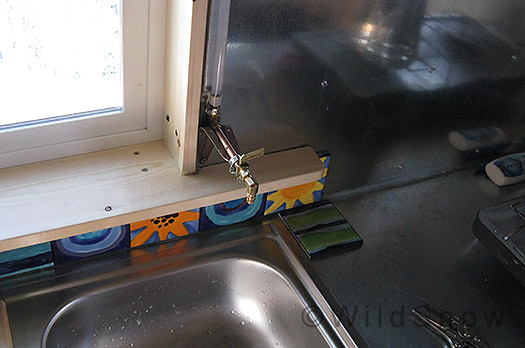
So where does it go after it leaves the sink? Greywater system?
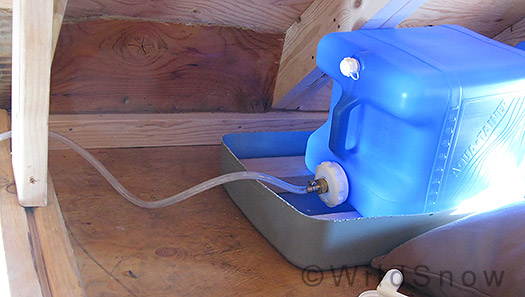
The bucket greywater system. Filtered if necessary and distributed on our “lawn.” Hardly any water ends up in the bucket, a few gallons after us being there for two days. Mostly, we like the tap for easy fills of tea kettle and water bottle. In summer, we’ll haul the greywater out if necessary or make a drywell, or water some of the trees we’re nurturing. The whole operation is similar to tent camping.
FYI Brass fittings contain small amounts of lead.
Scotty, thanks, I’ll look into that, but I’d imagine the miniscule exposure the water has to that small fitting is inconsequential… if not I’ll swap for something, using same concept.
What other options for fittings exist? Stainless?
The valve shown in photo is stiff and difficult to turn, I was upgrading anyway so I just got one that has a brass housing, but the ball valve is stainless on delrin. That combined with some galvanized steel and a couple of delrin fittings should eliminate most brass. That said, remember that in many houses and elsewhere there is going to be some brass in the plumbing system. I don’t think this is a big issue for a few fittings in a cabin, but might as well be careful. I’m pretty sure I got lead poisoning once when I was renovating old houses (from paint dust), took years to totally get over it. And still might explain a lot (grin).
Really Lou, that valve has to go. This project is coming out way too nice for that to adorn the sink area. Looking forward to the update!
I like the leak containment around the water tank. Good thinking. Once left the screw top on one of those loose and had to sleep in the passenger seat of my truck with all my clothes on as my down bag was soaked!
Hi there,
your cabin sure looks cozy.
I really like that the roof has a proper overhang .
Since you’ll be having liquid water in the hut ,
what sort of basic heating do you utilize ?
Didn’t see a smoke pipe.
A propane catalytic heater perhaps?
I couldn’t leave it on while away , though …
Electric infrared radiant heater . These are real nice . Even one 1000 watt device heats’ my 3 x 5 meter + 2 m high room – workshop nicely even when it has been cold for weeks in winter.
( insulated with 12,5 cm glasswool and 7 cm non-crumbly-styrofoam )
You could run them via a generator , store the generator in an soundproofed mini-shed / box , and it won’t disturb you too much.
You could also have some Deep cycle batteries (charged by generator).
to operate a small heating coil in your drinking water jug .
Wrap some closed cell foam around the jug for insulation.
This will keep the H2O liquid at about +5-10 °c , while the cabin heater is off while skiing.
Hope to see some more pictures of the inside and surrounding landscape.
Happy Wintertime,
Erik
Hey Lou,
Not sure if your photo shows the completed loft area or not but I see bare wood and rafters. I was wondering how you insulated the roof and if you used a vapor barrier?
No roof insulation (walls and floor insulted with blue foam behind paneling. VBL for walls and floor is taken care of by tight fit and caulking of the blue foam, as well careful interior caulking and clear finish. Space is small, and lots of fresh-dry air ingress due to combustion air for wood stove coming in through vent in floor under stove as well as the usual infiltration, so moisture is not a problem unless it’s 20 below zero F outside and 8 people are cooking and breathing (all so rare as to not be a concern). We do notice the cold from the uninsulated roof when the stove is turned down low. Plan is to make insulation panels that fit in between the rafters, using fire retardant foil faced foam, painted. No hurry on that, as again, everything works fine. Roof is thick 5/8 ply with tar paper, which does provide an R or two of insulation, so perhaps that’s why we see virtually no condensation on ceiling. More, it’s not usually super cold in that location. If this structure was in interior BC or Montana, I’d have built it with more insulation and VBL. Lou
Very smart, Lou. Sometimes simple fixes make life a lot easier.
suprised to see the A1+ location for insulation not insulated considering all the work you put in…
Gringo, no surprise, it was just a lot easier to start with the walls and a lot more important as I needed to get shelving up and stuff like that Such a small space, it’s really no big deal, and it’s not like the roof isn’t insulated, it’s probably about R-1. Like I used to always say when we live in a mobile home with R-6 walls: “I may not have R-30 walls like those new housed in Aspen that the building department lords over and I’m making my living working on, but we’re still using a fraction of the energy they do…so who has the most efficient home?” Lou
I spent several years living in dry cabins. My best trick for the water system that would eliminate hauling water upstairs was to install one of those primer squeezy balls that are used from a gas tank to a two-stroke motor. Had it mounted on the floor under the sink and I could work it with my foot like a sewing machine peddle while doing dishes.