Dynafit -- Speed Up!     Airbag packs, famous beacons, shovels, some of the best.     K2 has the skis that stay true to backcountry skiing.     Terrific deals on randonnee AT rando backcountry skiing gear.     Backcountry skiing equipment from Voile is hightly recommended.

Avalanche Airbag Backpack Overview

Bookmark and Share
This post by WildSnow.com blogger

Editor’s note from Lou: Our plan is to continuously update this post covering available airbag backpacks, and bring it up to the front several times a year. So today it again becomes your daily WildSnow fix. This time due to our updates regarding Mammut, as well as my adding exposition to this note.

Thanks to Nick our overview is astoundingly complete and being used by consumers and journalists worldwide as THE source for airbag backpack info. Nonetheless, it is a work in progress just as the avy airbag industry is these days. Yep, the “airbag wars” are in full swing!

On the surface, some of you might wonder why we’re directing so much energy to this product category. Simple. We feel strongly that using airbag backpacks will save lives, thus preventing a significant portion of the awful avalanche tragedies we’ve been reporting on and grieving over for years.

Basically, the whole avalanche safety issue has boiled down to human nature. Skiers will ski avalanche slopes, and some of us will ignore, forget, or perhaps never even learn how to play that game with reasonable safety. Thus, we need a backup plan. Beacons, while they’ve achieved an almost supernatural status in the pantheon of avalanche safety gear, have proved disappointing in real life. Fact is, if you’re buried in a slide you stand a pretty good chance of being dug up dead, no matter how many extra features your beacon has. Thus, two approaches to this problem. 1.Provide air to the otherwise suffocating buried victim. 2.Prevent burial in the first place.

The former approach is addressed by the Black Diamond Avalung. We like the idea of the ‘Lung, but even more, we like the idea of not being buried in the first place. Thus, again, we’re advocating airbag backpacks.

Speaking of the Avalung, what about using both ‘Lung and airbag? It’s easy to ziptie an Avalung on to the strap of your airbag backpack. However, we feel that doing so is a overly complex and excessive application of safety gear. At the least, how much fumbling around are you going to do in the split second when the snow fractures under your feet? Believe — in most cases of a skier triggered slab avalanche, you’re not going to have time to fiddle around with both getting an Avalung in your mouth as well as finding and pulling the ripcord on your airbag.

Thus, our advice. If (due to cost, weight, or personal preference) you’re not using an airbag backpack for backcountry skiing in avalanche terrain, by all means rock that Avalung. Otherwise, skip a year of costly mountain bike upgrades and acquire a late model airbag backpack from any of the brands below, practice using it, and don’t be afraid to pull the trigger.
*************************************************

Backcountry skiing avalanche airbag backpacks.

Airbag backpacks.

Below, our WildSnow.com overview of the various avalanche airbag systems and associated backpacks. We try our best to break out the details in the chart, but this is a complex backcountry skiing gear category so we can only go so far. Editing and improvement of this post is ongoing, so please refer to it as often as needed. If you’re shopping for or researching airbag backpacks, also see our category listing. If you’re wondering what these are and how they work, see this older post covering whether or not to use an airbag. By studying all our info you’ll be an informed shopper, though please note that this is a complex subject so getting clear on all the options and product availability can be tricky.

Models and shopping links Manufacturer Weight* Verified Weight Volume Self Refillable* MSRP Reviews/Links/Notes
ABS
shop for all ABS products    
Vario Base Unit (2012) 6.14 lbs (size L) $995
Vario 40 (2012) 7.39 lbs 7.65 lbs (size L) 40 L $1164
Vario 25 (2012) 6.95 lbs 7.29 lbs (size L) 25 L $1124
Vario Ultralight 18 (2012) 6.47 lbs 6.95 lbs (size L) 18 L $1085
Vario 15 (2012) 6.73 lbs 7.17 lbs (size L) 15 L $1110
Powder Base Unit (2012) 5.73 lbs $1037
Powder 15L (2012) 6.29 lbs 6.47 lbs 15 L $1152
Carbon Cartridge 0.62lbs $25 plus shipping £122 ~$160 w/ handle Not yet available in US
Steel Cartridge 1.14 lbs(Euro) 1.29 lbs(US) 1.30 lbs(US) $25 plus shipping $125 w/ handle
Activation Handle 0.14 lbs 0.15 lbs
Vario Base Unit (2007-2011) 6.0 lbs 6.37 lbs ABS Review
Vario 50 (2007-2011) 8.37 lbs 8.56 lbs 50 L $1,189.99 ABS Review
Vario 30 (2007-2011) 7.6 lbs 8.1 lbs 30 L $1,159.99 ABS Review
Vario Ultralight 18 (2007-2011) 6.6 lbs 7.01 lbs 18 L $1,124.99 ABS Review
Vario 15 (2007-2011) 6.9 lbs 7.39 lbs 18 L $1,124.99 ABS Review
Powder Base Unit (2011) 5.64 lbs 5.63 lbs First Look
Powder 15L (2011) 6.34 lbs 6.27 lbs 15 L £585 ~$919 First Look
Escape 50 (2005-2007) 8.83 lbs 50 L discontinued
Escape 30 (2005-2007) 8.53 lbs 30 L $1,035 limited availability
Escape 15 (2005-2007) ? ? ? ? discontinued
3rd party zip ons for ABS Vario:
Arva Crossover 27 ? 28 L €99 ~$130 This is a 3rd party zip on that uses the ABS Vario Base Unit
Arva Crossover 18 ? 18 L €99 ~$130 This is a 3rd party zip on that uses the ABS Vario Base Unit
Millet ABS Rider 18 ? 18 L $179.90 This is a 3rd party zip on that uses the ABS Vario Base Unit
Dynastar Pro Rider ABS Compatible ? 28 L €119 This is a 3rd party zip on that uses the ABS Vario Base Unit
Rossignol ABS Bag Compatible ? 28 L ? This is a 3rd party zip on that uses the ABS Vario Base Unit
*Weights include ABS Vario or Powder Base Unit as applicable, plus US Steel Cartridge and Activation Handle. Note: ABS refill prices do not include hazmat shipping (~$35) for filled cartridges. Vario and Powder unit prices include base unit.
Avi Vest
shop for Avi Vest products            
Avi Vest with cartridge 6.0 lbs 6.4 lbs
size M
20 L yes $625.00
Impact Vest with cartridge 6.0 lbs   20 L yes $695.00 Impact review
Backcountry Access
shop for BCA airbag backpacks            
Float 36 (2012) 7.7 lbs 7.93 lbs 36 L yes $785 Float 36 First Look
Float 30 (2012) 8lbs 30 L yes $750 Float 30 First Look

Full Review
OR Report

Float 18 (2012) 6.5 lbs 6.63 lbs 18 L yes $685 Float 18 First Look
Cylinder* 1.45 lbs $175
Refill Kit 5 refills $10 Refill Guide
*weights include cylinder
Mammut
shop for Mammut products            
Ride RAS 30L 6.8 lbs 6.83 lbs 30 L yes $874** Ride 30 First Look
Snowpulse RAS 2.0 system
Ride RAS 22L 6.6 lbs 22 L yes $854** Snowpulse RAS 2.0 system
2.0 cylinder 1.39 lbs 1.43 lbs yes $175 Snowpulse RAS 2.0 system
2.0 nonrefillable cylinder 1.1 lbs no $175 Only available in Europe
2.0 refill kit 3 refills $10.00 2.0 refill guide
**Cylinders are sold separately, but listed weights and prices include cylinder.
Mystery Ranch
Blackjack ? 7.8 lbs 43L yes $975 Announcement
First Look
Blackjack Review
Cylinder $200
Refill Kit 10 refills $10
*weights include cylinder
Snowpulse
shop for Snowpulse products            
RAS Pro 35 6.28 lbs 6.75 lbs 35 L yes $929.00 2.0 system
Pro35 Review
RAS Extrem 22 6.50 lbs 22 L yes $899.00 2.0 system
RAS FB ProTech Vest ? 15 L yes $929.00 2.0 system
Lifebag Tour 45 7.60 lbs 45 L yes $1,299.00 2.0 system
Lifebag Guide 30 7.16 lbs 7.78 lbs (size L) 30 L yes $1,249.00 2.0 system
Lifebag Highmark 22 7.16 lbs 30 L yes $1,199.00 2.0 system
Lifebag Prorider 15 6.50 lbs 15 L yes $1,149.00 2.0 system
2.0 cylinder 1.43 lbs $189.00 2.0 system
2.0 carbon cylinder   N/A Not yet available
2.0 refill kit 10 refills $30.00 2.0 refill guide
2.0 refill kit 20 refills $45.00 2.0 refill guide
Life Bag 45L 1.0 (2010-2011) 8.63 lbs(L)

8.43 lbs(M)

45L yes $1,149.99 1.0 system
Life Bag 30L 1.0 (2010-2011) 7.93 lbs(L)
7.83 lbs(M)
7.72 lbs(M) 30L yes $1,099.99 1.0 system
Life Bag 30L 1.0 (2008-2009) 7.93 lbs(L)

7.83 lbs(M)

8.22 lbs(M) 30L yes $1,099.99 1.0 system
1.0 Cylinder (2008-2011) 1.53lbs $250 1.0 system
1.0 Refill Kit 10 refills $40 1.0 refill guide
1.0 Refill Kit 20 refills $55 1.0 refill guide
*Weights include 2.0 or 1.0 cylinder as applicable.

**All weights and prices for packs include the cartridge (and activation handle for ABS). The cartridges and triggers are shown separately in the spreadsheet above in case you need a spare, and for weight clarification. All the information above is subject to revision, if anything looks off, please let us know.
**Cartridge weights are as FILLED.
*”Self Refillable” means you can possibly take to a local shop or location that can fill to high pressure. A normal air compressor can not accomplish this.

ABS


ABS started the avalanche airbag game back in 1985, giving them years to perfect their system. In fact, most of the published statistics available for air bags are from accidents and tests using the ABS system and are a result of their pioneering efforts. Early versions of their packs used a mono bag system (similar to the system used by BCA and Mystery Ranch), but they moved to a dual air bag in 1996 to create more surface area to ostensibly enhance the system’s ability to keep you on top of the snow. (As a bonus, having two bags provides some redundancy in case one of the bags or valves is damaged). They argue that their dual bag “wing” design puts an avy victim in a horizontal position and therefore less exposed to the dynamic forces of an avalanche. The 2001 Davos study reports that dummies using this system ended up face up or face down lying in the debris; however, real life reports show that many victims (not all) came to a stop head up and only buried to their hips. The ABS dual air bags have a cumulative 170 liter capacity.

New for 2011/12 season, the lighter system of the Powder line has been put in the Vario line, while further updates have reduced weights across the board. All packs will now have thermoform backs, better adjustability and comfort. Most of the weight of the airbag system has been moved closer to the back, decreasing swing weight and making the packs feel even lighter. ABS is still working on Canadian and US approval of their carbon cartridge, which is currently available in Europe. If you manage to get a hold of one, be aware that the North American refill facility will not be able to fill it. The facility has moved to Langley, British Columbia, closer to the US border for quicker turn around times.

Use
The ABS system differs from the others in that it uses a cartridge filled with nitrogen that is sealed (think of a sealed BB gun CO2 cartridge). There are no valves or gauges or cables to deal with, you just screw it into a socket in the backpack. The activation is accomplished with a removable “activation handle” which has an explosive round that, when pulled, sends a shockwave down the line to pierce the seal of the cartridge, which then inflates the dual bags which come out of either side of the pack like wings. The bags stay out of your way and don’t block your vision or range of motion, giving you more freedom to ski away or swim in the avalanche. Due to the bags being on either side, A-frame ski carry is not possible. The activation handle is stored out of the way in a pocket on the hipbelt, and when preparing for avy terrain, is attached to the shoulder strap via a quick-link coupler similar to an air hose. At times, this can be a difficult thing to do as it sometimes sticks, or you might think it is in only to have it fall into the snow. A little silicone oil helps. Once it is in place, the handle has a velcro strap which can be secured over it to keep it from being accidentally pulled. When ready to ski, adjust the strap so there is room for the handle to be pulled. Pulling the handle is surprisingly easy, even with heavy mitts. Repacking the air bags after detonation is very simple, just fold them up and tuck inside the velcro pouches.

The backpack is shipped to you with two sets of cartridges and activation handles. This is so you can perform a test release at home before venturing into the backcountry. Typically, you pay a deposit for the second cartridge when you buy the pack, which is then refunded when you send it back after your test. When you need your cartridge refilled, you must mail it to an ABS distributor who then sends it to ABS who will refill and send it back to you. The process is actually pretty quick–the filling is done in British Columbia, and I received mine the day after ABS received it. If you need a cartridge faster, you can have them overnight you one and cross ship your empty one.

Air Travel:
Print out the data sheet. For travel to or from the U.S., be sure to have a U.S. cartridge which is DOT certified, but sadly a little heavier than the European version (which TSA will not accept). One thing to make sure: Refer to your ABS cartridge as a cartridge not a canister or cylinder, which may confuse the highly educated and heavily qualified TSA officers and make them want to look inside.

Maintenance:
ABS recommends regularly weighing your cartridge (with the cap removed) to make sure no air has leaked. It should be within +/- 5 grams (0.18 oz) of the weight printed on the cartridge. ABS recommends sending the pack in for inspection (for a fee) after three years of use. See ABS’ maintenance page for more details.

Models

ABS Vario Line

The Vario line is innovative as a way to have multiple pack size options but with just one ABS air bag unit. You start with a base unit which is essentially the back, shoulder straps, hipbelt, and air bag apparatus. Different rucksack bags can then be zipped on to obtain the needed volume for your outing. This is a great way to have more options and save money. Previously, you had to either pick a pack that would work for most of your days, but perhaps not an overnight, or get a huge pack that would be overkill for most of your days but would work for anything. Small and large sizes available.

New for 2012 the Vario is lighter and comes in a different range of sizes. You can get 15, 25, 40, and “ultralight” 18 liter options. The ultralight simply ditches the outer shovel pocket and uses a lighter weight fabric. All but the 40 are clam shell zipper openings, and A-frame ski carry has been added to the 25 and 40.

ABS Powder Line

ABS’s newest offering, the Powder series uses a base unit with zip on back pack attachments similar to the Vario, however the base unit is shorter and lighter. So far, there are only 5 and 15 liter pack options, which is not a very usable size for backcountry tours, but is useful for sidecountry days at the ski area.

Escape Line

The older, heavier model. These are still very functional packs. They use the same airbag system as the original Vario, and can sometimes be found cheaper than the newer options. Fixed sizes of 15, 30, and 50 liters. Leg loops are webbing with plastic buckles that get stored in a pouch on the hip belt.

ABS Freeride Line
Coming in fixed 4 and 10 liter sizes, these packs are too small for practical backcountry skiing. They use the same system as the Powder line, but are fixed sizes (no zip-ons). Small and Large sizes available.

Snowpulse


Snowpulse was the second company to offer an air bag pack, and was recently acquired by Mammut. New for the 2012 season is the 2.0 system, which is much easier to refill and uses the same threads as ABS cartridges, including the available ABS carbon cartridge which saves significant weight. Also, Snowpulse has created the new RAS backpack line, which stands for Removable Airbag System. The airbag and all of it’s components easily detach from the pack for non avalanche use.

The Snowpulse single airbag systems have 150 liters of volume and fill with compressed air. Snowpulse began using a zip-on system similar to ABS’s Vario on their packs, but were forced to discontinue them due to infringing on ABS’s patent. Some of the zip on packs may still be out there, but the US ones had their zippers sewn shut.

Snowpulse Use
2.0 System (2012):
The activation handle tucks neatly and conveniently into a zippered pouch–very easy to stow or deploy with the new plastic handle that flips open. The handle is attached to a cable which mechanically punctures the copper burst disc in the cylinder, releasing air from the cylinder into the airbag.

1.0 System (2008-2011):
Webbing loop handle, harder to grasp with mitts. 2008 handles have too much velcro attaching them to the shoulder strap, making them hard to pull. This is easy to mod. When you pull the handle, it pulls a cable that in turn pulls a pin from the cylinder head, releasing the valve and sending air to the airbag.

Refilling and Repacking:
Do it yourself or keep it simple and exchange filled cylinders with the distributor. Also, when you buy your pack, some distributors offer the option to ship the cylinder empty to save on the HazMat fee.
2.0 system refill guide
1.0 system refill guide

Air Travel:
Snowpulse supplies three different types of cylinders, a U.S. refillable cylinder, a European refillable cylinder, and a European non-refillable cylinder. Only the U.S. version has DOT marking certifications, and should work the world over, Europe included. Sadly, the U.S. version operates at a lower pressure and thus must use a larger cylinder than the Euro version. For the refillable cylinders, you must empty the cylinder and unscrew the cylinder head for air travel. See the refill guides for more on this. The Euro non user refillable cylinder is certified by the IATA to travel filled, similar to ABS. This cylinder is only available in Europe.

Models

Lifebag Line

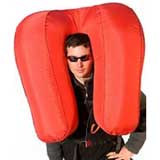
The Lifebag system is unique from the others in that the air bag comes out of the shoulder straps and top of the pack, wrapping around your head and chest. This is intended to protect your head and vital organs as well as perhaps help create an air pocket if you are indeed buried. See my commentary about how this doesn’t overly affect field of vision. This “Head On Top” technology is supported by tests of the Avagear which found that dummies more often ended up with their heads up on the surface than the dual or mono air bag systems which found dummies to be lying horizontal and sometimes face down.The 30L version is a panel style, while the 45L is a top loader. Snowpulse found a decent solution to the leg loop problem by having just one strap that goes between your legs and clips into the hipbelt buckle. When not in use, it folds up and gets cinched to the hipbelt by an elastic cord. The packs come in two sizes: medium for people up to 5’9″ and large for people over 5’8″.

RAS Line
Superlight, these packs use a behind-the-head ‘pillow’ single airbag, similar to BCA’s. It doesn’t offer the trauma protection of the lifebag line, but is lighter weight and removable from the backpack for use in summer or non avalanche hazard days. These packs are impressively lightweight.

Highmark Line

Just as the name implies, these packs are for slednecks. Basically the same as the Lifebag, but without ski and snowboard attachment, and with the addition of an external shovel flap.

Mammut


Mammut began licensing Snowpulse’s RAS system last year to create their own line of airbag packs, the Ride RAS series. In July of this year, Mammut bought the Snowpulse company, so for the time being the company is selling packs under both the Mammut and the Snowpulse name. They are working on aligning their brands to deliver a focused group of pack options for 2012. What this means for the future will be interesting; hopefully lower prices.

Mammut Use
See Snowpulse RAS 2.0 as it is the same system.

Refilling and Repacking:
There are two kinds of cylinder, a user refillable one and one that must be exchanged with Mammut to refill. The refilable one is the same as Snowpulse’s 2.0 cylinder, so see that section for more on that. You can buy the cylinder either filled or unfilled to save on the hazmat shipping fee. The non refillable one is only available in Europe.
2.0 system refill guide

Air Travel:
Mammut’s refillable cylinder is the same as Snowpulse’s, so see that section for more info. Mammut also sells a non user refillable cylinder that is certified by the IATA to travel filled, similar to ABS. This cylinder is only available in Europe.

Models

Ride RAS Line

Featuring 22L and 30L sizes, these packs use Snowpulse’s RAS system, which is light weight and removable from the backpack for use in summer or non avalanche hazard days and allows one to own one RAS system and multiple packs to zip it into. Both packs are similar to Mammut’s Nirvana pack, with clamshell zipper access, diagonal ski carry and vertical snowboard carry, and a separate avy tool pocket.

Backcountry Access


BCA stirred things up a few years ago when they introduced a U.S. made airbag pack at a significantly lower price than the European competitors. They are still seeking TUV certification (and pretty close it sounds like) which is necessary for European retailers. In the mean time, they are focusing on the North American market, with the Float 30 geared to snowmobilers, the new Float 18 for side country and mechanized skiers, and the new Float 36 for ski patrollers and avalanche professionals.

New for 2011/12 season are the Float 36 and 18. The Float 30 and 36 now have a zippered airbag compartment similar to Snowpulse’s instead of velcro, which should help keep it from bulging open and has allowed BCA to get rid of the annoying ‘gap’ in the old Float 30.

Use
The BCA airbag is activated via a handle connected to a cable attached to a release pin. The air bag comes out of the top of the pack, behind the head, sort of like a pillow. The idea here is that it keeps your head up and provides some protection, yet still allows full field of vision and mobility. The single airbag has 150 liters of volume.

The pack is shipped to you with a full cylinder and a refill kit is included–very nice. To get an even easier start, you can order the pack with a second cylinder, then test fire it and ship the spent cylinder back to recoup a deposit.

Refilling:
Do it yourself (see my refill guide below), or take it in to one of the many retailers who are licensed to do the refill for you. BCA has done an exemplary job of going out and training shops to do this and thus their list is continuing to grow.
Refill guide

Air Travel:
Print out the data safety sheet off BCA’s website. See the refill guide and other airbag posts for more details.

Models

Float 30

A 30 liter, panel style pack. Upgrades from last year’s model include a different material, hydration compatibility, waterproof zippers, diagonal ski carry straps, and a helmet net

Purchase at Backcountry.com
Float 36
Geared to patrollers, this pack is beefy and has lots of compartments and pockets to keep things in. Back panel access is nice, vertical ski carry is not, but you can rig your own ski carry system.
Float 18
Lightweight and perfect for sidecountry skiing out the gate. Diagonal ski carry.

Mystery Ranch


Made in Montana, this system was in prototype phase last winter and will be available this winter of 2011/12. Now using an airbag system made by WARY, which is similar to Snowpulse and BCA’s, they have switched to a closed venturi system like everyone else. Closed venturis are better because the air is forced into the airbag and can’t go anywhere else as opposed to an open system which might release air into the pack but not the airbag. The release handle is attached to the cable via a girth hitch, which is awkward but can still just be kept in a zipper out of the way. Apparently heli operations requested this, but I fail to see why just zipping it in a pack doesn’t do the job. The new WARY system is slightly lighter, bringing the pack weight down from last year.

Refilling:
Self refill kits are included with the pack! It should be similar to the Snowpulse and BCA refill process.

Models

Blackjack

A beefy pack tailored to ski patrollers, this pack appears to be super durable. It contains a 150 liter airbag volume in a system that rests entirely in the lid of the top loader pack. The lid can be replaced by a non-airbag version for no-danger days. An accessory waistbelt pocket is also sold separately.

- Custom fit harnessing
- Full side zip access
- (ATP) Avalanche Tool Pocket.
- Ski carry: A Frame or Diagonal.
- Snowboard Carry: Vertical.
- Ice Axe loops.
- Shoulder strap with zipper accessory pocket.
- Waistbelt contains harnessing leg loop.
- 43 liter pack volume.

WARY Avi Vest

Prior to this season, Avi Vest, while being the oldest North American avy airbag company, did not make a backpack. Instead, they sold two vest options primarily designed for snowmobilers. We found their vests to be useful, but lack enough carrying capacity for all but the shortest backcountry skiing trips. We’ll add more details here when they come out with a backpack, which they are said to be doing this season.

Comments

91 Responses to “Avalanche Airbag Backpack Overview”

  1. naginalf May 4th, 2011 8:55 pm

    Awesome! Thanks Lou! And thanks very much, Nick, for putting this together.

  2. Lou May 5th, 2011 5:34 am

    Thanks Nagin, we’ll improve and update. What took the time was combining the weights of the ABS base unit with various zip-on sacks, so their weights could be compared to other brands. My math might be off in places, apologies if so.

    Am not sure we included cartridge weight in every option, will check later today. If a weight looks too good to be true, that’s probably what happened.

    Also, once the carbon fiber cartridges become available that’ll change the weight picture quite a bit.

  3. Janne May 5th, 2011 6:18 am

    Hi Lou! Thanks for all the great artcles and test reports! Just wondered if you’ve noticed that most of the pictures, graphs etc don’t work when reading with a small palm top like the iPod. They aren’t scaled so I can never see the right half of the pic or sheet. Otherwise, fantastic!

  4. Lou May 5th, 2011 6:27 am

    Janne, I wish Apple would fix that. But they’re probably expect me to since I’m way better at that stuff then they are, so I’ll try (grin). Lou

  5. Ali E May 5th, 2011 10:07 am

    I have the same problem on my iPhone.

  6. Lou May 5th, 2011 11:37 am

    Guys, I’m getting serious about the iPhone issue today. I installed Safari browser and an iPhone emulator, now to the trouble shooting… no guarantees. Lou

  7. Hallvard May 5th, 2011 2:13 pm

    ABS have posted a picture of a new zip on pack for the Vario line on Facebook. Looks like it will get A-frame ski carry which would be nice. With the 50l pack the skiis end up very far from your back as it is now, especially on the small size frame. The 50l seems just to big for the small frame, it easily hangs down from the frame. Otherwise the frame fits really nice to both my girlfriend and me, her: height 166cm-size small and me: 183cm size large.

    And the carbon cartridge is nice! Double income, no kids ;)

  8. Hallvard May 5th, 2011 2:16 pm

    She also as the light weigth 18l and I the ARVA 27. I miss a proper ski carry on the Arva and a ice-axe holder, but other than that a tight packs to wear for resort skiing and shorter hikes.

  9. Lou May 5th, 2011 2:23 pm

    IPHONERS

    I might have got it working for you, please test ASAP and get back to me.

  10. Ali E May 6th, 2011 9:17 am

    I can confirm that the iPhone problem is solved Lou. Nice one!

  11. Lou May 6th, 2011 12:36 pm

    Great Ali, enjoy! I’m inspired now to improve my mobile theme, stay tuned…

  12. ewa May 6th, 2011 2:28 pm

    I have been reading the site via the Facebook app for the iPhone, now it is ok in the browser too. Thanks.

  13. Lou May 6th, 2011 2:39 pm

    ewa, my pleasure, please click on the advertiser links once in a while and check them out, as they’re the ones that make it possible for me to sit here and fiddle around with things like a mobile website version. Lou

  14. Lou May 6th, 2011 2:40 pm

    Not sure the chart in this post can ever be made to work very well in most mobile browsers, but we’ll keep trying.

  15. Chris Auld September 13th, 2011 5:22 am

    Any chance you can elaborate on the ABS Refilled in BC bit?

    At the moment you’ve really got to go through SnowBigIdea to get economical fills (they don’t even do refills in NZ have to buy a whole new cylinder). The issue is the Hazmat fees to and from.

    If I can just call into somewhere in Vancouver or somewhere around then en route to Whistler for my fills (really just the test release each year – touch wood) that would be well sweet.

  16. Andy September 17th, 2011 1:28 pm

    Enquiring minds want to know about the new Mammut/SnowPulse effort, which I thought was a bargin until I realized the price didn’t include the cylinder, although it is coming in over a pound lighter than the BCA models

  17. Lou September 17th, 2011 1:48 pm

    Nick is on the case with SnowPulse.

  18. ty gittins September 29th, 2011 8:38 am

    with all the built in harnesses for blackpack retention in an avalanche, why not just make it a full on alpine climbing harness with double backed webbing and two big gear loops?

  19. John September 29th, 2011 9:15 am

    My 2 sons and I are 6’1? to 6’4?, so we are intrested in the specs on long torso (21?-23?) models. I have talked to BCA and they say their Float 36 fits a longer torso then the Float 30, although I have not gotten any specs.
    The SnowPulse Life bag 2.0 looks intresting, but I haven’t been able to find many specs.

    We appreciate the info!

    Sorry about the double post.

  20. Nick September 29th, 2011 9:37 am

    Thanks for updating this – all of the weights of the Euro-based bags are closer to MR/BCA than I thought once you add in the cylinders, etc.. Interesting. I always thought MR was much heavier, but it seems pretty close for more “literage” in the bag itself.

  21. Chris September 29th, 2011 1:26 pm

    I don’t think the Vario 25 liter will have A-frame ski carry. This is what ABS writes on Facebook:

    “Hi Hallvard, the Vario 40L backpack is the only one where the A-frame carry is possible. All other smaller zip-ons work with the diagonal ski mount as the airbags need to have enough space to inflate. Additionally, put your helmet on top if you like. Here you can see some pictures…”

    This is an answer to a question by a fan of the page.

    Sadly I will have to be without A-frame ski carry on my 25 liter then…

  22. Nick September 29th, 2011 7:08 pm

    Hi everyone, sorry I was too busy at work today to check in. I’ll try to address everything:

    @Lou: All ABS, Snowpulse, and BCA weights include the respective cartridge and handle.

    @Chris: I’ll get back to you with more on refilling in BC.

    @Andy: Snowpulse pack prices include a refillable cylinder. Not sure where you heard that? Shipping a full cylinder can incur hazmat fees, but you can usually choose to receive an empty one and then refill yourself to avoid that fee. It will be interesting to see what the Mammut buyout will bring.

    @Ty: That could be nice, as long as taking the pack on and off wasn’t a pain.

    @John: Snowpulse Lifebag packs will come in size medium and large. I have a medium that my 5’0″ wife uses on occasion and that I have managed to use and I am 6’0″. I’d be happier in the large though. The R.A.S. series is one size fits all and my wife and I fight over the pack all the time, fits us both great.

    @Nick: Yes the weights are all getting closer now that MR has dropped nearly a pound and BCA’s new packs are lighter. Keep in mind the volume to weight ratio, though not all these packs are measuring volume the same.

    @Chris: Yes only Aframe on the 40L, sorry for the typo, will fix. You can easily add Aframe carry to the older Vario packs, I did on last year’s Vario 30 and it works great. Looks like you could rig something on the new 25.

  23. Nick September 29th, 2011 7:09 pm

    Just to be clear, MR and Avitech weights are based off what you gave me Lou- I’m assuming they include the cylinders too.

  24. Andy September 29th, 2011 9:18 pm

    All online retail sites I’ve seen, Euro and US, are selling the cylinders separately for the Mammut packs i.e. http://www.mountaingear.com/pages/product/product.asp/imanf/Mammut/idesc/Ride+Airbag+30+Backpack/Store/MG/item/229868/N/4294967244%201064
    That’s all I meant.

  25. Lou September 30th, 2011 6:51 am

    Everyone, thanks for the comments on this post. It’s not the easiest thing to keep together and I couldn’t keep it published without Nick spending time on it. I’ll check some of the weights when we’re home from some weekend traveling we’re doing.

    As predicted last year, quite a few important changes in this stuff this year. Such as the closed venturi systems. I agree they’re expensive. Seems like one the huge amount of behind the scene R&D calms down a bit and the market grows, the price might go down. After all, what does an airbag backpack consist of, anyway, but a backpack, an airbag, a trigger mechanism and a tank of compressed gas? Basically, a paintball gun with a nylon sack attached to it. How much would that cost? Should we make one in the WildSnow workshop and see?

  26. Nick September 30th, 2011 8:38 am

    Andy, sorry I forgot to mention the Mammut packs. Last year Mammut teamed up with Snowpulse to license their technology and produce their own packs. Since then, Mammut has bought Snowpulse. We’ll see how that plays out next season with the pack lineup. In the meantime, I neglected to put the Mammut pack in the list above. I’ll get that corrected when I get a chance. The cylinder is not included in the listing you link to, which might explain why the price is as low as it is. Great deal to get what is essentially a Snowpulse pack.

  27. Nick September 30th, 2011 10:50 am

    You can go directly through ABS for refills if it is more convenient than going through a retailer. The price will be the same. Contact ABS for refilling here: csr@abs-airbag.com

  28. Ben R October 9th, 2011 2:24 am

    Great resource here!

    Looking forward to snow pulse ras pro 35 review and hoping to see a comparison to the mamutt ras bag.

  29. Brad October 26th, 2011 1:33 pm

    Awesome work Nick!

    Just a quick FYI for local elk mtn range users. Aspen Expeditions, located at the Aspen Highlands base village will be serving as a fill station for both Mammut and Snowpulse 2.0 style systems. System should be up and running in late November.

    In regards to Snowpulse pack sizing, spoke directly to the North American distributor and they recommend anyone over 5’8″ utilize a large pack (lifebag series only). The medium packs will fit someone larger but are not recommended.

  30. Nick Thompson October 26th, 2011 2:15 pm

    Thanks Brad, psyched you guys will be doing refills! Will you refill BCA or WARY cylinders?

    I’ve got last year’s Snowpulse LIfebag 30 (1.0 system) in a size medium. I’m 6’0″ and it works fine for me. Imagine I’d be happier in a L though.

  31. Rob Coppolillo October 26th, 2011 9:09 pm

    Yo Gang,

    Just met with the folks at BCA for an article I’ll be doing in Elevation Outdoors. Andy Wenberg informed me they just received TUV certification–a detail, but worth updating next time you guys are editing.

    Thanks for the great resource and good turns to all,
    Rob C

  32. telemike October 26th, 2011 11:01 pm

    good stuff

    all I can add is that if you had an Avalung and an airbag pack, you should not have to fiddle with getting the Avalung in yer face and deploying the airbag

    Avalung should be in yer face already – you’ve got to practice skiing with it, as it’s a bit odd to try to breath through and around the snorkle – I have carried Avalungs and Avalung packs since they have been available, but have never tried an airbag system

    I trust Avalungs

    folks I trust trust airbags

    w/o trying an airbag, I’d say my 1st choice is still Avalung – my choice might change when I tyry an airbag system

    probably better to have both

    why wouldn’t you want something that prevents burial and something that helps in a burial?

    I’d go with BCA

    I really do not want to get buried.

    ~mike

  33. Dani October 27th, 2011 1:45 pm

    Great breakdown. Thanks!

  34. Arne November 9th, 2011 4:49 am

    Regarding the Snowpulse descriptions:
    1. “See my commentary about how this does overly affect field of vision.” Should this be “does NOT overly affect”?
    2. I think the latest news on Snowpulse cylinders is that the 3000psi non user refillable version is approved for air travel, like you describe for Mammut. The Snowpulse description should be updated, IMO.

  35. Lou November 9th, 2011 6:39 am

    Arne, thanks so much, I’m sure Nick will get this. Lou

  36. Arne November 10th, 2011 1:33 pm

    Sorry, “3000psi” in my comment above should be “300 bar”.

  37. Arne November 10th, 2011 1:37 pm

    Sorry to keep this coming in little bits.

    The 300 bar version is the same as was is called the European version above. It is not user refillable, but it is approved for air travel while filled. However, I think that does not apply the US.

  38. Nick November 10th, 2011 8:54 pm

    thanks for the catches Arne. updated.

  39. Arne November 11th, 2011 1:49 am

    Nick and Lou, thanks for making this great overview, as well as the various in depth articles. I based my shopping decision primarily on this. I chose Snowpulse (tour 45L, I like to have room for the helmet inside).

  40. Rob November 12th, 2011 3:36 pm

    I was looking to buy the new Snowpulse Guide 30, but tried it in the shop today and I found that the airbag stowed in the shoulder straps makes the straps really bulky and stiff and I’m afraid it would interfere too much with arm movement. I’m surprised this isn’t a more frequently mentioned issue when reviewing this backpack. (btw, Guide 30 is the new Lifebag 30).

    Anyway, now I’m thinking of going with PRO 35 instead and I’ve read your review. I just want to ask if it is possible to attach skis on the sides or is diagonally the only option available? Thanks for your reply and props for this overview.

  41. Jack November 13th, 2011 1:09 am

    Here is some info on travel with the 2010 ”American cartridge’ Snowpulse:

    http://www.tetongravity.com/forums/showthread.php/144348-Flying-with-Snowpulse-ABS-Pack?p=2226937#post2226937

    I’m not sure how the new 2011/2012 ‘American cartridges’ are filled, but the TSA info is still valid.

    About the shoulder straps: they will form to your body. The airbags in the shoulder straps will protect your neck from injury (like breaking….) so even if they are less comfortable (which they are not imho), I would go for the Lifebag line and not for the RAS line.

  42. Nick Thompson November 16th, 2011 10:18 am

    Rob, I thought the same thing about the Snowpulse Lifebag/guide shoulder straps when I first saw it. But after skiing and hiking with it a few times I don’t think it’s an issue. If the extra protection is important to you, then it might be worth it. If not, then go with the lighter RAS.

  43. Xavier November 16th, 2011 10:43 am

    Rob, I have the Snowpulse with airbag in shoulder straps…. doesn’t interfere with arm movement at all.
    In fact all the additional padding it provides makes it a very comfortable pack, carry wise!

  44. Nick Thompson November 16th, 2011 11:05 am

    Arne,
    Glad this was useful for you. Just got an ABS Vario 45 for review. Can’t wait to try it out.

  45. Rob November 16th, 2011 3:01 pm

    Hey guys, thanks for everyone’s input. I really appreciate all the opinions. Keep’em coming. :)

    I’m still looking for a store that would actually sell the PRO35 pack, seems like everyone is selling the Guide 30 only and I don’t want to pick a bag without trying it on first to see how it fits.

    Anyway, in case you’ve missed it – you might want to add the new North Face backpack with ABS system to your overview.

    http://www.engadget.com/2011/11/15/the-north-face-announces-avalanche-airbag-safety-system-abs-ve/

  46. Brad November 16th, 2011 3:12 pm

    Rob,
    Where are you located. We have both of the R.A.S packs on site to try on at Aspen Expeditions at the base village of Aspen Highlands. Let me know if you want to stop up and try some packs on.

  47. Lou November 16th, 2011 3:16 pm

    Rob, I heard about the TNF airbags. Appears to be somewhat of a me-to, but we’ll get to it eventually. Nothing to panic about. We’ll let content deprived and desperate individuals have at it first (grin).

  48. Rob November 16th, 2011 3:23 pm

    Brad, thank you, I’d love to stop by, but I live in Chamonix, France. You’d think our shops would be stocked first, since Snowpulse is a swiss company.

  49. Lou November 16th, 2011 4:46 pm

    What! You can’t find that stuff in the skiing center of the universe? Hmmmm, better head over to Austria (grin).

  50. Oli C November 17th, 2011 10:52 am

    get a better price in Austria (or germany)
    Rob: Conrad sport do good web prices from germany, don’t now what they carry on the technical side.

    i’m guessing Aux Vieux in Sallanches don’t stock them?
    what about heading over Verbier direction? or down in their Martigny Valley.

    I’m back in Cham from next week. Hope it snows in Dec! catchya round the hills.

  51. Dimi November 17th, 2011 10:55 am

    get onto snowsafe.co.uk. they sorted me out with the new Vario (complete with the new 25 liter design backpack) over 6 weeks ago for a little over 500 GBP (with carbon). now that is cheap.

    I have no connection to this business, btw ;)

  52. Rob November 17th, 2011 7:14 pm

    Oli: they have the Guide 30 in Sallanches, but I really want to see and try the PRO35 before I decide what to get. Snell’s got the Guide 30 as well, but they told me they won’t be getting the PRO35. I can order it, but then I have to buy it, of course.

    Btw…some people say to expect snow on Wednesday. ;)

  53. Jaakko November 19th, 2011 1:40 am

    Just purchased the ABS baseunit and the 25L Vario cover for it yesterday from the local store with the carbon cartridge.

    It really does look to me like ABS stepped up the game for this year. Last year the ABS covers/backpacks really didn’t impress as a whole, whereas Snowpulse’s Lifebag series looked good, except that you were stuck with one size. Now Snowpulse RAS looks good weight wise, but offers no large packs so if you plan on getting an airbag for longer tours, 35L is the biggest you get with Snowpulse RAS. For next season this will of course change. For ABS speaks the way the bag deploys (vs RAS, not Lifebag), but I do think that any bag will do the trick in an avy.

    So, to me, at the moment ABS still offers most versatility and now the new ABS covers/bags also work better than before. For lift served / sidecountry skiing you can always use just the cover that comes with the basic unit to reduce the weight and bulk of the backpack.

    Had there been 40-50L RAS backpacks available to compliment the current offering, I might have gone for RAS as well, but now I’m happy with my ABS.

  54. Lou November 19th, 2011 7:20 am

    Jaak, with the carbon cartridge! That must be really nice!

  55. Nick Thompson November 19th, 2011 9:07 am

    Jaako, I agree, the new ABS packs look pretty sweet. Just opened a box of all of them- very nice. Going to do a short ski with the ABS 40 in a few hours. Stay tuned for a quick review post of them in the next few weeks. Hopefully Mammut/Snowpulse will come out with a larger RAS model soon for big trips, it wouldn’t be hard.

  56. John November 23rd, 2011 4:05 pm

    ABS reccomends wearing a back protector as well as a helmet to meet their trauma and survival stats.

    Anyone have experience with back protecters?

  57. Jaakko November 29th, 2011 7:12 am

    John,

    Back protectors are, I suppose, most often worn by park skiers and they really are valid there. However, a back protector under a backpack is very uncomfortable and most of the time useless as well since a backpack that’s packed the right way protects your back well enough.

    I carry a shovel blade in my backpack every time I go out and you hopefully do as well. If something gets through that.. well, I don’t think a back protector would really have helped either.

    A back protector can of course offer better protection for your coccyx/tailbone than a mere backpack, so if you wish to get some protection for that, maybe consider impact shorts along with your backpack?

    In any case, I don’t know of anyone who wears a back protector under a backpack – it’s simply too uncomfortable.

    Cheers.

  58. Lou November 29th, 2011 7:37 am

    Yeah, there has to be a limit on how much safety gear is practical. It’s like automotive stuff. Sure, we could wear helmets while driving and doing so would up our odds of survival considerably in the event of an accident, but do we?

  59. Frank K November 29th, 2011 8:19 am

    Back in the 90′s, a lot of us would ski in the big-mountain comps with a pack and a shovel blade before there were spine protectors. Wouldn’t think of taking one into the bc- talk about non-breathable, and the pack does a fine job of protection anyway. Same for impact shorts, although I know a few who do ski in the bc with them. Inbounds, I ski with both every single day once the steeps are open, and my spine protector saved me from serious injury on one occasion.

  60. Lou November 29th, 2011 8:29 am

    Even with my conservative style, If I had a pair I’d ski at the resort with impact shorts, as well as snowmobile. I seem to hit my hip bones way too often, knees too.

  61. John November 29th, 2011 9:55 am

    I would think a backpack would serve as protection as well, but I have not dissected the stats. Just thought it was an odd statement from ABS. I’ve only seen guys in body armor at Sowbird.

  62. franz December 2nd, 2011 1:38 pm

    Problem of leaks on cylindr Snowpulse:

    http://www.snowpulse.com/en/information-concernant-des-fuites-sur-les-cartouches-2009-11/

    For the production of the Snowpulse Cartridge from 2009 – 2011 our supplier delivered us gauges that started to leak after some time. We already communicated this problem last winter and all customers who filled out the Warranty-Register Form were informed already in December 2010.

    We want to remind you as well to always follow the “quick check” steps in the user manual before every use. Especially the step to always check the pressure of the cartridge before usage.

    The cartridge production of this winter (2011-2012) remains unaffected by the problem – but a pressure check before each use is in any case recommended.

    You can return leaking cartridges to you dealer for an exchange.

  63. Jonathan December 12th, 2011 10:57 am

    Not trying to promote a company but a good review non the less and helpful with deployment, just adding to the wealth of good info

    reviews the following Avalanche Airbags: ABS, SnowPulse, BCA, AviVest, and Mammut Avalanche Airbags
    http://www.youtube.com/watch?v=GA5IrD6d5yY

  64. Will December 20th, 2011 9:26 am

    Nick,
    When I tested my Snowpulse Guide 30 with the factory cylinder, the inflation was complete and the airbag stayed full.

    When I tested it with an ABS cylinder, the inflation was about 95%, and it deflated slowly.

    What was your experience?

  65. Nick Thompson December 20th, 2011 9:49 am

    Interesting. I’ve only tested the Snowpulse Pro 35 RAS with an ABS cylinder. I’ll try the Snowpulse Guide and let you know.

  66. Nick December 20th, 2011 8:20 pm

    Just tested a Snowpulse Guide 30 with an ABS cartridge. Worked flawlessly. Airbag was completely filled tight. Not sure why yours didn’t. Did you weigh the cartridge to confirm that it was filled before you triggered it? ABS cartridges have their filled weight printed on the side (which does not include the cap).

    The Snowpulse Lifebag series airbags (including the Guide) wrap around your head and are designed to slowly deflate, the idea being that an air pocket will be formed. Not sure how well that part will work in real life, but it’s a good idea. At the very least, the bag will be releasing it’s air (most of which will be ambient air due to the venturi valve- very little of the actual air in the bag is from the cylinder) into the snowpack behind your head. ABS cartridges contain compressed nitrogen, but again, as most of the air is ambient, this isn’t a concern. That’s why you wouldn’t want to fill a cylinder with CO2.

  67. Will December 21st, 2011 9:30 am

    I will retest with both cylinders and share the results. The ABS cylinder was new so I did not weigh it:(
    Thanks,
    Will

  68. Rob December 23rd, 2011 5:45 pm

    So, I finally bought my airbag. Decided to go for the Snowpulse Guide 30. I see people discussing various cartridges. Well, my cartridge contains compressed nitrogen and it is not an ABS cartridge, it’s a Snowpulse. Is this one of those US vs. EU market differences? Does that change anything? I cannot fly with it? And I guess I cannot have it refilled at a local scuba shop, I have to exchange it for a new one which costs more than filling it up, right? They told me about 20 or 30 euros.

  69. Dirk December 24th, 2011 12:29 am

    ABS warns agains using their cartridges in the Mamut RAS (Snowpulse) packs. Here their official statement that they posted on facebook

    “We want to inform you that the use of ABS carbon cartridges in the Mammut RAS system can lead to massive obstructions of the RAS airbag’s filling system. This was shown by a re-examination conducted by the TÜV (Technical Control Board in Germany) Product Service in Munich we initiated after having observed problems in our own tests. We therefore explicitly warn against using ABS cartridges in other airbag systems!”

    I thought that this would be worth sharing as some of doing exactl that.

  70. Brad December 24th, 2011 9:37 am

    Dirk,
    Can you either elaborate on your quote above or provide who is your contact at ABS? I am trying to identify if this is only a problem with the carbon cartridge and how it interferes with the Venturi valve as this is not located or obstructed by the cylinder itself. I would imagine it may be a problem with the higher pressure 4500psi cylinders (which I believe the carbon is high pressure) in conjunction with a 3000psi Venturi. Any additional details or clarification are greatly appreciated.

  71. Dirk December 24th, 2011 2:26 pm

    Brad:

    I first came across that information on the facebook site from ABS. On the snow pulse website you can read the official statement from Mammut on the issue http://www.snowpulse.nl/pdf/Ride%20RAS%20Compatability%20ABS%20Carbon%20Cylinder_ENG.pdf

    Btw: God jul from Norway to everyone

  72. Brad December 24th, 2011 3:44 pm

    Dirk,
    Thanks for the follow up. It seems that this would apply not only to the R.A.S line but to all the snowpulse line (including the lifebag). After reading the article it sounds like the issue is with a thinner burst disk being used in the ABS cylinder. Does anyone have any info on using the standard (non carbon) cylinder with the Snowpulse/Mammut line?

    They decreased the thickness of the disk from .3mm to .2mm which is a safety concern for sure. At this point I am interested to know why they decreased the thickness except to potentially limit the use of their cylinders in snowpulse/mammut bags and force the use of the ABS pack.

    Merry Christmas!

  73. Will December 27th, 2011 9:10 pm

    Nick,
    Got a new NA ABS cylinder (November 14 fill date) and it worked flawlessly in my SnowPulse Guide 30, just like a SnowPulse cylinder does,
    Thanks,
    Will

  74. Brad January 2nd, 2012 3:20 pm

    Nick,
    Have you heard anything in the pipeline about Arc’teryx entering the airbag market for next year? Rumor has it that they are producing a pack that potentially may not use a canister.

  75. Nick January 2nd, 2012 3:23 pm

    Haven’t heard that rumor, but I’ve heard that Black Diamond is also working on a canisterless airbag. Couple years out at least. Not sure how it works- some way of triggering the venturi effect without any air to start with? Of course they also had some amazing new tele binding in the works that never came to light, so we’ll see what happens.

  76. John January 7th, 2012 7:50 pm
  77. Rob January 8th, 2012 5:31 pm

    After having skied about eight days with my snowpulse guide 30, I can say that the bulkiness of the shoulder straps is not as bad as I thought it would be. I’m glad I listened to advice given here. Thanks, guys.

    Did anyone else find that the shovel/probe front pocket is a bit too short? I can hardly fit my ortovox shovel handle in there. I thought these things were supposed to be standard length.

  78. Nick Thompson January 10th, 2012 9:47 am

    Regarding using ABS cartridges with Snowpulse and Mammut packs:
    http://www.wildsnow.com/6503/mammut-abs-compatibility/

  79. Brian January 17th, 2012 6:35 am

    I know this has been discussed a bit before, but I’m goig to bring it up again. Can an airbag replace a shovel/probe/beacon? I know the knee jerk reaction is an emphatic “no!”, but tell me why. For years the standard for basic avy safety has been transceiver/probe/shovel plus an education. Let’s say that gives you a 50% chance of surviving an avalanche if it occurs. That has for some time now been the level of risk we’ve decided is acceptable. Now these airbag packs are claiming a 95-98% survival rate. If airbags had come out first, would anyone have ever started carrying probes? I’m not saying transceivers and probes don’t add even more safety, of course. I’m just saying that if airbags provide a greater chance of surviving than probes and transceivers, and probes/transceivers have in the past provided a level of acceptable risk, shouldn’t the airbag alone do the same? Also, I know the probe and shovel are used for extracting other people, but let’s assume a future backcountry where everyone has airbags. Also, I think the failure rate for airbag deployment is much lower than the ignorance/failure rate for human searchers.

  80. Brian January 17th, 2012 7:00 am

    Also, a decent pack (~$135) + transceiver (~$335) + probe (~$75) + shovel (~$50) comes to ~$600 and ~50% survival. Add an Avalung, and you are at about $730 and an unknown, but higher survival rate. The BCA Float 36 is $785 and apparently provides an even higher survival rate. I would have a hard time not telling a new backcountry user to not go for the airbag pack first.

  81. Hallvard January 17th, 2012 7:08 am

    I think you have a point, but the backpack survival rates includes shallow burrials where you still need a tranciever and shovel to fint the person and get him/her out. How many this is, I don’t know.

    You could probably go for a simpler/cheaper transciever though.

  82. Nick Thompson January 17th, 2012 8:18 am

    Good question. I think a beacon and shovel will always be a good idea in addition to an airbag because you cannot count on an airbag to work in every instance. Here are some examples I can think of:

    1. Terrain traps. Airbags only work if you are moving with the debris. If you stop at an obstacle, the lifting affect of the airbag will cease and snow will pile over you.

    2. Second or sympathetic avalanche. After you’ve triggered an avalanche, have ridden it out and are sitting on top, if another avalanche occurred and there was no slope for you to be carried down, you would likely be buried. Similar to terrain trap problem above.

    3. Failure to deploy. Any number of reasons can cause this- not pulling the trigger handle, not having the handle out in ready position, having the pack ripped off your body by not using the straps correctly, not having the airbag sytem set up correctly, punctured airbag, etc. Pretty unlikely, but any of these things could happen with enough negligence.

  83. Brian January 17th, 2012 4:20 pm

    I understand the airbag stats include partial burials. Here’s some sloppy statistics: airbags lower the chance of burial to 13%. If every one of those people would have died if they didn’t also have a transceiver, that still means 87% of folks didn’t need a transceiver. How many of that 87% die even though they don’t get buried (due to trauma or going over cliffs or whatever): about 4-5%. That is still an 80% survival rate, being as conservative as is reasonable.

    Not carrying a probe, shovel, or beacon would also save 2.5 pounds plus their pack space (at least the probe and shovel space). Give up the Avalung and you are at 3 pounds. Because you don’t have a shovel or probe, you can get away with using an 18L pack for the day, meaning more comfort and another .5-1 pound of weight saving.

    So the 3-4 pound weight penalty of an airbag pack can disappear if you don’t take a transceiver, probe, shovel, or Avalung. And overall, on average, you’d be safer.

  84. Brian January 17th, 2012 4:53 pm

    Terrain traps, secondary avalanches, and failures to deploy are all already figured into the statistics for airbags. Those things are all part of why 5% of airbag users still die.

  85. Shawn January 21st, 2012 10:46 am

    what would be the difference between nito and compressed air at lower temp. such as -30c knowing there is moisture in compressed air and the volume difference when they fill the cylinders at room temp.

  86. Philip Maynard January 21st, 2012 7:41 pm

    There is essentially no moisture in air compressed that much anyway, but it seems these are usually filled by SCUBA compressors which have an additional moisture seperator.

    Air (mostly Nitrogen), and pure nitrogen behave pretty much the same over temperatures humans can withstand.

    So, no difference.

  87. Nick Thompson January 23rd, 2012 8:10 am

    Certified refillers, dive shops, and fire stations should all be able to fill with DRY air (not all paintball centers). If the air is dry, then there should be no worry about freezing as there is no water to freeze. Plus, air is much easier to come by than nitrogen for refills. See a past discussion on this in the comments here:
    http://www.wildsnow.com/3957/snowpulse-refill-howto/

  88. Brad January 23rd, 2012 8:19 am

    Nick,
    Did you make any headway at OR with either Snowpulse/Mammut or ABS in trying to understand how very similar designs of the canisters with the same thread pattern and burst disks and them not being incompatible. Last thread I was trying to understand how going with a slightly thinner burst disk (ABS) would void the incompatibility with using an ABS cylinder in a Snowpulse bag. If there is a chance of a shard from the disk getting stuck int he plunger (when ABS canister used with Snowpulse bag) then how does the snowpulse canister with a snowpulse bag not show this problem. Any info is helpful

  89. Nick Thompson January 23rd, 2012 8:41 am

    Wasn’t able to make it to OR unfortunately. Lou, did you get a chance to find out more about this? Here’s what I’ve got from a couple weeks ago in case you missed it:
    http://www.wildsnow.com/6503/mammut-abs-compatibility/

  90. Lou January 23rd, 2012 8:46 am

    In my case, not much time at show for airbag details, but I’m 100% all these questions can be resolved by communicating with folks at companies. More, the problem with show is in many cases you’re just going to get PR chatter, better to do this technical stuff at a more measured pace.

  91. Bob February 22nd, 2012 1:49 pm

    I’ve good experiences with the BCA floats. Traveling by plane wasn’t a big problem. Put the cylinder together with the ski’s or snowboard to make more clear where it is used for and you have to drop such a long sized bag on a special counter where they scan it right in front of you (at least in Amsterdam), so you can explain directly if needed.
    We made a nice funny video of the float in India:
    http://www.youtube.com/watch?v=2BcrNIpYYGA

Got something to say? Please do so.


Anti-Spam Quiz:


If you need an emoticon for a comment just copy/paste off the following list, or use text code you might be familiar with.
:D    :-)    :(    :lol:    :x    :P    :oops:    :cry:    :evil:    :twisted:    :roll:    :wink:    :!:    :?:    :idea:    :arrow:   
  
Due to comment spam we moderate most comments. Please do not submit your comment twice -- it will appear shortly after we approve it. Once you've had one comment published, your comments will be pre-approved and appear immediately if you're using the same computer and not blocking browser cookies. NOTE however that ALL comments with one or more links in the text will be held for moderation no matter what, again for spam prevention.
Welcome to Louis (Lou) Dawson's backcountry skiing information opinion website and e magazine. Lou's passion for the past 45 years has been alpinism, climbing, mountaineering and skiing -- along with all manner of outdoor recreation. He has authored numerous books and articles about backcountry skiing and is well known as the first person to ski down all 54 of Colorado's 14,000-foot peaks, otherwise known as the Fourteeners! Books and free back country news and information here, and tons of Randonnee rando telemark info.

WildSnow.com
All material on this website online magazine is copyrighted. Permission required for reproduction, electronic or otherwise. This includes publication and display on other websites by whatever means. PLEASE SEE OUR COPYRIGHT INFORMATION.

Backcountry skiing is a dangerous sport. You may be killed or severely injured if you do any form of randone, randonnee and randonnée skiing. The information and news on this website is intended only as general information. While the authors and editors of the information on this website make every effort to present useful information, due to human error the information, text and images contained within this website may be inaccurate, false, or out-of-date. By using, reading or viewing the information provided on this website, you agree to absolve the owners of Wild Snow as well as content contributors of any liability for injuries or losses incurred while using such information. Furthermore, you agree to use any of this website's information, maps, photos, or binding mounting instructions or templates at your own risk, and waive Wild Snow its owners and contributors of any liability for use of said items for backcountry skiing or any other use.