
Boots of Italy Part One – Scarpa Mountain Scarpone
I’m in the Montebelluna area of northern Italy, far from the alpine mountains (as central European distances go, anyway) and immersing myself in the business side of backcountry boots and shoes. Dynafit and Scarpa are my hosts. I’ll give Scarpa time first since I’ll be doing major Dynafit coverage over the next days due to their annual product launch (heading back up north to Praxmar, Austria for that, near Innsbruck). Today, the more traditional part of the alpine shoe business: That of climbing and hiking footwear.
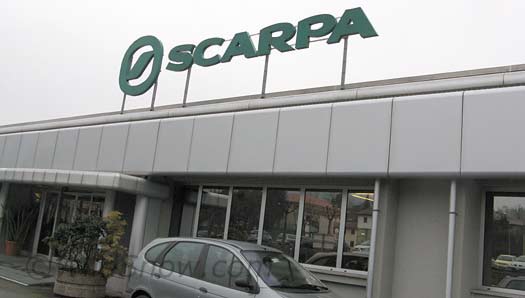
The Montebelluna area (see map below) varies from quite industrial to outlying areas that a tourist would find enjoyable. For example, I'm staying in your classic country inn about 15 minutes from here, an ancient farmhouse that's been modernized inside but still has its old walls, surrounding animals and vineyards, stuff like that. The Scarpa HQ in this photo the larger and more recently built of their factory buildings in Asolo, a more classic town outside of Montebelluna.
This is Andrea Parisotto and his father Antonio, some of the many family members who are part of Scarpa. A couple of the patriarchs can frequently be seen working along with the younger folks, doing quality control and probably keeping their eyes out for slackers.
The word 'Scarpa' means shoe in Italian, and also stands for the acronym S.C.A.R.P.A, Associated Shoe Manufacturing Company of the Asolo mountain area. The acronym trademark is all caps and SCARPA likes it written that way, though I choose to write the word in proper case for ease of typing and reading.
Scarpa has been around about 73 years depending on how you define their beginnings. They're a family business. While the company could probably outsource more manufacturing, they choose to keep much of it here and in Romania. Doing so allows a much tighter control of quality and innovation, and of course bucks the trend of loosing work to Asian countries -- instead they can keep extended families and locals employed. Andrea says they compensate for the added costs by having more efficient employees, state-of-art technology, and superior innovation supported by being in-house for every part of the footwear development process. Judging from recent success such as the Maestrale ski boot, and past triumphs such as transforming the telemark ski business by making the first plastic tele boot that worked, Scarpa's model appears to function quite well.
Interestingly (at least to me), this area of Italy is a special economic incentive district designed to encourage similar industry to grow in the same place, in this case sporting goods; especially footwear. Thus while we're covering hiking and climbing boots today, Montebelluna and Asolo are still where most of the world's ski boots originate.
If any of you reading this are investors, it's probably good to keep in mind that the outdoor recreation segment has steadily grown throughout the big downturn. Last year, Scarpa is said to have had 18% growth, and Dynafit grew about 66% in the last five years. I get encouraged by that mostly because I make my living in the outdoor industry. More, other than the downsides of growth such as access issues and increased crowds, nice healthy movement in the gear companies allows them to offer quality product improvements and perhaps even more value for the dollar or euro (not to mention helping support a website). I'm probably stating the obvious, but it's good to get the philosophy out on the table as to the reasons we devote so much time and energy to reporting on gear here at WildSnow.com.
Visualizzazione ingrandita della mappa

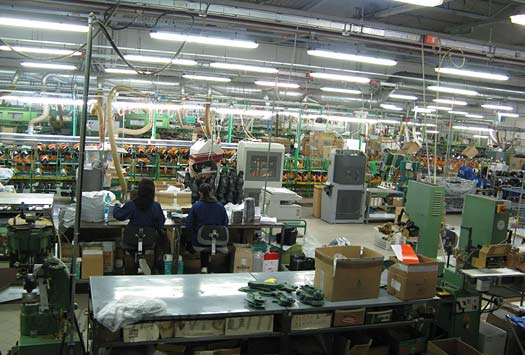
Scarpa factory is well used, but clean and neat with of course many diligent people getting it done. This building is mostly climbing boot manufacture from start to finish, with a section in the back devoted to ski boot final assembly.
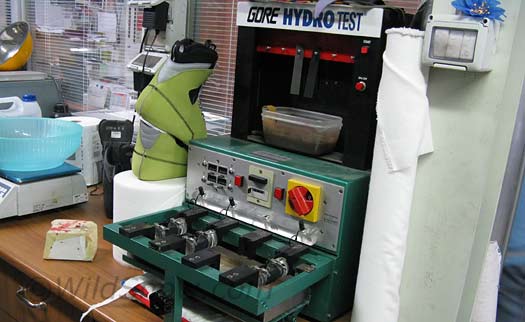
The Gore Hydro Test machine is one of the mandatory processes you have to apply to your materials so you can obtain and use Gore products. It measures how much water the boot's materials absorb. Too much water in the leather or fabric, and hydraulic pressure while you walk will force the water through the Gore membrane. So it's pretty important that notwithstanding the actual Gore membrane, boots are made of fairly waterproof non-absorptive materials.
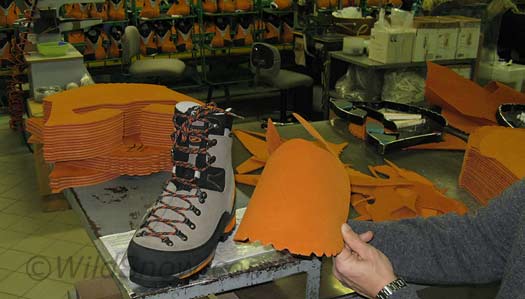
Now, into the process of making boots. First step is cutting numerous parts of the raw materials. In this photo, on the right is the piece which forms the upper, left is a finished boot of a different color. It's impressive to see how a bunch of what appear to be scraps quickly become a brilliant alpine climbing boot. Apparently they make a few hundred thousand shoes and boots a year.
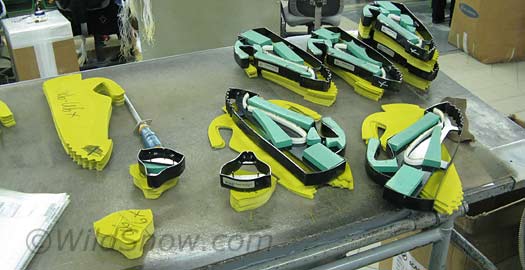
Most boot parts are cut using dies (shown) in a die press. Most of this cutting is automated, some more of a hand process due to variations in materials such as leather that it takes a 2 million euro machine to catch, or a human hand and eye. Walls near this area are covered with thousands of carefully labeled dies for myriad boot models and parts. Can you imagine loosing just one die, talk about a holdup! Probably the most interesting thing about the 'artisan bootmakers' of Asolo is seeing how they mix hand work with automation. You can tell boot making robotics could be taken to the nth degree, but it's nice to see a few humans involved in more than punching buttons or clicking a mouse.
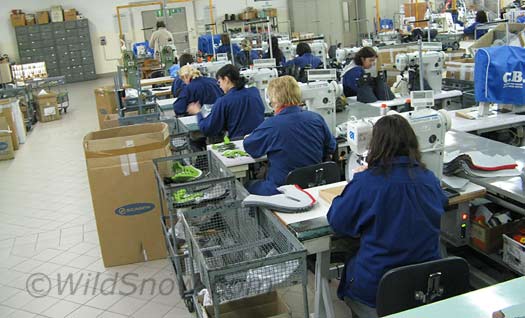
Scarpa has about 160 employees in Asolo and Romania, that's down from several times that during days of less automation. Still, as for example in this photo, some tasks may be better suited for the human eye and hand (these guys are sewing various small parts inside the boot upper).
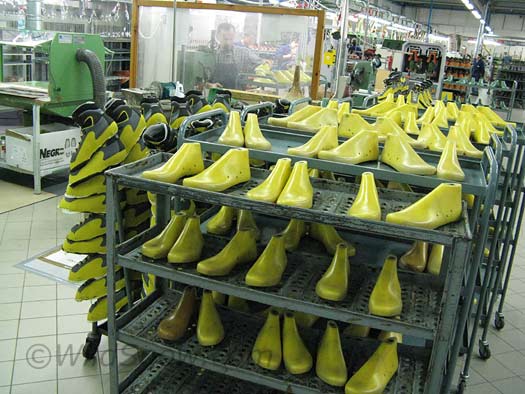
The magic of boot and shoe making is in the last, a carefully sculpted shape that is used as a form to mold the boot over. To manufactured lots of boots, you need lots of lasts. So they make one master for each size, then mold a bunch from that, resulting in thousands of last feet 'kicking' around the factory on racks and shelves. It looks kind of surreal. Adding complexity, Andrea told me that in some cases they make a European, North American and Asian last in each size, and thus shape boots according to what part of the world they're going to because the average foot shape tends to vary with the greater regions.
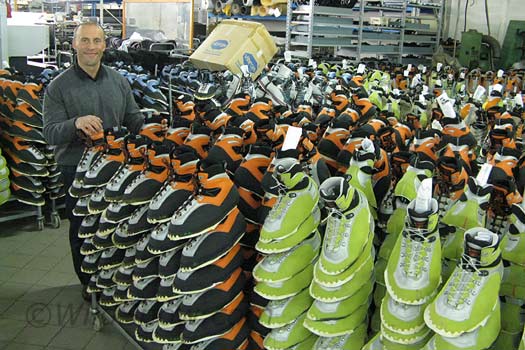
Big step, boot uppers are ready to placed on the lasts.
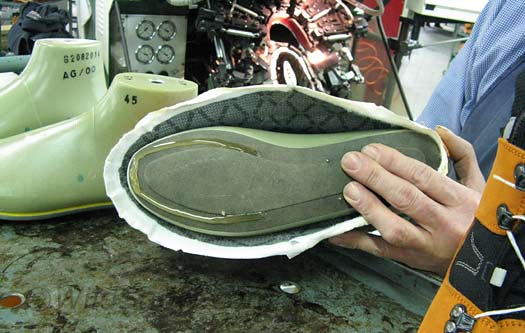
Prior to final steps in making a hiking or climbing boot, the last is inserted.
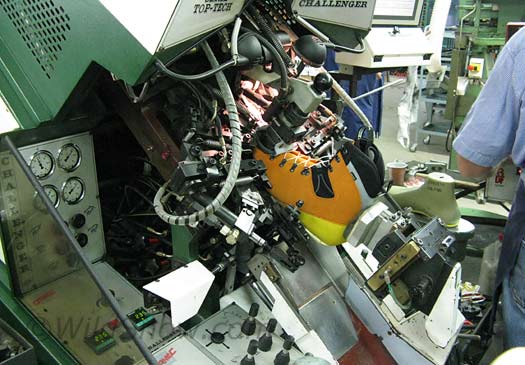
This octopus looking machine stretches the boot upper over the last and turns the edges underneath the sole area, where they'll eventually be buried by the boot sole. I'd imagine that when done by hand 70 years ago, this process was one reason they only made 6 pair of boots a day, instead of several thousand.
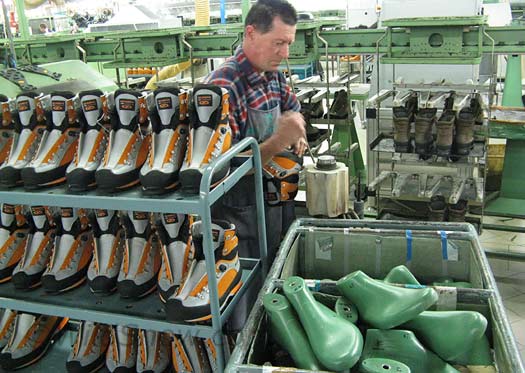
Just about done. The sole is applied, the whole boot is pressed in a device called a 'water press,' then the last is popped out. After that a few details such as laces are taken care of along with a quality control inspection, then into the box they go for your perusal on the store shelf.
Next visit to Scarpa we’ll check out the ski boot making, which is actually quite simple from a labor standpoint compared to mountaineering boots. Meanwhile, I’ve got to get some bloggin’ in the pipe for Dynafit as well! Fun stuff.
Comments
12 Responses to “Boots of Italy Part One – Scarpa Mountain Scarpone”
Got something to say? Please do so.


The last shall be first and the first last. Footwear manufacturing humor…
good to see on wildsnow my home turf. I used to live at a walking distance from the scarpa facility. great products and very nice surroundings (Asolo is a true medieval gem).
Great to see where it all gets done. Hats off to the Parisotto family for making such fine products. Hello to Andrea and family.
Very intersting report – I always wondered how boots are made! I have a little more appreciation for the cost for a good pair of boots. Good photos also.
Wayne, I was indeed amazed at how complex a pair of mountain boots are. I guess there are various degrees of automation possible, but some hand work is ineveitable. The Scarpa folks are not shy about the hand work, which I found very cool. They’re well aware it’s a battle to keep production at home and not go ever more robotic, and they fight hard. Where it all ends, who knows. In the end, main thing is that we have good affordable gear to use. That’s why Maestrale AT boot has been such a big success for these guys.
Love the scarpa product. have been using their shoes as “work boots” for years and they outlast and outperform other brands by a long shot. Because of this (and wildsnow reviews) I bought the Maestrales this year and even though I only got to ski it twice before the season ended I was not dissapointed. Are you going to visit the Trab factory while in Italy. They are also very family orientated business -nice to see in this day and age!
Neat report. Thanks for sharing!
With all the hand work going into a pair of Mountaineering Boots, I wonder why the “simpler” to manufacture Ski Boots are so much more expensive?
Must be the difference in the price of leather and gore-tex vs oil based plastics. (even Castor Bean Oil!)
KDog, that exact question occurred to me and I asked. The trouble with ski boots is each mold costs at least 100,000 euros, and you need a mold for each size of a given model. Not only that, but the injection molding machine is expensive, and there are still a number of parts that have to be hand assembled. Hidden costs are there as well. For example, by the time you pay retail, you’re paying $10 or more just for the graphics. Or, gluing the rubber sole on an AT boot is quite difficult and sometimes is even jobbed out to a factory where they probably use chemicals we simply wouldn’t want to know about. On top of that, the R&D costs for ski boots are not cheap, since getting a one-off molding done is as you can imagine quite expensive, and it’s not like you can just walk over to your cobbler sewing machine and whip something up to go hiking in for the day.
All that said, however, I wouldn’t be surprised if the profit margin for ski boots is better than that of hiking/climbing boots. But not by much, and only if it’s a ski boot that sells well so the cost of the molds is amortized.
I’m on my 4th pair of Scarpas. A really great write up, good to see what goes into the construction. It would be great to score a tour of that factory. Thanks for the report.
Is there a factory store at the factory, is it possible to buy mountaneering boots there?
Oto, I have no idea, perhaps someone else knows. Lou