Backcountry Skiing Binding Flex Tests — updated June 2007
![]() |
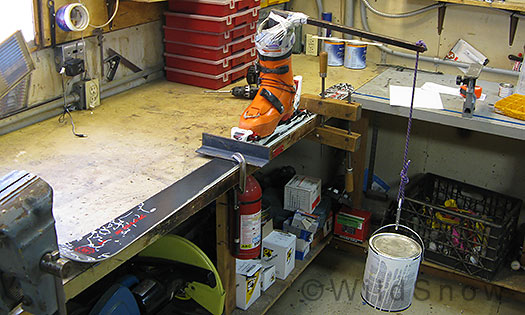
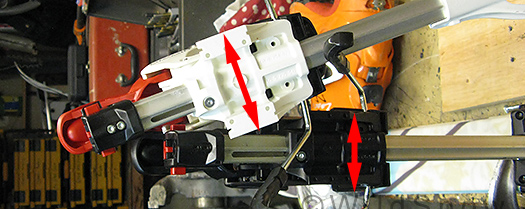
| Animation above shows the type of movement this test is designed to evaluate. All bindings move, the Diamir shown above is one of the more solid ones — it has about the same amount of movement as a good quality recreational alpine binding. |
We test randonnee backcountry skiing bindings for how solid they attach your foot to the ski (as when the cuff of the boot is tilted/pushed from side to side). While this is not as big a factor in control as some people think, it still makes a difference in how the binding “feels,” and definitely affects how well bindings ski on hard snow or ice, especially if your skis tend to flutter or chatter, and you need a binding that doesn’t exacerbate that effect.
For this evaluation I use essentially the same test rig as in my preliminary test done a while back. With the general procedure the same as detailed here, though we’re now a bit more careful, and made sure our results repeat. Results below use dashed lines as horizontal bar graph, each dash for one unit of deflection. A “unit” is simply arbitrary and only a basis for comparison, it is not a defined measure of weight or force. What I found fascinating is that the Freeride and heavy duty Naxo Nx21 (formerly known as the “Stomp”) were essentially equal to the Marker alpine binding, while the Dynafit was quite a bit more solid than anything but the Duke, even though it appears incredibly minimal. Shows you what good design can do.
Marker Duke
——————– (19 units deflection from vertical*)
Dynafit
——————– (20 units deflection from vertical)
Fritschi Freeride Plus (2006 model with black toe wings and red support plate under binding)
————————– (26 units deflection…)
Fritschi Freeride (2004 model with white toe wings)
————————— (27 units deflection…)
Marker M1100 Titanium alpine binding
—————————- (28 units deflection…)
Naxo Nx21
—————————– (29 units deflection…)
Silvretta Pure Freeride
———————————– (35 units deflection, measured virtually the same as other Pure models)
Silvretta Pure Performance
———————————— (36 units deflection, 07/08 model has solid carbon rails instead of hollow, should be slightly stiffer)
Naxo NX01
——————————————- (45 units deflection…)
*Marker Duke, when used with alpine boots could possibly be somewhat stiffer than measured here, as we used Dynafit compatible randonnee boots for all tests, and the sole of most such boots does twist more than a quality alpine boot. More, the base support of Duke is wider than any binding, and is said to thus give better edge control on wider skis. We don’t know if that’s true or not, but it sounds worth considering and could mean the real-life feel of the Duke is more solid than our chart indicates.
Due to inherent error in any mechanical testing system, I’m confident in saying the Marker alpine, Freeride and Naxo Nx21 bindings are all essentially equal in lateral twisting stiffness, while the Pure and Naxo NXO1 are clearly much looser. Marker and Dynafit are the clear winners overall — stiffer than the alpine binding and the Freeride!
The “units” above are for comparison only, they have no direct relationship to any unit of distance or weight. My gut tells me a difference of under 4 units would only be noticeable to precision skiers who could switch skis during the same run while using the same boots.
An interesting aspect of this study is the realization that if you use bindings with less flex, you might be able to use a more moderate boot and get the same performance as with a stiffer boot and flexy binding. All you stiff boot lovers might want to keep that in mind when considering Dynafit.

Comments
41 Responses to “Backcountry Skiing Binding Flex Tests — updated June 2007”
Got something to say?


Lou, Thanks you for all the great information on wildsnow.com
How would the Ramer Universal Binding fair in the above flex test?
I am 5′10″, 150lbs, and I have a lightly used pair of Ramer Universal Binding that I purchased new in the early 1990s. My boots are a similiar vintage, lightly used lime green Dachstein AT model. I have a new (~2003, yellow) pair of 160cm, 100/70/92, K2 Ascent 1186 AT skis that I am considering mounting the Ramers on. The plus of this is that I will be able to use them for skiing with the Dachstein boots and as an approach ski with climbing boots. Alternatively, I also am considering buying a pair of DynaFit bindings and mounting them on the K2 skis. I would also need a DynaFit compatable pair of boots so things start to get expensive. So, is anyone still skiing the Ramer Univeral Binding? Would you ski them? Would using them be like driving a mid ’80s car compared to a 2008 car, or is the Ramer binding closer to a 1950s vehicle and best left in the garage?
Hi William, nope, I wouldn’t ski the Ramers simply because most modern AT bindings are better. But that doesn’t mean the Ramers don’t work. Your choice. In terms of flex, they’re probably somewhere in the middle of the scale.
Hi Lou,
Not sure if you have seen these lighter weight Dynafit syle race bindings yet… I read today that they are the rage in European AT races.
For more info http://www.atkrace.com/
William, I have seen that ATK product. The binding is not as nice as the Dynafit Ti toe combined with the Dynafit race heel unit. But both models seem to be hard to get here in the States. The Dynafit race heel has side release, while the ATK does not. We might review someday (we have the Dynafit version), but we don’t put much energy into reviewing products that are hard to get for most of our readers.
The lightweight probe they sell looks nice, but their “shovel” is an insult to your skiing partner. Perhaps it’s appropriate for racing in Europe, as you’ve got 1,000 other people around with the things so they’d probably be able to dig you out pretty fast (grin).
What’s the difference between the Naxo 21, Naxo 11 and the Dynastar Legend?
One shop told me that the Legend was te same as the 21 and another shop told me the Legend was the same as the 11
I’d call Backcountry Access to get clear on that. We hate rebranding, what a great way to confuse and discourage your customer base…
303.417.1345
Hi Joe,
The 21 is sold by Dynastar as Early Tram, the 11 as Legend. According to Naxo the 11 is for “casual touring skiers” and the 21 for “sporty, aggresive freeriders”. Choose your weapon :-)
and Rossignol sell the 21 as the Bandit Free Rando binding…
Thanks guys.
I’ve had quite a time of learning about AT gear.
The only Shop I know of in the SF bay area that has rando gear rented me a set of skis with a freeride bindings that kept insta-teleing every time I dropped off a little log or rock.
Also of note, the deposit was $1400.
From what I’ve found this was probably from have the rear half of the binding mounted a forward or maybe the flex from my 220lbs.
Any Ideas about the best place to buy the 21, Early Tram, or Bandit?
Lou,
What are your thoughts on mounting dynafits on very fat skis (i.e. Pontoons)? My concern is that the torque generated by such a setup might cause the boot to pop out of the toe piece even in soft snow.
Separate question: anyone know where I can get the dynafit manuals online? Dynafit official site does not seem to have them. The info I want is the DIN setting table which takes into account boot size and skier type.
Thanks in advance,
Dave
Dave, I don’t see why you’d pop out of a Dynafit any more easily than any other AT binding.
DIN chart is here:
http://www.wildsnow.com/articles/naxo-mount/naxo_mount_5.html
I just wanted to make you aware that there is a simple modification that can be made for the Naxo bindings to make them more direct and decrease flex.
It would be fun to see what this mod/tweak would change your flex test!
ref: http://hem.bredband.net/evapeva/skigear/
hi lou.im from argentina weight 230 lbs and bought a pair of BH shoots 191 cm stiff flex 149-128-133 specs.Didnt know which randonee binding to put them,I thought about dynafits but here nobody mounts them and is impossible to get the spare parts if broken.So i thought about easy mounting of freerides plus or marker duke.I will be doing considerable skiining to other mountains beside the ski area plus heli approach then skiining (usually testing new mountains in the andes) and need a good secure performance.ALso have to buy boots.I had decided for dukes but dont convince me for the heel elevation is not enough maybe although they are quite stiff and burlier than freerides plus.Please let me know your opinion.
Thank you. great site, greetings
brian
I find somewhat amazing that you’re discussing Dynafit in the same breath as the Marker Duke and Fritschi Freerides. In SW Montana these bindings serve two completely different end user groups-.
Fritschis have gained a reputation as bomber options for in-area as well as side- or back-country use. Many at Bridger and Big Sky have them on the daily drivers. The Markers seem heavy for big backcountry approaches but provide the hucksters with security on super-fat boards in-area and in the side-country. Both drive fat boards with ease and work with normal downhill gear.
On the other extreme, Dynafits around here are used almost exclusively by those who value light weight over downhill performance, and are generally seen mounted on tiny skis by the huge-lung crowd who can sprint uphill for hours but then mince (or crash) their way down. Seems like nobody skis fast or hucks with Dynafits, from my limited observations.
Robb, while there is definitely a difference between Dukes and Dynafits… I think you guys are selling yourselves short if you think Dynafits can’t hold up to some fairly agro skiing. They’re not Fritschi or Duke, but they’ve been used for some incredibly extreme stuff all over the world.
What’s amazing about FT12, even if it’s not a Duke, is that they’ve given DIN 12 in that lightweight of a package.
Lou please help me for choosing between fritschis plus or marker dukes..
Are there crampons for such a weight of 128??dont tkink so…and dont think diamir sells a brake that can be bend that much instead marker duke does..I will definitely need the binding to toru up well and will be doing 6 hours hike skinnings several days..But the dukes have very wide brakes that definitely will fit 128 mm waist without defroming that much and laterall stiffness but lucks the heel height maybe i will need
LEt me know your opinion.
Greetings from argentina
brian
Brian, the wide Fritschi brakes go to 120 and I’d imagine it would be trivial to bend another 8 mm. Since you’re really touring, I’d say that less weight of Fritschi combined with the well designed heel lift makes that binding the winner for your application. ‘best, lou
Hi Lou, two questions: First, any news on the Naxo NX22 yet? Second: I noticed that the Naxo bindings from 06/07 have an extra feature under the toe section, near the first hinge. Do you know what this feature does?
Lou (and other Dynafit binding owners) -
All my friends and colleagues have been raving for years about Dynafit bindings and I finally bought a pair. I had them out for the first time last week, and skied some terrible breakable wind slab and they worked just fine. But, when I went back into the ski area I cruised one run on a groomed trail and brought my skis up to speed and cranked a big GS turn and blew right out of the binding.
Admittedly, I like to set my bindings loose. I have my alpine bindings set at a DIN of 7.5 and I set the two DIN settings at 7 on these bindings. I rarely, if ever, pre-release out of my alpine bindings (Markers).
I’ve got the bindings on a pair of Volkl Polar Bears (130/94/113 or something like that) and I’m skiing a Garmont Radium boot.
Any advice from folks? I guess I need to crank up the DIN on these, but how high do I need to go? And, what are the two different settings for? Also, some friends lock their toes into touring mode, but I’d rather not be doing that except if I’m really in a situation where I don’t want to loose my skis (i.e., some steep descent).
Thanks!
I’d first ski again and make sure you didn’t have ice in your toe sockets or under the middle of the binding wings. Also, I’d go ahead and set the DIN of the mode you blow out in at the same you use for your alpine bindings. And check the gap between heel of boot and binding. Cranking up your DIN is the last thing you do, not the first.
To clear ice from toe sockets when going to alpine mode, before snapping your heel down make a stationary touring stride (do it about 6 times per ski) to rotate the toe pins in the toe sockets and thus cut out any ice.
Karl
Lou’s right on the setting procedure. I’m surprised you don’t have your settings a little higher on your other rig, considering your strength, power and Tele background. But first on the Dynafits is always to check the heel-to-boot clearance and then contamination in general.
I ski on 7-8, and although I’m older and slower than you, I’m also heavier.
the upper (very small) screw is the forward release adjustment and the very large lower screw is the lateral adjustment. These should match, as with all bindings, according to DIN, TUV and who knows whatever other standards might be involved.
Hope this helps.
Hey Karl and Lou,
Karl, you happen to have the exact package that I am looking at getting: Radium, Polar Bear and I already have Dynafit bindings not yet tried.
2 things: How are the polar bear? I am a fan of the mantra but some skeptics told me that the real mantra would be too much for a pair of dynafit to handle. So i figure i ll take something softer and lighter…thus Polar bear looks like ideal choice! But is it? hearing mix reviews.
Second, I wanted to ask: Can I just mount my last year TLT vertical on a pair of std mantras?
Lou, Keith, and Ed -
First off, thanks to both Lou and Keith for the tips. I conferred some more with Keith and he convinced me that it was likely operator error from a newbie dynafit owner. I have since skied pretty hard at the ski area in a variety of conditions on the bindings and have not blown out again. I still am a bit leery, but my confidence has been growing with every additional day. I am now VERY careful about making sure that the toe is entirely clear of snow when I put them on and I also rotate the skis (as if touring) about a half a dozen times as suggested by Lou.
Ed, the set up is – for me – perfect. I also have the Mantras and love them, but went with the Polar Bear to get something a bit lighter. It’s still a lot more of a ski than many alpine boards, IMO. Carves through crud just fine, hold an edge reasonably well, and plenty of float for a guy who was on skinny boards not long ago. Just what I was looking for in an AT board.
I got a pair of early trams (Naxo21); mounted according to instructions (will retry with yours). The problem I am having is the tails won’t lift when side stepping (older vokyl snowranger lites 190). The skies pivot on the front pivot which is too far forward to lift the ski balanced. They ski well though. Would you recommend moving the binding back or modifying with a retrun spring like a small bungy or something?
Lou
Have you tested (or noticed) any improvements w/ the current Naxo NX02’s and NX22’s? The 01 seemed like a binding that tried to be everything to everyone and failed. I know a few people that still have a bad taste in their mouth from the 1st gen Naxo and wondering what your experience has been w/ the current evolution of NX product.
I’ve been skiing with setups like Dynastar Legend Pro Rider, Racing Alpine bindings an Racing alpine boots (140 flex index +). This is a stiff setup, but i like the control.
How would it be if I try a setup with Garmont Radium boots and Dynafit TLT Vertical FT 12 on skis like the Dynastar Legend Pro rider (beefy/heavy skis)? Will I loose much of my feel with the skis or?
Joakim,
I have found it hard to make the transition from stiff & burly alpine gear to lightweight AT gear, mainly due to the very soft fore/aft flex of AT boots. The stiffest AT boot I have tried is the Dynafit Zzero 4CF, which I found very solid laterally but extremely soft fore/aft when compared to my alpine boots. I would not expect to be able to drive my Head Monster 88 skis with the Zzeros, unless I was World Cup racer precise in my technique. There’s just not much boot to drive the ski.
If you match the softer flex of an AT boot to a softer flexing ski, the combination starts to make more sense. The Zzeros drove a Volkl T-Rock just fine. I would imagine they could drive a Fischer Watea 94 or 101 just as well. I haven’t skied a Dynaster LP but I imagine it’s similar to my Monster 88 skis and would want a boot like a Dynafit Zzeus, Black Diamond Factor, Garmont Radium
Thanks, that confirms my suspicion.
I’ll probably go for one hardcore alpine setup and one AT setup and not mixing the two.
I have skied the entire winter on Radiums and Fritschi mounted Line Prophet 100’s and BD Zealot 110’s. The Radium does both proud. If there is a beefier and stiffer ski out there than the Zealot I wanna ski it, with Radiums of course. What I will say is that they are not race stiff. But I can carve tight radius turns on 100mm waisted Lines as easy as I can with my race boots and Head 78mm waisted race ski. I’ve skied both setups inbounds and out. (The Zealots are great for coming down, not so much for hiking up.) I can’t carve anything on the Zealots other than at mach speed just because they are a freakishly stiff ski, however the Radiums are more than up to the challenge and I have never felt nervous that when I leaned into a turn that the Radium was going to go all mushy on me.
Everything Lou has done on this site to explain the safety, engineering and burliness of Dynafit bindings should be answer enough pertaining the bindings. If you need more conclusive answers to your questions I believe FT 12’s were just used to ski Capitol pushing BD Kilowatts. And Davenport drives his skis with Radiums and as memory serves just switched over to some FT12’s. It’s all about preference. I don’t mind exchanging SOME stiffness for hikeability and overall comfort. If you absolutely have to have a Race boot then the Radium is definitely not for you. But give some a test drive, you might be surprised.
I’m looking for a review of the Volkl Nanuq. Would like something that can be used as a 50/50 backcountry/slopes ski (i.e., Alpental).
I think the Nanuq is basically just an updated Volkl Polar Bear. Karl and Ed, what are your thoughts on these?
Lou, have you reviewed the Volkl Nanuq? I can’t find anything on them… your advice for my interests is much appreciated. Thanks…
@Frank R:
How have you liked the Line Prophet 100 for an AT board?
I bought some Fritschi Freeride Plus bindings already, and was looking for something that could do either resort or backcountry (not planning on doing any crazy tours this season… will get a light setup later if I do). Have these bindings been good for you for this purpose?
I believe the Nanuq, if it is a renamed Polar Bear, is actually a previous incarnation of the Mantra. Mantra is a metal sandwich ski that has gotten rave reviews for years. Solid, stable, busts crud, decent in soft snow–you name it. I skied it and agreed it is great.
I just mounted up a pair of the Naxo (Rossignol Bandit) binding on my Elan 888 skis. I have a pair of the new Dalbello Virus boots 110 flex. My question is I noticed I was having a hard time carving a turn. The tails seemed to wash out on my turns. I also noticed that when I flexed forward the tails of my skis lift up starting from under the ball of my foot. Was this a known problem with the binding? I know they are no longer being produced but has anyone else noticed this?
Naxo has a bunch of slop, sometimes hard to get used to.
Thanks! Not so much slop but more of a lifting/hinging of the ski when I flex forward. Made the ski feel strange at the end of my turn.
Peter, no idea what that would be, perhaps vertical slop combined with vertical elasticity of the heel unit?
Hello Lou.
I am 5′9″ 165 lbs and ski in and out. Mostly In bounds. Hard on my gear. Ski fast, bumps and jumps.
Is money the only reason not to buy Dynafit bindings?
I want a pair of DPS Wailer 105 skis for my dozen western days and handful of soft eastern days including Tuckerman. They are so light, I was wondering if the Dynafit would be a great all around binding for them. I have Garmont Megaride boot.
Thank you.
Bob
Bob,
I love my Wailer 105s Flex 3 188s for BC skiing, they ski well and have a very sturdy construction. I keep a pair in CO, and another in UT. Both have FT-12s. I have no complaints about the bindings, I use FT-12s on my Atomic RT-86s for bumps or sidecountry stuff, or sometimes the Volkl PolarBear/Nanuq for the same, more stable but not quite as quick and light.
I think the Wailer 105 is a wonderful ski both up and down, but you might look at the 95 as a quicker edge to edge ski.
John
I own Fritschi Freeride plus, Freeride and Titanl II bindings. And the Freeride plus has way less deflection than the Freerides (much less than the 4% difference you measured). It may be that my Freerides are more worn than yours, and that is an important point to note. As the Freeride lock-down wears it is much more prone to deflection whereas the Freeride plus relies a lot on the ridges in the red base plate to prevent twisting. That said, the plus version tends to hold up against deflection with many days of use.
Bruno, I did my test multiple times and that’s what I got. Perhaps we’re measuring a slightly different type of deflection.
Hi from Spain.
First of all, excuseme for my poor English, I Hope U can understand me.
You talk all time about the torque stiffness and says that a stiff boot equalizes the transmision when combined with a soft binding.
and the opsite, soft boot and stiff binding.
But I think it’s also important to comment the fact that a stiff boot in combination with a stiff binding could be little dangerous.
In fact, a Carbon made boot, with a dynafit could make a ligth(and soft cored) ski break by the screw holesbecause of a excesive energy transmission.
Congrats by this web I find it very interesting.
Bye!