
Gear for backcountry skiing.

Our Denali Satphone Blogging System

Bookmark and Share
This post by WildSnow.com blogger  

Some of you WildSnow readers have been asking about our communications system here on Denali. I didn’t want to get into details before the trip because I wasn’t totally sure everything would work. But the system is doing fine after a week on the mountain now, with all sorts of temperatures, violent hauling, and several hours a day of use.
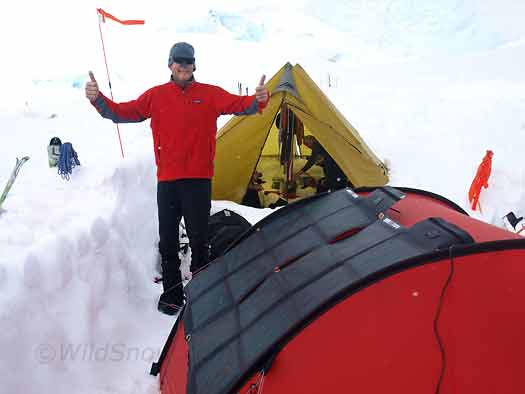
Lou gives the sign to a system that works. In our first camp we mounted the panels on the tent, but discovered they provided too much shade. We could move them around during the day for optimal angle, but we seem to have more than enough panel to leave them in one position. Keep in mind that here in Alaska we get a ton of sunlight. Indeed, we might have easily used just one panel (though the redundancy of having a pair is important.)

Lou gives the sign to a system that works. In our first camp we mounted the panels on the tent, but discovered they provided too much shade. We could move them around during the day for optimal angle, but we seem to have more than enough panel to leave them in one position. Keep in mind that here in Alaska we get a ton of sunlight. Indeed, we might have easily used just one panel (though the redundancy of having a pair is important.)


Because the reputation of WildSnow.com rides on blogging from the mountain, I set up the whole system with redundancy in mind, thus, two of anything critical. Two panels, two batteries, and so on. This resulted in slightly more weight, but if the system were to fail, the huge investment we’ve made in this expedition would be basically down the tubes — not to mention a lot of disappointed gear sponsors, friends, relatives and so on.

Main goal with this system was to keep costs down and still file blog posts. Many solar panel and battery options exist that would work well. In this case, with Brunton as a gear sponsor, I went with two of their folding panels and two Solo 7.5 batteries. Two Acer Aspire One computers with solid state drives and fan control software provide the brains. (Fan control is important, as you don’t want the computer trying to spin the fan when doing so is unnecessary.) I turned off as many of the computer’s internal components as possible, such as the wireless card and network card.
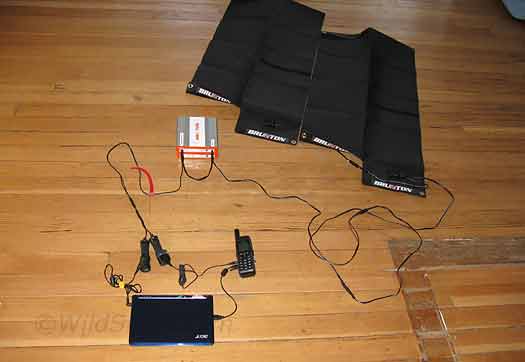
The system laid out at WildSnow HQ. Quite simple, really. The batteries are necessary to act as a charge reserve/controller/buffer, though most devices can be charged directly from the panels as well.

The system laid out at WildSnow HQ. Quite simple, really. The batteries are necessary to act as a charge reserve/controller/buffer, though most devices can be charge directly from the panels as well.


Key to our system is using the correct communications software. Iridium tries to provide their own, but it is totally lame. Better are any of the third-party companies that exist to provide efficient satphone data communications. In my case, due to financial constraints I’m having a ground person assemble and publish the blog posts after they arrive as emails from the field (rather than running a full-on internet browsing system. As far as I can tell, the best satphone email software is Uuplus — super efficient and reliable, costs a yearly fee but it’s worth it.

As for the satphone, don’t even bother with the older model Iridiums if you’re trying to do data. They have an incredibly bogus connection method. Instead, always go with the latest phone.
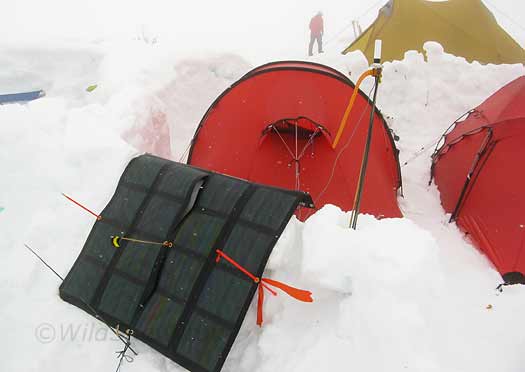
Our panel array at 14,200 feet on Denali. Staked out in case of wind.

Our panel array at 14,200 feet on Denali. Staked out in case of wind.


Rounding out the system is the cabling and connectors. I included a number of USB ports so the boys can keep their ‘Pods charged. All the wire was heavy, so I cut and spliced nearly everything to shorter lengths.
One of the bulky heavy items in these systems is the ridiculous auto cigarette lighter plug used for connectors. I tried my best to eliminate those, but kept running up against adapters that required them, so that part of the project was a wash.

If the system is divided in half, a kit with the bare essentials weighs about 11 pounds. Total weight is around 16 lbs. Storage is in a Pelican case (heavy) for the essentials, and one lightweight inexpensive Plano brand gun case for other items (get them at Sports Authority, great value though not waterproof).
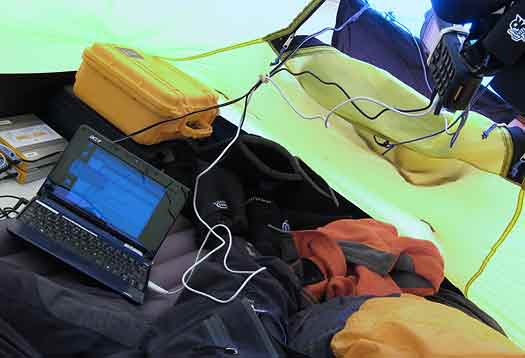
 How it looks in real life inside the tent. I brought along an efficient external antenna for the satphone, so I can hang the phone anywhere in the tent and not have to worry about positioning it during calls. The external antenna also gives me more reliable connections, an issue when mountains block the horizon.

How it looks in real life inside the tent. I brought along an efficient external antenna for the satphone, so I can hang the phone anywhere in the tent and not have to worry about positioning it during calls. The external antenna also gives me more reliable connections, an issue when mountains block the horizon.


So there you go. While there are a ton of ways you can do internet comm from the backcountry these days, that’s the system we ended up with and it seems to be working great.

Comments

5 Responses to “Our Denali Satphone Blogging System”

  1. Adayak June 8th, 2010 2:16 pm

    That’s quite a set up you have on the mountain. We appreciate you hauling that extra gear so you can bring us regular updates. Things look much easier in the movies.

  2. Kyle June 8th, 2010 5:24 pm

    I’m surprised you didn’t crack open the computers to actually remove components you didn’t plan on using, thus saving weight ;)

  3. bogon June 8th, 2010 9:13 pm

    i’d crack open them.
    When i clean my notebook guts first time, i usually remove modem and/or wireless (it is seldom needed here). Saves a couple of minutes on battery. Also FreeBSD kernel has nifty way to de-power HW for which no driver is loaded (so i do not load ethernet, sound, USB and such on startup). I doubt winblows can do it.

  4. Joel Gratz June 9th, 2010 10:36 am

    Lou et al – feel free to email me if you’d like updated weather information for your summit bid. I just helped a father/son team summit Denali in a pretty short weather window and am happy to help you guys in any way that I can!

  5. Jay Kerr June 10th, 2010 3:08 pm

    How would an iPad work instead of a netbook? Lighter, and no fan to manage…

Got something to say? Please do so.


Anti-Spam Quiz:


If you need an emoticon for a comment just copy/paste off the following list, or use text code you might be familiar with.
:D    :-)    :(    :lol:    :x    :P    :oops:    :cry:    :evil:    :twisted:    :roll:    :wink:    :!:    :?:    :idea:    :arrow:   
  
Due to comment spam we moderate most comments. Please do not submit your comment twice -- it will appear shortly after we approve it. Once you've had one comment published, your comments will be pre-approved and appear immediately if you're using the same computer and not blocking browser cookies. NOTE however that ALL comments with one or more links in the text will be held for moderation no matter what, again for spam prevention.
Welcome to Louis (Lou) Dawson's backcountry skiing information opinion website and e magazine. Lou's passion for the past 45 years has been alpinism, climbing, mountaineering and skiing -- along with all manner of outdoor recreation. He has authored numerous books and articles about backcountry skiing and is well known as the first person to ski down all 54 of Colorado's 14,000-foot peaks, otherwise known as the Fourteeners! Books and free back country news and information here, and tons of Randonnee rando telemark info.

All material on this website online magazine is copyrighted, the name WildSnow is trademarked.. Permission required for reproduction, electronic or otherwise. This includes publication and display on other websites by whatever means. PLEASE SEE OUR COPYRIGHT and TRADEMARK INFORMATION.

Backcountry skiing is a dangerous sport. You may be killed or severely injured if you do any form of randone, randonnee and randonnée skiing. The information and news on this website is intended only as general information. While the authors and editors of the information on this website make every effort to present useful information, due to human error the information, text and images contained within this website may be inaccurate, false, or out-of-date. By using, reading or viewing the information provided on this website, you agree to absolve the owners of Wild Snow as well as content contributors of any liability for injuries or losses incurred while using such information. Furthermore, you agree to use any of this website's information, maps, photos, or binding mounting instructions or templates at your own risk, and waive Wild Snow its owners and contributors of any liability for use of said items for backcountry skiing or any other use.