
Outdoor Retailer — Saturday — BCA’s Float 30 Avy Airbag
Still feeling pretty wasted so off to bed early. But coffee kept me jacked long enough to get some interesting show encounters taken care of — though I did miss an appointment with K2 due to wasting disease (I’ll try to make up for that tomorrow).
Big stop of the day was probably Backcountry Access (BCA). Their (now on the market) Float 30 avy airbag is worth some blog time. The new Tracker2 beacon looks good as well, and does have that fast processing time that makes for a very fluid and intuitive search style. We’ll get more into the beacon at a later date, for now, the airbag.
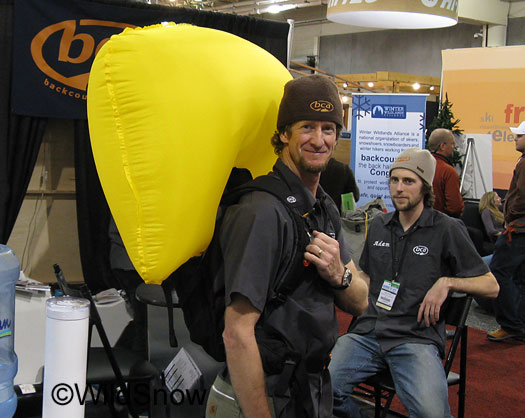
BCA Float 30 avalanche airbag modeled by BCA's ever attractive Bruce Edgerly, with engineer Adam Sotkin observing his creation in action.
BCA has refined their avalanche airbag “Float 30″ pack, and they’re shipping to selected retailers. This thing is excellent. Only about 5 extra pounds for the bag system, built into a fairly nice backpack.
I’d still like to see more variety in the packs airbags are built into — main gripe being that many seem to be overbuilt. But the fact remains that avalanche airbags save lives so quibbling about the style of backpack is perhaps a symptom of too much blogging… or too much traveling?
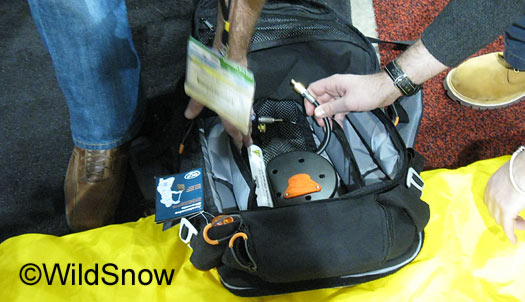
Float 30 airbag pack interior. The wizardry is in a valve system and venturi opening that cause gas to flow fast enough to fill the bag in a second or two -- not as easy to accomplish as one would think.
Airbag points to remember:
What frequently kills people in avalanches is lengthy burial times; tests show that airbags can prevent burial in a majority of cases.
While an airbag that inflates around your head for protection is a seductive concept, it’s really not practical. The deal is you don’t want to hesitate pulling the cord if you’re in a slide, but at the same time you may still be on your feet trying to ski out of the flow, or perhaps swimming or fighting. A big airbag that wraps around your head could prevent anything but fairly passive behavior once deployed. Float inflates only up and behind your head and cuts off none of your peripheral vision. It feels quite reasonable for something so bulky.
You need to be able to play around with and test your airbag, then easily get the gas cylinder refilled. BCA’s system can be recharged just like a paintball gun tank or SCUBA tank. Easy and inexpensive. Traveling? Discharge for airline travel, easily recharge at your destination.
Well done.
An anchoring harness system that goes under the crotch is essential for proper performance of an avalanche airbag (and possibly the BD Avalung as well). If you’re using an airbag and just carrying it with shoulder straps and waistbelt, you’re fooling yourself as to how effective it’ll be if you take a ride and actually need the thing. At best, you’ll end up with your pack tangled up around your neck and head, at worst it’ll get ripped off your body.
The hassle and style (and flesh) crunching nature of a crotch harness is is in my view one of the major drawbacks of avalanche airbags. More, while the Float does have a harness that is strong and stows away cleanly, it’s not UIAA climbing rated so you’d have to wear it along with your climbing harness if you’re doing ski alpinism. That’s of course impractical, so you’d need to cobble up a system of clipping the airbag waist belt into your climbing harness. And so on.
So, the solution I propose is that BCA’s next product should be a ski touring pant with a built in minimalist harness that doubles as both airbag anchor and low bulk climbing harness.
Heard at WildSnow HQ the morning before a ski tour “honey, remember to wear your airbag pants…”
Back at it today.
Comments
26 Responses to “Outdoor Retailer — Saturday — BCA’s Float 30 Avy Airbag”
Got something to say?


Lou,
In my perfect imaginary world, BCA would team up with BD to provide that line of airbag packs and incorporate BD’s new Couloir harness into the pack, providing a climbing AND airbag-ready system. What do you think?
Chris
I’m with Chris on this one…
also, I think that the bag should come down around the ribs and forward as well as the head to provide more protection/breathing space.
Njord
I’d prefer solid metal buckles and hip and sternum instead of cheap plastic. Crotch straps and integrated climbing harnesses are a deal killer. The K2 Avalanche Ball was still the best device for fast locating of victims. If that was integrated into packs, it would be way better than an Avalung and lots cheaper and lighter than any airbag pack. Pity everyone is going in the wrong direction with this technology.
Hi Lou,
This is week old news. I had the chance to see this yesterday at MT Hood Meadows resort. Impressive! http://www.skihood.com/Community-and-News/Meadows-Blog/Posts/2010/01/Anatomy-of-an-Avalanche#comments
Lou: although there is a study that states that 85.7% of avalanche deaths are caused by suffocation, that study seems to be based on data only from Utah State, and only includes 46 deaths.
A broader study (329 deaths, 30 years) done in Canada finds that trauma has a much higher role to play http://www.cmaj.ca/cgi/content/full/180/5/507
Even in asphyxia, trauma has a significant contributing factor.
In their conclusions, the authors state
“…in western Canada, during the study period, major trauma contributed to a total of 33% (68/204) of avalanche deaths overall and, for ice climbers, to more than 50% (7/13) of deaths. In our study, trees were identified as the most common objects hit in trauma deaths. This may be explained by the much greater access to forested ski terrain in Canada20 than in Europe. In a recent study from Utah, United States, trauma was the immediate cause of death in 5.4% of cases and contributed to death in an additional 8.9% of 56 avalanche fatalities.21 Variations between studies point to differences in geography, such as mountain topography and distances for rescue flights, as well as demographics, notably different activity types.9,21–23″
The sample (number of deaths) is quite small. This is a good thing, who wants more dead people. However, for science it’s hard to draw conclusions based on small samples. It may be that the type of snow has a lot to do with the mechanism of injury and death.
The 3 major manufacturers seem to have chosen different designs in respect to where the bags deploy.
My local BCA rep told us that the Float is designed to deploy behind the head and high up in order to allow you to continue skiing and try to escape the avalanche after deployment. I guess the idea is that you can pull sooner, and still fight, rather than wating to pull…
I’m just glad to see this technology being ironed out further. Refinement means a lot to prospective buyers.
Interesting that you say “A big airbag that wraps around your head could prevent anything but fairly passive behavior once deployed. ”
Anyone who’s escape plan involves trying to ski out of an avalanche is quite optimistic! Been there, tried that… doesn’t work. And even if you could, it would be a fairly straightforward “get the hell outta here” straightshot to the side, and you wouldn’t have full control even if you had eyes on the sides of your head.
Therefore, it seems obvious that protection from head trauma would trump any concerns about peripheral vision. The possibility of losing my side vision would never cause me to hesitate to pull the airbag…
In my opinion, the only possible reason to buy the Float over the Snowpulse is to save a couple hundred bucks. And if you’re throwing down $700, would it really kill you to spend a little more for a product that works?
It surprises me that you would recommend an inferior product. Perhaps you’re biased towards your advertisers?
Joseph,
I think the point of having vision and being able to still ski is a good thing. Not every avalanche moves 70 miles and hour, seems to me that having the potential to outrun and avalanche is a good thing. And for you to say that it doesn’t work at all seems a little presumptuous…have you tried it in an avalanche? Advertisers aside, it is the OR show, and its about showing off new products. Personally I’m stoked to see more companies trying their hands at increasing the probability of surviving avalanches.
J
Perhaps we should step it up and inject the balloons with helium…. seriously why settle for less, when we could just float up, up and away to safety. I find all this innovation interesting. Might consider a butt balloon next time I have to upgrade/replace my current pack.
Funny to see folks trying the avybag operations in the videos with shorts on, outside on a nice sunny day, in a parking lot of green grass, smiling, and then stating how nice and easy it works. Be nice to see someone fully dressed for a BC day with poles, skiis, snow, helmet, goggles and then pull the chord as they are skiing down a run then purposely tumbling to the ground. Doing so on a ski run somewhere in a more realistic and unbiased testing situation away from the manufacturers would be a worthy project, if not already done.
lou … glad you enjoyed EU//welcome back……next trip.. AK
Joseph, to conjecture that any bias on my part would obfuscate my opinion about something as important as avalanche safety gear is rather insulting.
Let me assure you, I’m simply doing opinion writing about the gear, and my opinion is that with an airbag you want to pull the cord sooner rather than later, and if the bag is going to inflate around your head or to the sides of your head, that could be problematic in an early deployment. Not so much in big slides, but you CAN fight your way or sometimes ski out of smaller ones, and in those situations having the bag only inflate behind your head seems like a good idea.
I’m also well aware of the trauma issue, having personally experienced it. Hence, I’m actually not very high on ANY of this after-the-fact stuff. The key is still to not get caught in the first place. Until we have an oxygen supplied globe that inflates around your whole body with 6 feet of padding, all recovery and protection systems are iffy.
BTW, I’d forgotten that pants with built-in harness do exist, and remembered this morning while checking the comments here.
One example:
http://www.backcountry.com/outdoorgear/Rossignol-Harness-Shell-Pant-Mens/ROS0601M.html
Hmm- like parachute pants . . .
Lou,
Did Backcountry Access have any packs with hydration and ski carry along with the airbag feature?
Morgan, no, they’ve just got that one ski pack for now, the Float 30, and a snowmobile pack that has the rip cord on the left, so you can keep squeezing that throttle for all you’re worth (or, perhaps you have a left hand throttle).
The ABS was long ago proven through legitimate analysis of results. The question is how do other airbag packs compare and perform in comparison. After lugging my ABS for 5 years, I would welcome something lighter. Bottom line is do not get caught in an avalanche. For those caught, the only real chance is with the use of an ABS that prevents burial in an avalanche..
Great blog and great discussion. You’re right that deploying the Float at summer trade shows is inadequate field testing. But we’ve been working hard on the real thing: http://www.backcountryaccess.com/blog (if you watch this video, then parental discretion is advised!)
It’s quite difficult getting these things into real avalanches with life-sized, 185-pound dummies. But in the meantime, we have designed and tested the system to meet and exceed the TUV guidelines that have been established in Europe. For example, the whole system is designed to take 1000-pounds of pull force from airbag to waist belt–and we’ve tested it to deploy very reliably at -30 degrees C (-20 F).
We’ll be deploying the Float 30 at the SIA on-snow demo at Winter Park next Monday and Tuesday. We’ll be getting folks to deploy them while skiing, snowboarding, tellying, hucking, even while riding cafeteria trays. Maybe we’ll even get some some Float 30’s into the terrain park. That should result in some valuable crash testing. Any takers?
Clyde, the Float does indeed have metal waist buckles. It is bomber and user friendly. We consider the crotch straps optional, except in “harness-worthy” terrain where a huge ride could rip the waist strap up and over your head, a la Shishapangma.
Edge. Tks for reading the blog here for input. Hope you can send lou some of the video from Winter Park and he can post them or let us know when you have them up on your web site. Fly me down there and I will be a crash tester.test!!.
Or…. :lol:…. you can heli me into the Wasatch for a day of the real thing.
re: Skiing visibility with an airbag deployed. The current catalog for SnowPulse shows a skier making turns while the airbag fills up and surrounds the sides of his head. I’m sure the skier’s peripheral vision wasn’t so hot, but the time lapse photos indicate some measure of visibility.
Bottom line. The only surefire way to survive an avalanche is to be watching it, not riding it. 100% survival rate in this mode. If you’re riding it, the best way to survive is with an airbag pack. 96% survival rate based on over 140 incidents with the ABS airbag pack. Next best way is to jettison your skis and have an AvaLung. So far, even with skis still on the survival rate is 100%, but there are only half a dozen documented cases so far. And in all cases, wearing a beacon is the final piece of insurance for surviving an avalanche, but the odds are less than 50% if this is all you rely on.
Thanks for the update Lou. Sure hope the sledders find these packs appealing so that the numbers produced are high enough to bring the cost down for us human powered sliders.
Anyone know if there has been more recent studies/comparisons between abs/snowpulse than this one: http://www.snowpulse.ch/v3/medias/essai_davos_en.pdf
Also just read that snowpulse will have to stop using the vario system where you can buy one base unit and have separate bags to attach. Apparently ABS have patented this and sued snowpulse….
Looks like the ABS vario system is the most versatile now. Trying to decide which one to buy is not easy. Leaning towards the abs vario system now with the 18l ultralight pack and a 50l for longer trips. anyone have experiences with this bag?
Cost will be $700 next year (the first version with a ski carry system) instead of $500 this year. Still a decent price for a great product.
Seems like BCA is working really hard at making it as easy as possible to refill, and hopefully it gets to the point where you can just refill it in Tibet after you get off the plane. But for now, if I understand correctly, you still need to send it back to BCA for a refill — $40 including shipping back to a US address or $5 if you show up at their headquarters in Boulder. Next year, there should be a bunch of refill centers in the US and Canada. And eventually, I hope they sell the refill kits — adapters, o-rings and their lubricant — so you can just stop at any scuba or paintball shop, or fill it up from your own tank.
I guess paintball shops already have the refill adapter, but you need to replace this tiny rubber o-ring on the cylinder every time, and use the right grease, and make sure it’s filled to the right pressure — no more, no less. It seems easy, but BCA wants to see the real world results before they let every paintball shop in the world refill them without any training at all. It’s a brand new product with compressed air canister, they’re not taking any chances until there’s some real world testing, and some properly trained individuals have refilled a whole bunch of them.
Right, Edge?
Well said, Bryce. We’re taking it easy the first year and making sure that the shops that refill the cylinders do it right, document everything, and send us feedback. We’ll be loosening up the system once we’re confident that everything is going according to plan.
By the way, we can train refillers remotely, so if there are customers out there that have a refiller in mind, we can get them authorized and up to speed very quickly.
Hey Lou,
This looks nice, I dont know if you ever heard the story but i was up in AK last March, we had a private heli at the todrillo mtn lodge. ON our 4th day we landed on a run we had skied about 3 days prior. Their had been some wind and a little snow. It was cold and blowing. The guide went first, then two others went. (It was as tight coulour that then ran out to a large ramp 45 sustained.)
That left me and one more up top. I let the other skier go since i had a guide radio. he made two turns and the slope snapped, it was about a 45 degree slope, 1800 feet. Fracture line was about 2.5-3.5 deep. Anyway i yelled, and the skier had an avs pack. He could not get off the slab and the slide propegated all the way accross the hill, I lost sight of him, i thought he was done. The pack kept him above the snow and he came out with minor injuries. Without the pack, i would bet there would have been sever injury. Depris pile was about 6-10 deep with very large chunks lining the hill.
Anyway the only problem with the AVS is travel. Seems like BCA has solved that problem.
Great story Matt, thanks!
Edge, WildSnow Carbondale should be a refiller, once we get these things going in some various ski packs we use… gotta fit one into my Dyneema Cilogear pack, then I’ll be happy (grin).
“In my perfect imaginary world, BCA would team up with BD to provide that line of airbag packs and incorporate BD’s new Couloir harness into the pack, providing a climbing AND airbag-ready system. What do you think?”
Years ago I tried to get BD to bite on a system I cobbled together with a waist belt-free Go-lite pack that clips onto my modified Alpine bod harness. That way, I can take the pack off without removing my harness, & I don’t have two waist belts fighting for space & adding pointless weight.
BD wasn’t interested, but I’d still love to buy that system–my homemade version isn’t all that comfy. BCA?