Black Diamond for everything climbing and skiing.    Dynafit -- Speed Up!    Tracker beacons, Stash packs, shovels, more more more.    Terrific deals on randonnee AT rando backcountry skiing gear.    K2 has the skis that stay true to earning your turns.    Garmont boots -- excellent choice for backcountry skiing.

Randonnee AT Ski Touring Boot ISO Standards

Bookmark and Share            By Lou

(First, apologies for our site being down again this morning for about 35 minutes. Our new hosting at Media Temple seems to be somewhat unreliable. Gut punch. We’re looking at other options. Appreciate your patience. )

Industrial standards are a mixed blessing (e.g., it’s required quite a bit of designer skill to keep Dynafit bindings and boots working well together while having the boots conform to the ISO standard.) Yet on the whole, our gear would be reminiscent of stone age eating utensils if we didn’t have agreement among manufacturers to stick with the program.

Thus, when we’ve got questions about the boot/binding interface — or just wonder the “why” of a given boot feature, we find ourselves frequently referring back to ISO 9523:1990, the “DIN” standard for “Ski Touring Boots,” (telemark boots have a separate standard).

What got me thinking about this is a recent question we got about someones Marker Duke bindings seeming to place damaging pressure on their boot’s heel shelf. Also, a few blogs ago we brought up the issue of toe wear from hiking in randonnee boots, and how thicker rubber could fix that. Thus, for “mission: summer blog” I figured publishing more equipment backstory would be a nice way to add something to the great knowledge bank otherwise known as WWW.

Backcountry skiing boots.
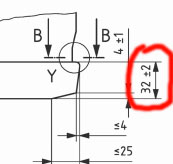
Side view of ISO ski touring boot heel dimensions shown above. Somewhat common issues with AT backcountry skiing boots are things like the binding heel not closing when you step down, or the boot having vertical play once the binding is closed. If you get any of those symptoms, check your dimensions based on the ISO drawing above. For example, see that the vertical thickness of the sole heel is 32 mm +- 3 mm (measure by placing boot on a flat surface and measure up from surface. If your binding is acting funny and your boot is within this spec (many of ours measure at 30 mm) then look at the binding for problems such as having the wrong length or forward pressure set. If the boot is out of spec or at the extreme end of the range, then consider fixes such as grinding to reduce thickness (rarely necessary), or re-soling if your boots are worn from dirt hiking (likely).

Backcountry skiing boots.
ISO boot toe dimensions shown above (side view). One of our pet issues here is that most AT boots could have more rubber at the toe, where most wear happens while walking. As shown in the diagram, this would be easy to accomplish while sacrificing some rocker. Many soles could even be made overall thicker (most of ours measure at around 28 mm), but doing this can be difficult in the case of Dynafit bindings, as the amount of sole below the Dynafit fitting is critical in how the binding operates.

An update to ISO 9523:1990 is in the works. According to sources it’ll have nearly the same if not identical dimensions, but define a sole that has solid areas that work better with binding support points (AFDs). The new standard is 9523:2008 (later digits are the standard’s date).

Comments

6 Responses to “Randonnee AT Ski Touring Boot ISO Standards”

  1. Halsted July 21st, 2008 5:08 pm

    Lou,

    Gee, I can’t make heads of those drawings. Are they for some new part on the space shuttle??? ;-)

    Cheers,
    Halsted

  2. Lou July 22nd, 2008 5:57 am

    Both are side views, after you know that they’re fairly self explanatory. Compared to rando bindings, the space shuttle isn’t that complex (g).

  3. Altis July 22nd, 2008 1:49 pm

    I wish you’d published drawings those six months ago – would have saved me $40! Aren’t they copyrighted though?

    I often wonder why Dynafit didn’t define a hole in the middle of the sole so that the binding arms impinged on a hard bit of plastic instead of wearable rubber.

  4. Lou July 22nd, 2008 2:17 pm

    Altis, the original drawings have some kind of use restriction (not sure it’s really a copyright), but by excerpting them and adding graphic elements, they become a derivative work, especially since I didn’t publish the work as a whole but only a small part. That’s the way I understand it, anyhow. Of course IANAL… It’s a grey area, for sure.

    If necessary, I’ll just re-draw them.

    What happened that cost you $40?

  5. Altis July 22nd, 2008 2:34 pm

    I downloaded ISO 9523:1990 from ansi.org in March and this cost me $40. At the bottom of every page it says “Single user license only. Copying and networking prohibited.” I needed it because I was modding some Flexons for touring and needed to know the maximum thickness of rubber I could use. I reckon 6mm just takes me to the upper limit. However, I found the two forks on the heel of my Fritschi bindings pressed worryingly hard into the rubber. With a belt sander I soon put a big chamfer on the rubber. When house and work are a bit less hectic I’ll put up some photos.

    Of course, what I’d really like is to fit some Dynafit inserts. I have a few ideas but the Dalbello Virus will probably be out before I get around to it!

  6. Lou July 22nd, 2008 2:44 pm

    Yeah, a “user license” is different than a copyright. But either way, a derivative work mucks it up enough so I doubt that my sharing it is a problem. If so, if asked I’ll remove and make my own version.

Got something to say?


Anti-Spam Quiz:

:alien: :angel: :angry: :blink: :blush: :cheerful: :cool: :cwy: :devil: :dizzy: :ermm: :face: :getlost: :biggrin: :happy: :heart: :kissing: :lol: :ninja: :pinch: :pouty: :sad: :shocked: :sick: :sideways: :silly: :sleeping: :smile: :tongue: :unsure: :w00t: :wassat: :whistle: :wink: :wub:

Due to comment spam we moderate most comments. Please do not submit your comment twice -- it will appear shortly after we approve it. Once you've had one comment published, your comments will be pre-approved and appear immediately if you're using the same computer and not blocking browser cookies. NOTE however that ALL comments with one or more links in the text will be held for moderation no matter what, again for spam prevention.
Welcome to Louis (Lou) Dawson's backcountry skiing information and opinion website. Lou's passion for the past forty years has been alpinism, climbing, mountaineering and skiing -- along with all manner of outdoor recreation. He has authored numerous books and articles about backcountry skiing and is well known as the first person to ski down all 54 of Colorado's 14,000-foot peaks, otherwise known as the Fourteeners! Books and free back country information here, and tons of Randonnee rando telemark info.

All material on this website is copyrighted. Permission required for reproduction, electronic or otherwise. That includes publication and display on other websites by whatever means. PLEASE SEE OUR COPYRIGHT INFORMATION.

Backcountry skiing is a dangerous sport. You may be killed or severely injured if you do any form of randone, randonnee and randonnée skiing. The information on this website is intended only as general information. While the authors and editors of the information on this website make every effort to present useful information, due to human error the information, text and images contained within this website may be inaccurate, false, or out-of-date. By using, reading or viewing the information provided on this website, you agree to absolve the owners of Wild Snow as well as content contributors of any liability for injuries or losses incurred while using such information. Furthermore, you agree to use any of this website's information, maps, photos, or binding mounting instructions or templates at your own risk, and waive Wild Snow its owners and contributors of any liability for use of said items for backcountry skiing or any other use.